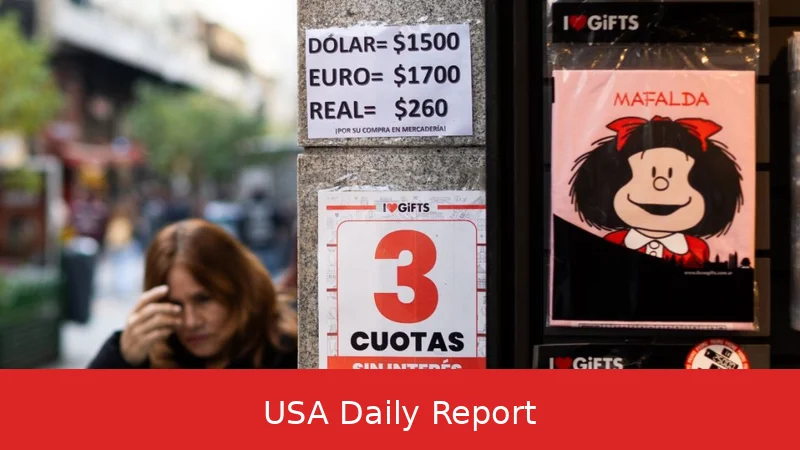
Argentina's central bank has cut interest rates from record highs, but the move has pushed rates below the country's soaring inflation. The peso’s sharp decline and government intervention are shaking markets and raising concerns over the economy’s stability.
Peso Weakens as Government Adjusts Strategy
The Argentine peso took a sharp tumble last week, dropping about 4% in just one day before continuing its slide. President Javier Milei’s government surprised markets by allowing the currency to weaken, stepping back from aggressive dollar sales that had cost the Treasury roughly $100 million a day.
Officials had been propping up the peso ahead of a crucial provincial election, but following Milei’s party’s defeat, the Treasury reduced its dollar interventions. Economy Minister Luis Caputo explained that the government pulled back as market liquidity normalized after election-related disruptions.
Still, the central bank didn’t just stand by. It intervened by selling overnight repos and reviving dollar futures sales to soak up liquidity and soften the peso’s fall. But those tools are running out. Treasury dollar deposits have plunged below $1.1 billion, and futures contracts are nearing a $9 billion legal ceiling.
Interest Rates Dip While Inflation Remains High
Local interest rates have dropped from their record highs of 35%, but they remain below the inflation rate, which analysts estimate at around 7.5% monthly for April.
That means real interest rates are negative — investors are essentially losing money when adjusted for inflation.
The official consumer price index for April won't be released until mid-May, but private economists and government insiders agree inflation is still running hot. The first four months of 2023 have seen an accumulated inflation of roughly 30%, with little sign of easing soon.
Inflation’s persistence makes the central bank’s efforts. Normally, high rates help attract investment and stabilize the currency. But when rates lag behind inflation, confidence erodes and money leaving the country accelerates, putting more pressure on the peso.
Markets React Amid Regional and Global Turbulence
Argentina’s stock market also felt the pain, with the Merval index losing 2.58% on Thursday. Key companies like ALUA, Transportadora Gas del Norte, and Banco BBVA Argentina dragged the market down.
Latin American markets overall were mixed, with Colombia’s Colcap index posting small gains and Chile and Peru showing slight increases. But uncertainty in Argentina’s economy weighed heavily on investor sentiment.
On Wall Street, turmoil in the banking sector added to market jitters. Several regional banks saw steep losses, triggering trading halts amid fears of further financial instability. The KBW Bank Index, which tracks major US banks, retreated across the board, capping the S&P 500’s losses and signaling broader unease.
Government Options Narrow as Crisis Deepens
Economic consultants warn the government’s set of tools to support the peso and control inflation is shrinking fast. Gabriel Caamaño of Outlier consultancy pointed out that the central bank’s futures contracts are near their legal limit, and Treasury reserves are dangerously low.
Allowing the peso to slide moderately might be a strategic move to avoid a full-blown currency crisis. But it risks fueling inflation further and undermining already fragile investor confidence.
Pedro Martínez from PxQ consultancy sees the government’s messaging as contradictory. Officials deny policy shifts while quietly changing tactics, which could confuse markets more than reassure them.
Bottom line: Argentina remains stuck with no good options. The peso can't weaken much more without breaching government limits. Yet, propping it up demands resources that are running out. Interest rates below inflation add another layer of risk, threatening to deepen money leaving the country and economic instability.
As inflation stays stubbornly high and the peso continues its downward march, Argentina’s economic outlook is deeply uncertain. The government’s limited intervention tools and negative real interest rates raise questions about how long stability can last.