The Japanese yen briefly touched 159.45 against the dollar last week. That's an 18-month low, and it's putting the Bank of Japan in a tough spot. The central bank recently hiked rates, but the yen's slide continues to pressure its next moves.
BOJ's Tightrope Walk
Japan's central bank wrapped up its final policy meeting of 2025 in December with a big move. It raised benchmark interest rates to 0.75%, the highest point in 30 years. The decision marked a step toward normalizing monetary policy, a process the BOJ started last year.
Thing is, that hike didn't fully calm the waters. Investors are now looking for hints about when the BOJ might tighten policy again, not if. LSEG data showed an 86.4% chance of that December hike, but the market's focus has quickly shifted to what comes next.
A rate hike usually strengthens a currency, and it's meant to help contain inflation. Japan's consumer prices have run above the BOJ's 2% target for 44 straight months.
But a stronger yen could also further slow an already weak Japanese economy. Revised GDP numbers showed Japan's economy shrank more than expected in the third quarter, contracting 0.6% quarter-on-quarter and 2.3% on an annualized basis.
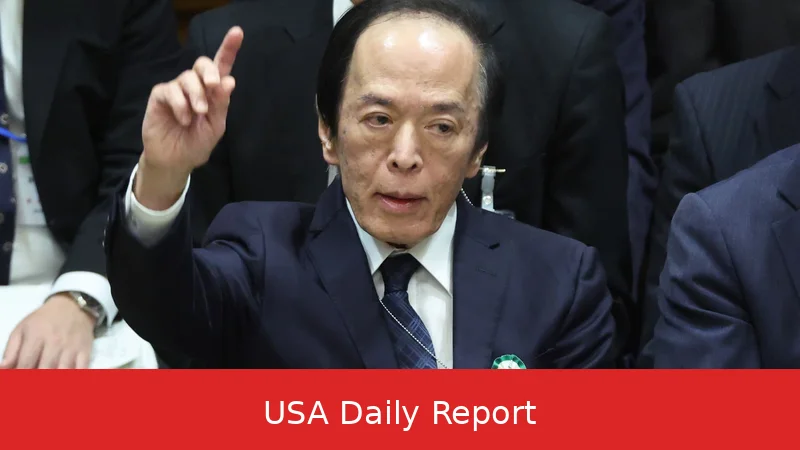
So, the BOJ faces a balancing act. It needs to curb inflation without suffocating economic growth. Governor Kazuo Ueda has a tough job ahead.
The Yen's Slide and the 160 Watch
The yen's continued depreciation is a major headache for Tokyo. It pushes up the cost of imports, which then feeds into higher consumer prices.
This is happening even as climbing government bond yields independently tighten financial conditions.
Citigroup strategist Akira Hoshino sees 160 yen to the dollar as a potential trigger point. He predicts the BOJ could raise rates by a quarter-point to 1% in April if the dollar climbs past that level. He then sees another hike in July, and possibly a third before the year ends, assuming the yen stays weak. "Put simply," Hoshino said, "the yen's weakness is being driven by negative real interest rates." That means borrowing costs aren't keeping pace with inflation, making the yen less attractive.
The currency briefly hit 159.45 last week. It's since pulled back some, sitting around 158.18.
But the threat of 160 looms large.
Political Shake-Up Adds Uncertainty
Adding to the complexity is a snap election called for February by Prime Minister Sanae Takaichi. She announced the plans and repeated calls to cut Japan's consumption tax. This political shake-up has investors watching closely to see how the BOJ will react.
Analysts warn that a looser fiscal policy, like tax cuts, could fuel inflation even more. That would likely push the BOJ toward further rate hikes.
But a Takaichi victory could also strengthen calls from her advisors who want to keep borrowing costs low. Ayako Fujita, Japan chief economist at JPMorgan Securities, noted, "Whether the recent yen depreciation will prompt a change in this stance is a key point to watch."
Bond markets are already reflecting these worries. The 10-year Japanese government bond yield surged to 2.30% earlier this week, hitting a 27-year peak.
Concerns over Japan's fiscal outlook are mounting, making investors nervous about government debt.
The Elusive "Neutral Rate"
The Bank of Japan also faces a challenge in communicating its long-term policy goals. Governor Kazuo Ueda said earlier this month it's hard to estimate the "neutral rate" — the rate that balances inflation and economic growth. The central bank pegs it roughly between 1% and 2.5%.
"Unfortunately, the neutral rate of interest is a concept for which we can only produce an estimate with quite a wide range," Ueda told Japan's parliament. He explained that the BOJ has to guide monetary policy without a clear fix on where that rate exactly sits.
Carl Ang, a fixed income research analyst at MFS Investment Management, thinks an updated estimate might come after the next meeting. This lack of clarity adds another layer of difficulty for market participants trying to predict the BOJ's long-term trajectory.
Policymakers inside the BOJ are expected to raise their growth forecasts. But balancing a weak economy, stubborn inflation, a sliding yen, and now political uncertainty means Governor Ueda's upcoming press conference could shake markets even more than the rate decision itself.