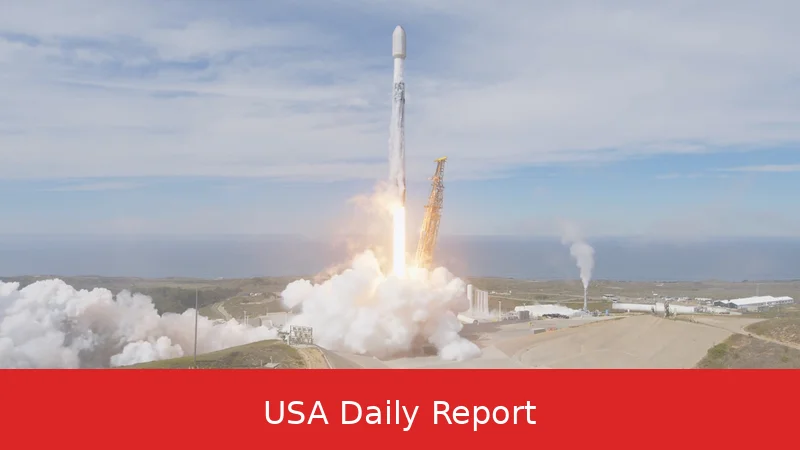
SpaceX achieved a significant milestone this week, surpassing 10,000 active Starlink satellites in low Earth orbit, coinciding with a rapid succession of Falcon 9 rocket launches from both California and Florida.
California Launch Marks Starlink Milestone
The company confirmed its Starlink constellation reached more than 10,000 satellites operating simultaneously in low Earth orbit following a late-night launch from California. This achievement comes less than seven years after SpaceX deployed its initial batch of Starlink satellites in May 2019, highlighting the aggressive pace of its network expansion.
The mission, designated Starlink Group 17-24, lifted off at 10:19:09 p.m. PDT on Monday, March 16 (1:19:09 a.m. EDT on Tuesday, March 17) from Space Launch Complex 4 East at Vandenberg Space Force Base. The Falcon 9 rocket carried 25 Starlink satellites on a southerly trajectory. This marked the 17th orbital launch from Vandenberg so far in 2026.
The first stage booster, identified as B1088, completed its 14th flight. This veteran booster had previously supported missions including NASA's SPHEREx, Transporter-12, two National Reconnaissance Office payloads, and nine prior Starlink deployments. About eight minutes after liftoff, B1088 executed a precise landing on the drone ship 'Of Course I Still Love You,' stationed in the Pacific Ocean. This was the 184th landing for that vessel and the 586th booster recovery for SpaceX overall.
Coincidentally, this milestone launch occurred exactly 100 years after Robert Goddard launched the world's first liquid-propelled rocket, which used gasoline as fuel. A century later, SpaceX's Monday night mission represented the 615th flight of its kerosene-fueled Falcon 9 rocket, demonstrating the vast evolution of rocketry.
Florida's Space Coast Stays Busy
Florida’s Space Coast has also seen a flurry of activity, with two SpaceX Starlink missions scheduled for this week from Cape Canaveral. The region set a new record in 2025, hosting 109 orbital rocket launches, and has already seen 18 launches in 2026 as of Monday, March 16.
One of these missions, Starlink 10-46, successfully launched on St. Patrick's Day, Tuesday, March 17, from Launch Complex 40 at Cape Canaveral Space Force Station. Liftoff occurred at 9:27 a.m. EDT, sending 29 Starlink V2 Mini Optimized satellites into low Earth orbit on a north-easterly trajectory. The 45th Weather Squadron had forecast a 75 percent chance of favorable conditions, despite monitoring for strong liftoff winds and cumulus clouds.
The Falcon 9 first stage booster for this mission, B1090, made its 11th flight. Its past missions included Crew-10, Bandwagon-3, and CRS-33. Just under 8.5 minutes after launch, B1090 landed on the drone ship 'A Shortfall of Gravitas,' positioned in the Atlantic Ocean. This marked the 147th landing on that particular vessel and SpaceX's 587th booster recovery to date, further illustrating the routine nature of the company's reusability efforts.
Another Starlink mission, Starlink 10-33, is slated for Thursday, March 19. This launch will also send 29 Starlink satellites into low Earth orbit from Launch Complex 40 at Cape Canaveral Space Force Station. The launch window is scheduled from 6:36 a.m. to 10:35 a.m. ET, with a northeast trajectory expected. Depending on factors like weather and trajectory, rocket launches from Florida's Space Coast can be visible as far north as Jacksonville and as far south as West Palm Beach, with some Falcon 9 rockets even spotted in other states.
Starlink's Unprecedented Scale
The sheer volume of SpaceX's Starlink constellation sets it apart in the satellite industry. The company has maintained an aggressive launch cadence in 2026, averaging a Falcon 9 launch every 2.3 days. Of its 33 Falcon 9 launches this year, 26 have been dedicated to deploying Starlink satellites.
This rapid deployment strategy supports a rapidly growing customer base. As of February 13, 2026, Starlink reported over 10 million active customers spread across 160 countries, territories, and other markets. In the month following that announcement, the service expanded its connectivity to Niue, Kuwait, and the Central African Republic.
Back in October 2025, when SpaceX crossed the threshold of 10,000 Starlink satellites launched (with approximately 8,600 concurrently in orbit at the time), expert orbital tracker and X-ray astronomer Dr. Jonathan McDowell called it a "truly remarkable" achievement. He emphasized the advanced technical capabilities required to manage such a vast network, noting the tens of thousands of avoidance maneuvers the system performs annually to prevent collisions. Dr. McDowell highlighted this as a significant technical feat, regardless of individual perspectives on SpaceX or its personnel.
Continued Momentum in Space
The high frequency of SpaceX's launches is a defining characteristic of the current space industry. While Starlink missions dominate the schedule, Florida's space enthusiasts also anticipate other significant events. These include NASA's Artemis II crewed moon mission and Blue Origin's next New Glenn rocket launch, both contributing to a dynamic and expanding era of space exploration and commercial activity.
SpaceX continues to push the boundaries of orbital deployment and reusability, with its 587th booster landing solidifying its operational efficiency.