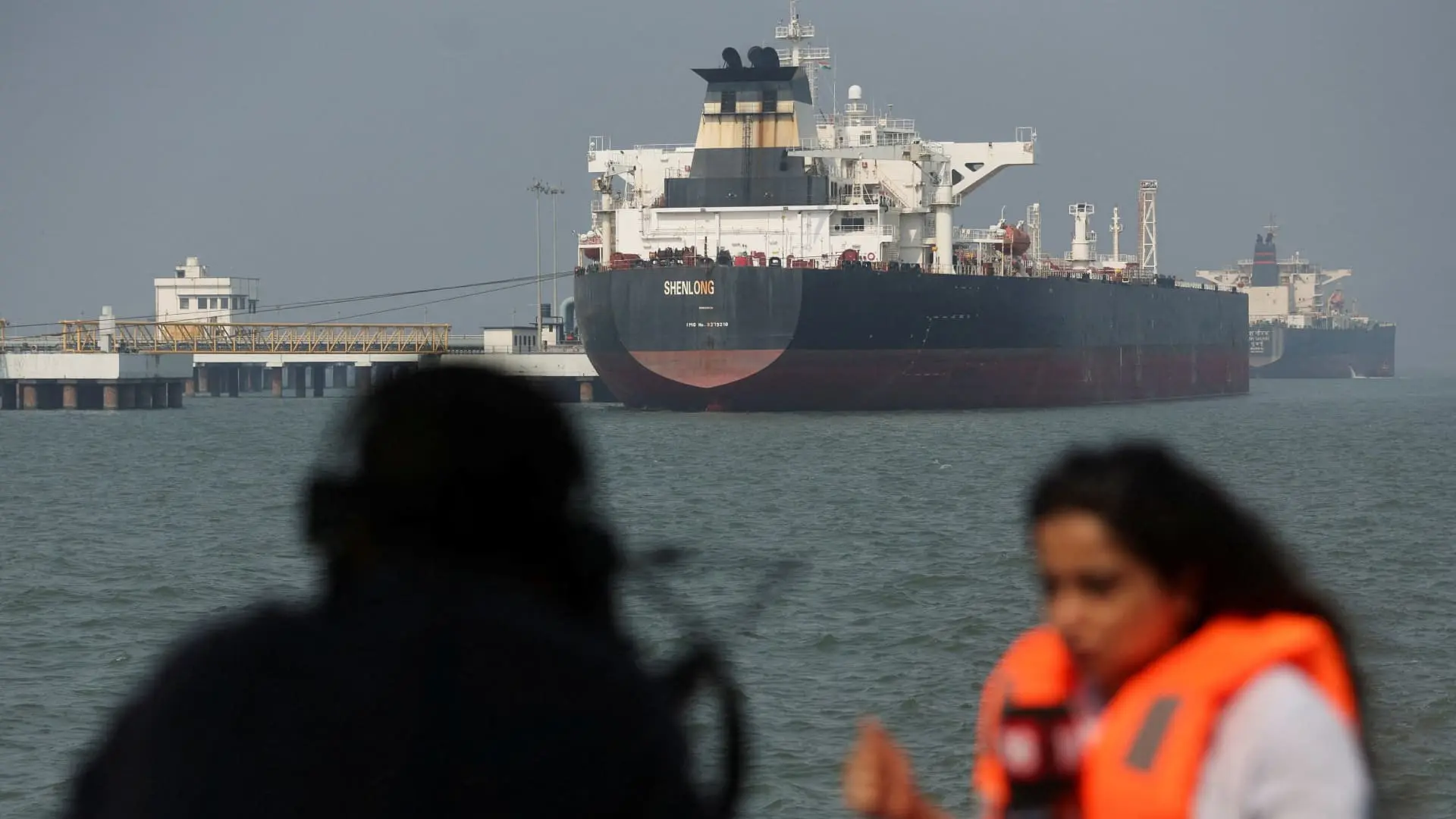
Brent crude, the global oil benchmark, surged past $106 a barrel this week, despite an unprecedented release of emergency stockpiles, as the effective closure of the critical Strait of Hormuz continued to disrupt global supply. The ongoing Iran war has choked a vital waterway, sending oil prices soaring and fueling fears of a broader economic slowdown.
The Strait of Hormuz—bordered by Iran, Oman, and the UAE—normally carries about one-fifth of global oil. It has seen shipping traffic grind to a near halt since the Iran war began on February 28.
Saudi Arabia, Iraq, Kuwait, and the UAE shipped roughly 14 million barrels daily through the region before the conflict. Pipelines to the Red Sea and Gulf of Oman can handle 5-6 million bpd, but that leaves 9 million bpd stuck. This represents a substantial 10% of global supply that cannot pass through the chokepoint.
The UK Maritime Trade Operations center shows shipping has collapsed. Only five ships per day have transited the Strait since the war started, a dramatic decrease from the historical average of 138 daily passages. At least 16 commercial vessels have come under attack in the region during the conflict.
Emergency Measures Fall Short
The IEA—which represents over 30 nations—announced its biggest emergency oil release in 50 years. Member countries in Europe, North America, and Northeast Asia committed to flooding the market with 400 million barrels of crude.
The United States leads this effort, pledging 172 million barrels from its Strategic Petroleum Reserve, accounting for 43% of the IEA’s total contribution. This US release will occur over a 120-day period, translating to about 1.4 million barrels per day hitting the market.
But traders aren't buying it. Crude prices have surged more than 17% since the IEA announced the emergency stockpile release last Wednesday. Brent crude closed above $100 a barrel for two consecutive sessions last week, a level not seen in four years, and then topped $106 a barrel on Sunday.
The reason is straightforward. The daily volume of oil disrupted by the Strait of Hormuz closure, estimated at 9 million bpd, far outweighs the 1.4 million bpd the US can release. Tom Liles, senior vice president of upstream research at Rystad Energy, pointed out that while 400 million barrels might seem to cover 40 days of lost supply, the reality is more complex. "There's only a limited amount of volume that can be released over a given period. It's not as if 400 million barrels just appear immediately on the market," Liles said.
And there's a 13-day lag before those barrels even hit the market. That delay, plus the massive supply gap, means the emergency release barely moves the needle on prices.
Political Tensions Escalate
US President Donald Trump has actively sought to rally international support to reopen the Strait of Hormuz. He called on other countries, including China, Japan, France, and the UK, to help Washington secure the waterway.
But Trump's getting the cold shoulder. None of the nations he appealed to by name have publicly committed to deploying their navies to protect shipping in the strait. Japan and Australia both confirmed on Monday they had no plans to send ships to the critical waterway.
In an interview with The Financial Times, Trump warned that NATO would face a "very bad" future if his proposal received "no response, or if it's a negative response." He has repeatedly stated his willingness to deploy the US Navy to escort commercial shipping if necessary, though administration officials have indicated such operations might wait until Iran's military capacity is further degraded.
Trump also threatened Iran over the weekend. He told NBC News that US strikes on Iran's Kharg Island had "totally demolished" most of the island. He then warned that the US might strike crude facilities on the island if Iran continued its attacks on tankers in the Strait of Hormuz, adding, "we may hit it a few more times just for fun."
Economic Fallout Widens
Oil's up more than 40% since the conflict started. This sharp increase directly translates to higher fuel prices for consumers and businesses worldwide, adding significant pressure to already strained global economies.
Sustained high energy costs risk triggering a global slowdown. Companies see higher operating costs; consumers pay more at the pump and for everything else. The International Energy Agency has characterized the disruption to global energy supplies as the largest in history.
As international benchmark Brent crude futures for May delivery traded 1.5% higher at $104.72 per barrel on Monday, and US West Texas Intermediate futures for April delivery advanced to $98.91, the market continued to reflect deep concern over the unresolved geopolitical tensions and their direct impact on energy flows.
With no end in sight for the Strait closure, oil stays above $100 and shows no sign of falling.