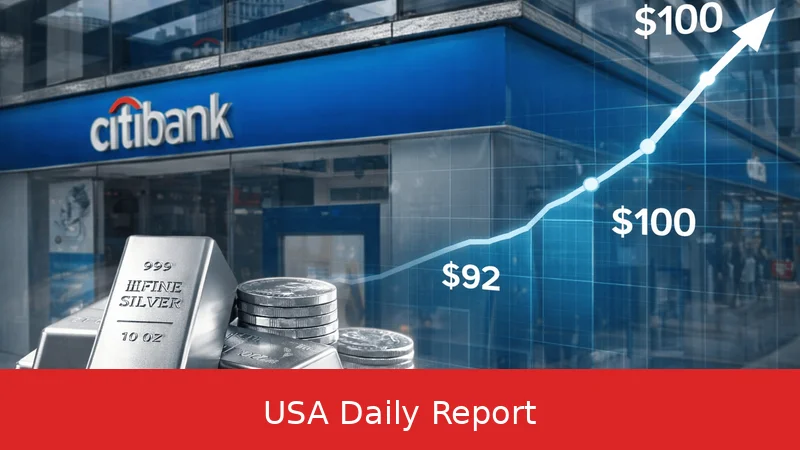
Silver prices just shattered records this week, climbing above $92 an ounce for the first time ever. Now, Citigroup says the white metal could hit $100 by March, driven by tight supply and a surge in investor anxiety over global stability.
Silver's Explosive Rally
The precious metal has been on a tear, more than doubling its value in just four months. It's up roughly 180% over the past year, a stunning move that analysts attribute to a perfect storm of supply shortages and accelerating demand. We're seeing a big annual deficit in the silver market, around 200 million ounces. Plus, mine production isn't keeping up, growing at just 1-2% each year.
Industrial demand is a big part of the story. Solar panels alone now eat up 15% of the global silver supply. And that's not all. New demand from AI hardware and electric vehicle batteries is adding even more pressure to an already strained market. This matters because it creates a fundamental imbalance that pushes prices higher.
Citi's Bold Price Target
Citigroup just dropped a headline-grabbing forecast: silver could reach $100 per ounce by March. They even see it potentially climbing to $110 by the second half of 2026. This isn't just a wild guess; it reflects an acute shortage of physical silver.
COMEX registered inventories, for example, have plummeted over 70% since 2020. That's a huge drop. And as we mentioned, industrial demand keeps accelerating. Citi isn't alone in its bullish outlook, either. BNP Paribas also thinks $100 is possible by the end of the year. GoldSilver's Alan Hibbard believes 2026 could even outperform last year's 147% gain.
To be fair, there was some volatility recently. Silver's 147% surge in 2025 triggered index rebalancing, which led to a $6.8 billion futures selling spree this month. But the underlying story hasn't changed. Tight supply, surging industrial use, and demand for safe-haven assets are all still very much intact. If Citi is right, we're still in the early stages of this rally.
Gold Miners Join the Party
Gold is also having a moment, with prices breaching $4,630 per ounce. Major banks like Goldman Sachs and JP Morgan have revised their targets upward, now calling for gold to hit $5,000 by the end of 2026. Central banks keep buying, and geopolitical risks are piling up, fueling this demand.
Higher gold prices mean more cash flow for producers. With fixed operating costs, every dollar above the breakeven point drops straight to the bottom line. Newmont, for instance, forecasts 5.6 million ounces of production this year. That's a lot of potential profit. Gold miners are seeing big gains, too. Newmont hit an all-time high of $106 this week. Barrick's shares have surged over 180% since early 2025.
Mounting Global Anxieties Fuel Demand
This rally in precious metals reflects deeper anxieties across the global financial system. Concerns about currency debasement, the independence of the Federal Reserve, and overall global instability are all playing a role. Investors are piling into gold and silver as a hedge against these risks.
We saw a glimpse of this instability in April when the US Administration announced new tariffs. That caused a spike in financial market volatility and tested already stretched market valuations. Even though expectations for those tariff rates have eased a bit since then, the repercussions are still reverberating. The risks of an economic slowdown have increased markedly.
Financial markets around the globe sold off at an unsettling speed in early April. Financial conditions tightened considerably. While risky assets have recovered some losses after temporary tariff pauses were announced, markets remain highly sensitive to news about global trade arrangements. This abrupt change in US tariff policy is part of a larger shift in the geopolitical environment. That shift has economic and financial impacts that could still test financial stability, especially in places like the euro area.
Uncertainty hangs over many important policy domains beyond just trade. We're talking regulation, national security, and more. In this kind of environment, the likelihood of more frequent and impactful adverse tail events has gone up. The European Central Bank, for example, noted that while global imbalances are a long-standing issue, it's not clear tariffs are the best way to fix them.
The ECB's May 2025 Financial Stability Review also pointed out some other worries. Equity valuations remain high, and credit spreads still seem out of sync with underlying credit risk. Open-ended funds that invest in corporate bonds have seen some outflows. They don't appear well-prepared to handle significant liquidity stress. If renewed turmoil hits, these funds might be forced to sell assets, potentially turning price swings into more disorderly adjustments.
The euro area is an open economy, and its firms are deeply integrated into global supply chains. So, trade frictions hit their revenues and costs directly. Plus, adverse confidence effects could make market players act more cautiously. That could affect sectors less exposed to tariffs, putting pressure on credit risk management for euro area financial intermediaries. And if economic growth falls short, government finances — already strained by higher defense spending needs — could face even more pressure.
With these kinds of risks mounting globally, and fundamental supply issues persisting, many analysts expect gold and silver to keep shining in 2026 and beyond.