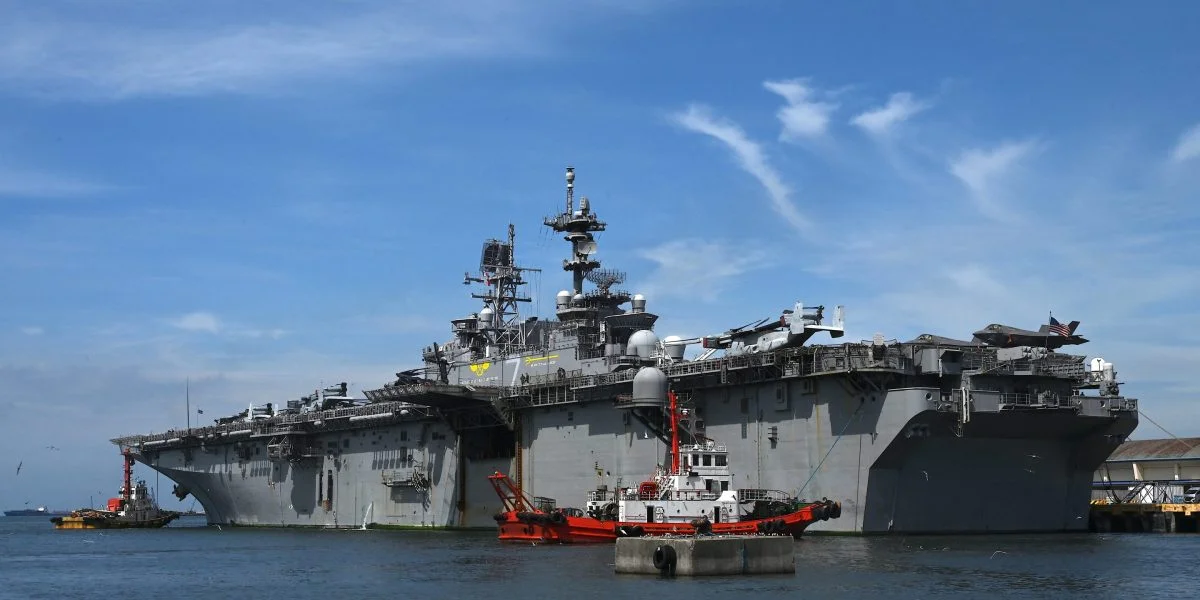
The United States has ordered the amphibious assault ship USS Tripoli and approximately 2,500 Marines to the Middle East, significantly boosting its military presence in the region as the conflict with Iran enters its third week.
Major Shift in US Military Posture
The deployment, confirmed by a U.S. official on Friday, marks a critical reallocation of forces previously operating in the Pacific. Elements of the 31st Marine Expeditionary Unit (MEU), along with the USS Tripoli, were pulled from waters near Taiwan, where they had been engaged in exercises. This move underscores the escalating tensions and the severity of the ongoing war that has rattled the global economy and shows no sign of abating.
For nearly two weeks, the region has been gripped by intense fighting. Iran has continued to launch widespread missile and drone attacks against Israel and neighboring Gulf states. Meanwhile, U.S. and Israeli warplanes have pounded military and other targets across Iran. The conflict has also seen Iran effectively close the Strait of Hormuz, a crucial choke point through which a fifth of the world’s traded oil passes, exacerbating global economic concerns.
The humanitarian crisis in Lebanon has deepened dramatically. Israel has launched waves of strikes against Iran-backed Hezbollah militants, leading to nearly 800 deaths and displacing 850,000 people. Israel has warned of no let-up in its operations there.
The USS Tripoli and Its Amphibious Ready Group
The USS Tripoli (LHA-7) is a state-of-the-art America-class amphibious assault ship, designed to carry and deploy a Marine Expeditionary Unit. It's capable of supporting a wide range of operations, from amphibious landings to disaster relief. The ship, along with its associated Amphibious Ready Group (ARG), was initially assigned to the 7th Fleet in the U.S. military's Indo-Pacific Command (INDOPACOM) area of responsibility, based out of Japan.
The ARG accompanying the Tripoli is a formidable naval force. It includes the USS New Orleans (LPD-18), an amphibious transport dock, the Ticonderoga-class guided-missile cruiser USS Robert Smalls (CG-62), and the Arleigh Burke-class guided-missile destroyer USS Rafael Peralta (DDG-115). This group provides comprehensive capabilities for air defense, surface warfare, and the projection of power ashore.
The 31st Marine Expeditionary Unit, headquartered in Okinawa, Japan, is a self-contained, air-ground task force. It comprises over 2,000 Marines equipped for a variety of missions. These units specialize in amphibious landings, but also conduct embassy security, civilian evacuations, and humanitarian aid. The deployment of such a unit, however, does not necessarily signal an imminent ground operation.
Capabilities and Strategic Implications
The USS Tripoli's air wing significantly enhances the MEU's operational reach and combat power. It carries F-35 Lightning II fighter jets, MV-22B tilt-rotor transports, AH-1Z Viper attack helicopters, UH-1Y Venom attack/utility helicopters, MH-60S utility/search and rescue helicopters, and CH-53E/K Stallion transport helicopters. These aircraft, combined with sea-based landing craft, enable rapid deployment and support of Marines in coastal and littoral environments.
The transfer of the Tripoli ARG represents one of the most significant assets moved from INDOPACOM's inventory to the Middle East thus far. Previously, the U.S. had primarily shifted air-defense assets, including THAAD and Patriot battery components, from Korea to the region. This latest deployment signals a more robust commitment of conventional forces.
Potential missions for the newly arrived forces remain broad. They could involve bolstering security at U.S. diplomatic facilities, conducting non-combatant evacuations, or providing a deterrent presence. There is also speculation about potential roles in interdicting Iranian mining or interdiction efforts in the Strait of Hormuz, or even securing outlying Iranian islands to maintain freedom of navigation.
Escalating Regional Tensions
The deployment comes amidst heightened regional volatility. In the Iranian capital, a large explosion recently rocked a central square where thousands had gathered for a state-organized rally supporting Palestinians and calling for Israel’s demise. Israel had warned it would target the area in central Tehran, though there were no immediate reports of casualties. The decision to proceed with the mass demonstration, attended by senior government officials, and Israel’s threat, underscored the fierce determination on both sides of the conflict.
President Donald Trump, in an interview with Fox News, stated the war would end “when I feel it in my bones.” He also expressed a measured view on the prospect of opponents toppling the Islamic government. Trump noted that it would be “a big hurdle to climb for people that don’t have weapons,” citing Iran’s paramilitary Basij force, which has been instrumental in crushing recent nationwide protests.
Related Articles
- Austin Wells' Walk-Off Homer Propels Dominican Republic to WBC Semifinals, Ties Home Run Record
- Over 120,000 Hawaiian Electric Customers Face Overnight Outages Amid Severe Storm
- Struggling Puebla, Necaxa Play to Scoreless Draw in Liga MX Clash
Commercial satellites have already spotted the USS Tripoli sailing alone near Taiwan, placing it more than a week away from the waters off Iran, indicating a lengthy transit for its critical mission.