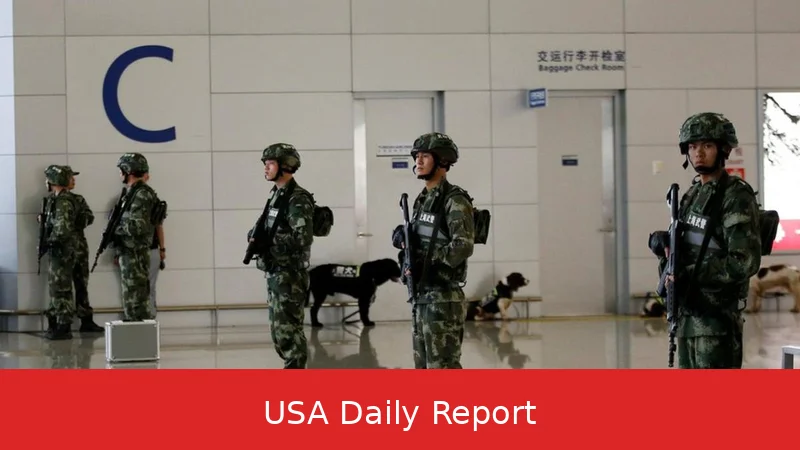
A homemade explosive device detonated at Shanghai's Pudong International Airport this weekend, injuring four people, while an ongoing investigation by the National Transportation Safety Board (NTSB) continues into a natural gas leak that caused a house explosion in Centreville, Virginia, underscoring the diverse and often sudden nature of such devastating events.
International Incident Rocks Shanghai Airport
The incident at Shanghai Pudong International Airport unfolded around 3:00 PM local time on Sunday, sending shockwaves through Terminal Two. Chinese officials confirmed a man ignited a homemade explosive device near a check-in counter, wounding four individuals along with himself. Eyewitness Ni Bowen described a loud bang, recalling a beer bottle filled with white smoke rolling past her feet. She quickly fled the area in fear.
After the initial explosion, the attacker reportedly took out a knife and stabbed himself in the neck. All four victims suffered light wounds and are currently receiving treatment in a hospital. The assailant, whose identity hasn't been released, remains in critical condition.
Attacks like this in airports obviously raise serious security questions. Airports worldwide have strict security measures, but homemade explosives remain a persistent threat. This isn't the first time a Chinese airport has faced such an attack. In 2013, a man in a wheelchair detonated a bomb at Beijing Airport, citing a personal grievance. He later received a six-year prison sentence for that act.
The Shanghai attack raises doubts about whether security can stop someone truly bent on violence in crowded spaces. The immediate aftermath at Pudong was chaotic, with travelers scrambling for safety and emergency services quickly responding. Security personnel locked down the area, and flights experienced delays as authorities investigated the scene.
These incidents shake travelers' confidence and expose gaps even in well-guarded airports. We don't know why he did it, but stabbing himself suggests he was in serious psychological distress. Investigators will probably examine the bottle bomb to figure out how dangerous it was and whether it matches other attacks. The incident serves as a stark reminder of the constant vigilance required to safeguard public infrastructure against both targeted attacks and spontaneous acts of violence.
Gas Leak Triggers Virginia Home Blast
Across the globe, in Centreville, Virginia, residents are grappling with the aftermath of a different kind of explosion—one caused by a natural gas leak. The National Transportation Safety Board (NTSB) has launched a thorough investigation, releasing a preliminary report detailing the timeline of the gas leak that ultimately destroyed a house. While specific details of the timeline were not immediately public, the NTSB's involvement signifies the severity and complexity of the incident.
The NTSB investigates plane crashes, some highway and rail accidents, pipeline failures, and hazmat incidents. Its role is crucial in determining the probable cause of such events and issuing safety recommendations to prevent future occurrences. Gas explosions aren't common, but they're devastating—they can destroy entire houses and threaten neighbors.
Investigators dig through gas lines, pressure data, maintenance logs, and what people saw. Figuring out exactly what happened—from leak to blast—matters for gas companies and regulators trying to prevent the next one. Such incidents typically lead to property damage across a wider radius than just the immediate blast site, with debris scattering and structures potentially being compromised. For the Centreville community, the NTSB's findings will be critical in understanding what went wrong and how similar tragedies can be averted.
Natural gas is cheap and efficient, but it's flammable and has no smell on its own. Gas companies add mercaptan—a chemical that smells like rotten eggs—so you can smell a leak. But leaks can slip past you, especially underground or trapped in closed rooms. One spark from a stove, light switch, or static—and it all goes up.
Neighbors probably had to evacuate fast while firefighters locked down the area and looked for more danger. People who lost homes carry scars that go way deeper than the wreckage. When the NTSB releases its final report, it could force gas companies to fix how they run pipes and connect homes—protecting everyone.
The Silent Internal 'Explosion': A Doctor's Ordeal
Not all "explosions" manifest as physical blasts. For Dr. Bernadette Hard, a 53-year-old physician from Rudry near Caerphilly, the sensation was intensely internal, a terrifying feeling that her head was literally going to explode. This harrowing experience occurred in 2022 while she was attending a medical conference alone in her hotel room in Malta. The headache was so severe, she could barely move.
"I felt like my head was going to explode then surprisingly it actually did," Dr. Hard recounted. She was rushed to a local hospital, where she would remain for a month. Doctors diagnosed her with a rare condition: a leak in the sac containing the cerebrospinal fluid (CSF) that protects the brain and spinal cord. This critical fluid cushions the brain, and a leak can lead to debilitating symptoms, including severe headaches, nausea, and neurological issues.
Her condition necessitated state-of-the-art surgery to repair the leak. The rarity of her diagnosis became evident upon her return home, where even her own general practitioner was unfamiliar with the ailment. Dr. Hard's ordeal highlights the often-invisible battles individuals face with their health, where internal bodily processes can feel as catastrophic and sudden as an external explosion. It underscores the challenges of diagnosing and treating rare diseases, even within the medical community.
The experience of a CSF leak can be profoundly disorienting and painful, often mimicking other neurological conditions, which makes accurate diagnosis challenging. The pressure changes in the brain caused by the fluid loss can lead to orthostatic headaches, meaning they worsen when standing and improve when lying down. For a medical professional like Dr. Hard to encounter a condition so obscure that her own GP hadn't heard of it speaks volumes about the specialized nature of medicine and the continuous need for research and awareness regarding rare illnesses. Her recovery journey involved not only complex surgical intervention but also a period of careful recuperation, emphasizing the body's delicate balance and its capacity for profound internal crises. Her story serves as a powerful testament to personal resilience in the face of a hidden, internal "explosion" that demanded immediate and expert medical attention.
The attacker in Shanghai remains in critical condition.