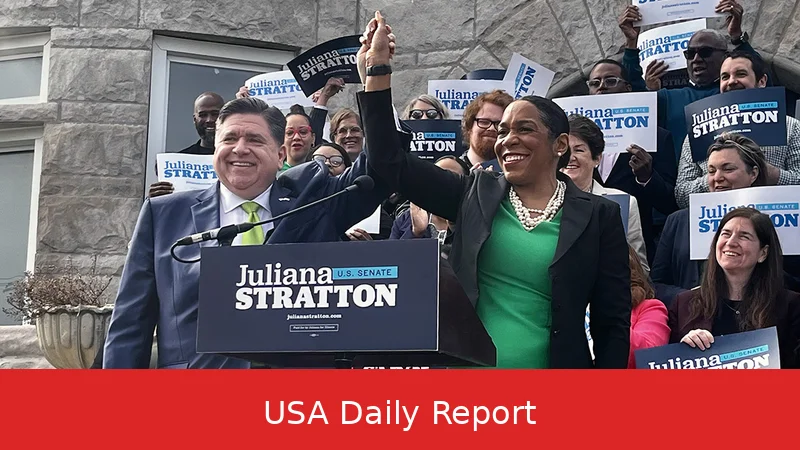
Lieutenant Governor Juliana Stratton is locked in a tight Democratic primary battle for Illinois' open U.S. Senate seat, facing off against two House members in a contest shaped by massive outside spending and a controversial posthumous endorsement ahead of the March 17 vote.
A Pivotal Primary Battle
Illinois' rare open Senate seat has drawn intense attention, pitting Lt. Gov. Juliana Stratton against House members Raja Krishnamoorthi and Robin Kelly. The winner of this primary is widely expected to succeed retiring Democratic Senator Dick Durbin, a vocal critic of the cryptocurrency industry, given Illinois' deep-blue political leanings.
It's the first open Illinois Senate seat since Peter Fitzgerald retired in 2004—20 years of continuity broken. Senator Dick Durbin, a fixture in national Democratic leadership as the Senate Majority Whip, has held his seat since 1997. Durbin's exit leaves a power vacuum, and candidates are scrambling to fill it. Illinois, a reliably "deep-blue" state, has not elected a Republican to the U.S. Senate since Fitzgerald's victory in 1998 and has consistently voted for Democratic presidential candidates since 1992. So whoever wins the Democratic primary will almost certainly win the general election—which is why this primary matters so much. Stratton's the establishment pick with executive credentials. Krishnamoorthi's the moderate tech guy from the suburbs. Kelly represents the urban progressive wing.
Polls show Stratton and Krishnamoorthi neck-and-neck, while Kelly lags behind. In this environment, every move and dollar matters in the final stretch.
The Money Factor: Pritzker vs. Crypto
The primary has become a significant test of influence for two major financial forces within Democratic politics: the cryptocurrency industry and Illinois Governor JB Pritzker. A super PAC named Fairshake, funded by crypto interests, has poured nearly $10 million into supporting Krishnamoorthi, one of the leading candidates.
The crypto industry's $10 million bet on Krishnamoorthi shows how serious it is about getting friendly faces into Congress. After FTX and other blowups, plus SEC crackdowns, the industry wants Congress to write rules it can actually live with. Krishnamoorthi's tech background makes him look like a friendlier ear than Durbin, who's been openly skeptical of crypto.
On the other side, a super PAC bankrolled by Governor Pritzker—a billionaire and potential 2028 presidential contender—and his family has spent even more, nearly $12 million, to back Stratton. Pritzker himself has directly donated at least $5 million to the Illinois Future PAC, which has run ads accusing Krishnamoorthi of being soft on ICE (Immigration and Customs Enforcement) funding, citing his past votes. Pritzker's $12 million counter-punch through Illinois Future PAC is just as calculated. By pouring money behind Stratton, his own lieutenant governor, Pritzker's flexing his muscle and cementing his grip on Illinois Democrats. The race has become a proxy war—Pritzker proving he can pick winners and reward allies, skills he'll need if he runs nationally. Super PACs can run attack ads that campaigns won't touch, letting candidates keep their hands clean while the damage gets done.
The Posthumous Endorsement Controversy
Adding another layer of complexity and intrigue to the primary was the controversial "posthumous" endorsement of Juliana Stratton by civil rights icon Rev. Jesse Jackson Sr. In late February, Jackson's team announced he'd backed Stratton—except Jackson had already died.
Krishnamoorthi and Kelly's camps immediately cried foul, questioning how the endorsement was secured. Critics argued that Jackson, given his health struggles, couldn't have made an independent choice. The blowback forced Stratton to defend the endorsement and remind people of her ties to Jackson and Pritzker. It probably didn't swing the race, but it made Stratton look like she was playing dirty.
Implications and Outlook
This race is a test case for bigger Democratic Party trends. The crypto industry versus the party establishment are battling for control through super PACs, showing how money is reshaping Democratic politics. Whoever wins will have to heal a party divided by a nasty, expensive fight. The winner's agenda—whether it's jobs, social justice, or reining in tech—will shape what Illinois gets in Washington. Democrats need this seat to keep their razor-thin Senate majority. The winner steps into Durbin's shoes—a powerful position in a party that values seniority.xpected to immediately contribute to the party's legislative agenda in a highly polarized Congress.
The full extent of Governor Pritzker's financial support for Juliana Stratton, and the ultimate impact of outside spending and the various political maneuvers, including the endorsement controversy, may not become clear until the latest campaign finance filings are due after the primary, offering a complete picture of the forces that shaped this pivotal contest.