Paying taxes often feels confusing and complicated. It doesn’t have to be so confusing, though. The US tax system relies on tax brackets, deductions, and credits to calculate what you owe. Once you understand these concepts, the numbers become clearer and you can manage your taxes better.
Quick Facts About the 2026 US Tax System
- Seven tax brackets ranging from 10% to 37%
- Standard deduction: $16,100 for singles, $32,200 for married filing jointly
- Income thresholds for brackets adjusted annually for inflation
- Deductions lower taxable income; credits reduce tax owed dollar-for-dollar
- Filing status impacts tax rates — singles, married filing jointly, head of household, etc.
- Self-employed individuals pay quarterly estimated taxes plus 15.3% self-employment tax covering Social Security and Medicare
- Tax deadlines: April 15, 2027, for 2026 tax returns, with extensions available until October 15, 2027
- Additional taxes may apply for high earners, like the 3.8% Net Investment Income Tax for incomes above $200,000 for singles and $250,000 for married filing jointly
What Are Tax Brackets?
Think of tax brackets as slices of a cake. Your income is divided into chunks, and each chunk is taxed at a different rate. The US uses a progressive system, meaning the more you earn, the higher the tax rate on the top slices of your income. The system tries to be fair by taxing people according to what they can afford.
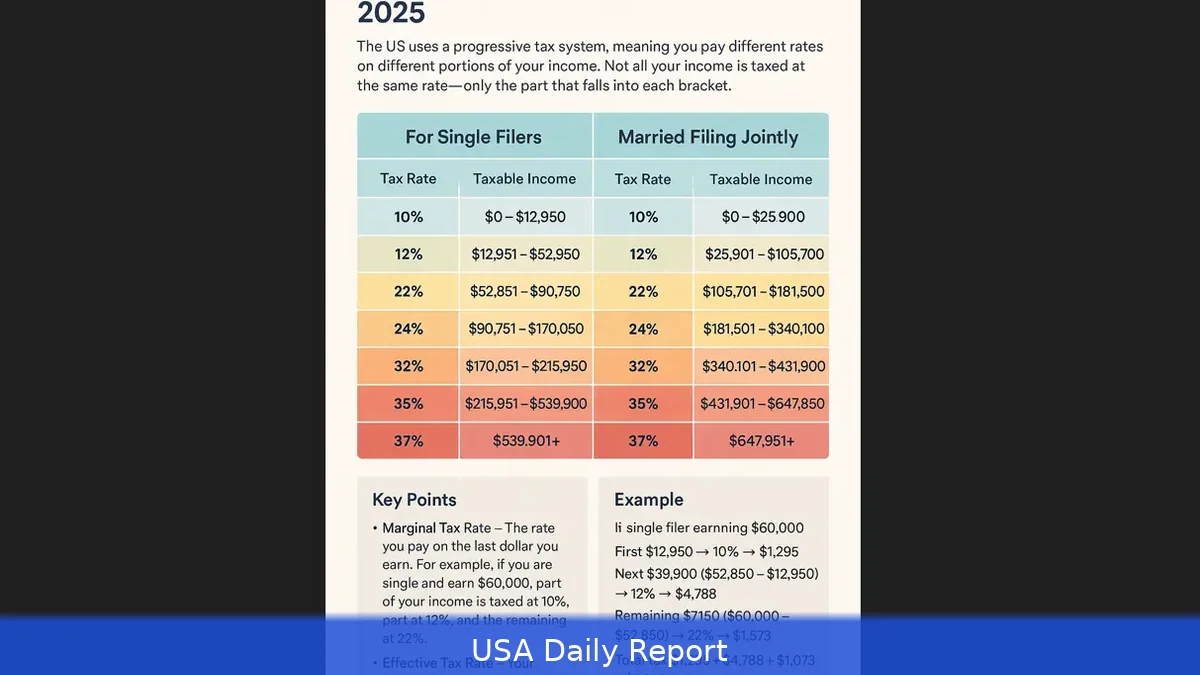
For 2026, the IRS set seven brackets for federal income taxes: 10%, 12%, 22%, 24%, 32%, 35%, and 37%. But you don’t pay one single rate on all your income. Instead, each slice of your income falls into its own bracket and gets taxed at that rate.
Here’s how the brackets apply for a single filer in 2026:
- 10% on income up to $12,400
- 12% on income between $12,401 and $50,400
- 22% on income between $50,401 and $105,700
- 24% on income between $105,701 and $201,775
- 32% on income between $201,776 and $256,225
- 35% on income between $256,226 and $640,600
- 37% on income over $640,600
Married couples filing jointly have higher income thresholds before hitting each bracket, starting at $24,800 for the 10% bracket and topping out at $768,700 for the 37% bracket. This means spouses can earn more together before reaching higher tax rates.
Other filing statuses like head of household or married filing separately have their own bracket thresholds, which adjust annually for inflation. For example, the head of household 10% bracket starts at $18,700.
How Tax Brackets Work in Practice
Imagine you’re a single filer making $80,000 in 2026. Your tax isn’t 22% on the entire $80,000. Instead, it breaks down like this:
- 10% on the first $12,400 = $1,240
- 12% on $12,401 to $50,400 ($37,999) = $4,560
- 22% on $50,401 to $80,000 ($29,599) = $6,512
Add those up and you get $12,312 in federal income tax before any deductions or credits. This is called your "tax liability." But the story doesn’t end here — deductions and credits can lower this amount.
Keep in mind that these brackets apply to your taxable income, which means your total income minus deductions. So your actual tax bill is often less than this initial calculation.
For married couples filing jointly, the brackets allow for higher income ranges before moving into higher rates. For example, the 22% bracket covers income from $100,801 to $214,200, giving more leeway before hitting higher rates.
Each year, the IRS adjusts these brackets to keep up with inflation. So, the thresholds usually rise slightly, helping taxpayers avoid paying more taxes just because of inflation-driven income increases.
What Are Deductions?
Deductions are amounts you can subtract from your total income to lower your taxable income. It’s like shrinking your income before the tax brackets apply.
The most common deduction is the standard deduction, which is a flat amount set by the IRS. For 2026, it’s $16,100 for singles and $32,200 for married couples filing jointly. This means if you’re single and make $80,000, you subtract $16,100 first, so you’re only taxed on $63,900.
You can also itemize deductions if they add up to more than the standard deduction. Itemized deductions include things like mortgage interest, state and local taxes (up to $10,000), charitable donations, and medical expenses above 7.5% of your adjusted gross income.
For example, if your itemized deductions total $20,000, you’d use that instead of the standard deduction to reduce your taxable income further.
Deductions don’t reduce the tax you owe directly — they reduce the income you’re taxed on. So if you’re in the 22% bracket, a $1,000 deduction saves you $220 in tax.
What Are Tax Credits?
Tax credits cut the tax you owe dollar-for-dollar. If deductions reduce the size of the cake, credits take a knife right to the tax bill.
There are many types of credits. Some common ones include:
- Earned Income Tax Credit (EITC) — helps low to moderate-income workers
- Child Tax Credit — up to $2,000 per qualifying child
- American Opportunity Tax Credit — up to $2,500 for college expenses
- Lifetime Learning Credit — up to $2,000 for education costs
For example, if you owe $3,000 in tax but qualify for a $1,000 credit, you only pay $2,000. Some credits are refundable, meaning if the credit is more than your tax bill, you get the difference back as a refund.
Credits can cut your tax bill or boost your refund, so it pays to see if you qualify.
How to Get Started With Your Taxes
First, gather your income documents — W-2s from employers, 1099s for freelance or investment income, and records of any other earnings. Then, determine your filing status: single, married filing jointly, married filing separately, head of household, or qualifying widow(er).
Next, decide whether to take the standard deduction or itemize deductions. The standard deduction is simpler, but itemizing could save you more if you have a lot of deductible expenses.
Calculate your taxable income by subtracting deductions from your total income. Then apply the tax brackets to figure out your tax before credits.
Finally, subtract any tax credits you qualify for to find your final tax owed or refund due.
If you’re self-employed, remember to pay quarterly estimated taxes throughout the year to avoid penalties. Also, account for the 15.3% self-employment tax covering Social Security and Medicare.
There are plenty of tax software programs and IRS resources to help you through the process. And if your taxes are complex, consulting a tax professional might be worth it.
Common Questions About US Taxes
Q: Why does my tax rate seem high even if I’m in a lower bracket?
Because the US tax system is progressive, only the income in higher brackets is taxed at higher rates. Your overall tax rate (effective tax rate) is usually lower than your top bracket rate.
Q: What if I have multiple jobs or income sources?
All your income adds up to your total taxable income. Make sure to report all earnings on your tax return to avoid penalties.
Q: How do tax credits differ from deductions?
Deductions lower how much income you pay tax on. Credits reduce the actual tax you owe, dollar-for-dollar.
Q: Can I file taxes for free?
The IRS offers free filing for people below certain income thresholds, and many tax software providers have free options for simple returns.
Q: What happens if I don’t file or pay taxes on time?
You could face penalties, interest charges, and in severe cases, legal action. The deadline for filing 2026 taxes is April 15, 2027, with extensions available until October 15, 2027.
Understanding tax brackets, deductions, and credits takes the mystery out of filing your taxes. Knowing that only parts of your income are taxed at higher rates, that deductions lower taxable income, and credits cut your tax bill directly can help you see how to save money. The US tax system adjusts yearly for inflation and offers various ways to reduce your tax burden depending on your situation.


