
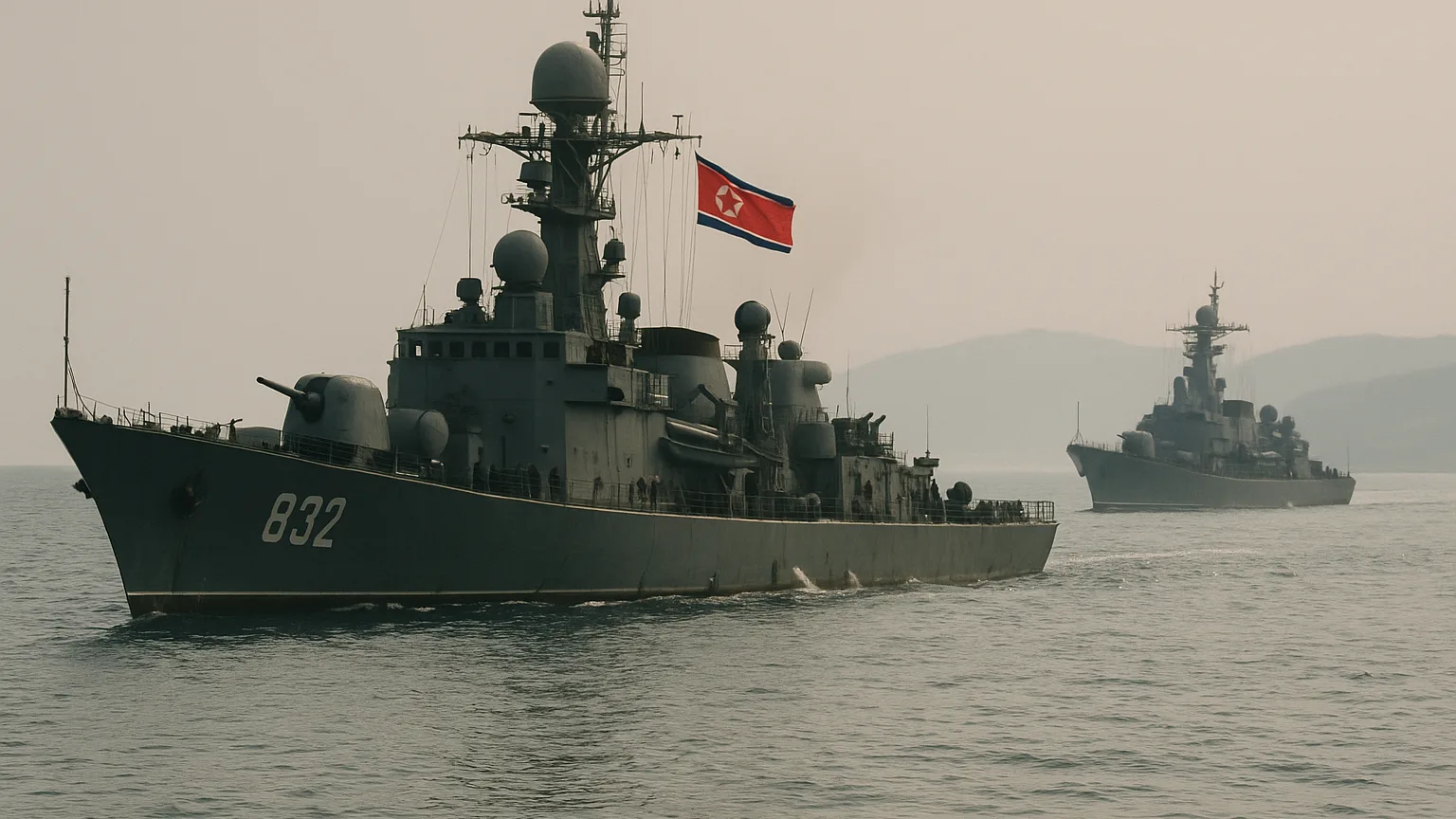
Pyongyang on Sept. 6 commissioned the 5,000-ton destroyer Kang Kon as the United States, South Korea and Japan began the five-day Freedom Edge exercise, signaling an expansion of North Korea’s sea-based nuclear and conventional capabilities.
"We must build a more reliable nuclear war deterrent," Kim Jong Un said, state media reported. That declaration came as Kim presided over the Sept. 6 commissioning at Wonsan of the 5,000-ton destroyer Kang Kon, North Korea's second ship of the new class. State photos showed Kim alongside his teenage daughter on a red carpet at the ceremony, and Pyongyang has described the vessel as similar to the Choe Hyon destroyer put into service in June. North Korea also said the Kang Kon test-fired nuclear-capable cruise missiles in July. The commissioning coincided with the start of the five-day Freedom Edge trilateral exercise by the United States, South Korea and Japan. Kim told the crowd another "significant" naval advancement would be unveiled in eight months as construction continues on east coast bases and new naval units.
What Happened
The ceremony marked a push to expand North Korea's sea-based strike options. Kim framed the event as part of a naval buildout; state media and later imagery made clear the new ships are meant to change how Pyongyang projects power at sea.
Outside analysts call the new destroyers the largest and most heavily armed vessels North Korea has produced. Imagery analysts put the hull at about 145 meters, roughly 475 feet, and report a sophisticated mix of missile launchers, gun systems and radar arrays visible in released photos.
Some analysts say design features and construction details point to likely outside technical help, including probable Russian assistance during build phases. The combination of sensors and armament, they say, would expand the ships' offensive reach while also improving their ability to detect and counter incoming threats.
The Context
Kim framed the Kang Kon as a deliberate step to give Pyongyang a maritime dimension to its deterrent, shifting some emphasis from land-based forces to sea-launched options.
State media said the vessel would form part of Pyongyang's nuclear response system.

In remarks carried by KCNA, Kim was quoted saying the ship could deliver "annihilating retaliatory strikes on an enemy" and that "the time has come for us to exercise our sovereignty at sea and under water."
Analysts note that the class's size and visible weapons and radar suites expand both strike reach and detection capacity, converting surface ships into a more versatile element of North Korea's military toolkit. Some analysts point to likely Russian technical assistance in parts of the design and construction, which would accelerate Pyongyang's move into more complex naval platforms.
Taken together, the commissioning adds a maritime layer that Seoul, Tokyo and Washington must factor into planning and exercises, because it changes where and how Pyongyang might project power.
Reaction
Seoul called the five-day Freedom Edge drill defensive, saying it is meant to sharpen joint responses to North Korea’s nuclear and missile threats. Allies held the exercise as the Kang Kon entered service.
Analysts warned the destroyers will complicate allied planning at sea. They describe the 5,000-ton ships as North Korea’s largest and most capable surface combatants, with weapons and radar suites that extend strike reach and improve detection. Some analysts pointed to likely Russian technical help during construction, which would accelerate Pyongyang’s move into more complex naval platforms.
Some analysts view the commissioning as a pressure move aimed at extracting bigger concessions from Washington. They say the timing, alongside trilateral exercises, signals Pyongyang’s intent to force a recalculation of its bargaining position.
Regional accounts rapidly circulated images and the initial reporting of the event (regional accounts).
What's Next
North Korea has put a timetable and a construction program on display. KCNA reported that Kim Jong Un promised another “significant” naval advancement in eight months, and that building of east coast naval bases and new naval units is underway.
What to watch over the coming months
- KCNA announcements and state ceremonies, which will set the public schedule and provide Pyongyang’s official claims about capabilities. Analysts will treat those claims as signals rather than proof.
- Physical progress on the east coast construction projects KCNA described, and any state disclosures about new ship classes or base names. Those projects are the backbone of the naval expansion Kim ordered.
- Technical confirmations of capability: more sea-launched missile tests, stepped-up patrols by the new destroyers, or imagery showing larger hulls or submarine construction. Such signs would move the programs from announcement to operational threat.
- Signs of a longer-term ambition toward submarines with greater endurance or nuclear propulsion, an option analysts say North Korea’s naval program could include.
Allies and intelligence services will be watching these markers in real time rather than waiting for another commissioning ceremony. Monitoring will focus on concrete engineering milestones, not rhetoric.
Kim set the deadline: another major naval advance, he promised, will be unveiled in eight months, on May 6, 2027.
Originally reported by AP.
This article was created with AI assistance.


