
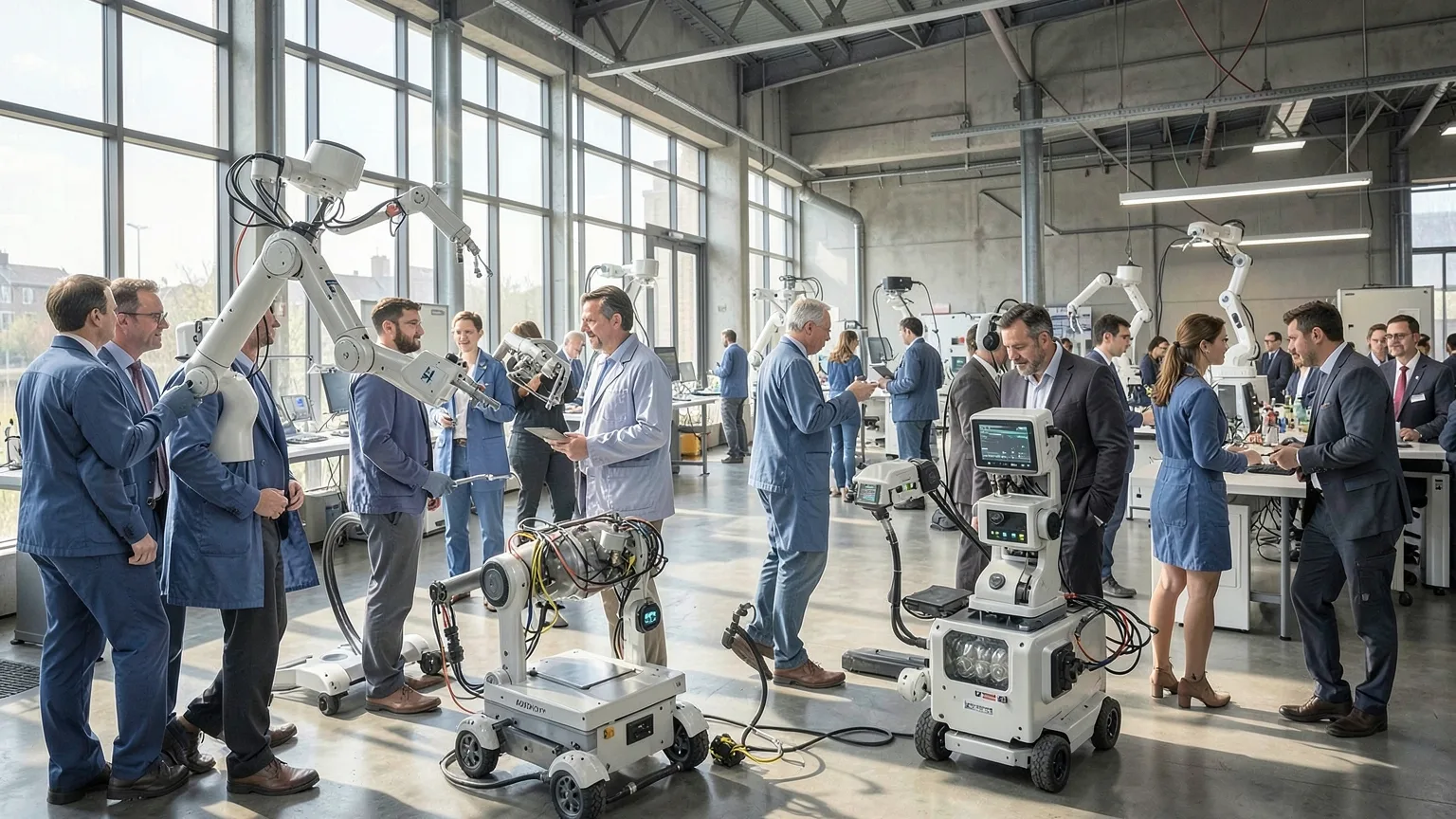
The government is funding eight regional Robotics Adoption Hubs with £40m to help businesses and public services try and adopt robotics across sectors from surgery and farming to recycling and logistics.
What the hubs will do, and where
The UK government is betting that eight regional Robotics Adoption Hubs, backed by £40m, can turn laboratory demonstrations into tools used in hospitals, farms, factories and recycling centres [www.bbc.com]. The program lists hubs covering healthcare, agriculture, manufacturing, logistics, waste and regional small-business support: the Newcastle Surgical Hub (which is receiving £7.4m), a HARVEST hub in Lincoln aimed at farming and food systems, a Yorkshire hub based in Bradford, a South Wales hub in Swansea, a Greater Southwest hub, a National Waste and Recycling hub in the South East, RoboPass Plus in Milton Keynes, and Hwb Llwybr Roboteg Cymru for manufacturers.
Ministers and local researchers showed automated machines picking strawberries, moving across ploughed fields and using bursts of concentrated light to kill weeds during a visit to Lincoln; those are examples the HARVEST hub will work with as it supports farm and food businesses, the BBC report said. The Newcastle hub is described as a centre to help healthcare providers adopt robotic-assisted surgery, and the Milton Keynes site will support service robots, drones and driverless vehicles for transport and logistics uses [www.business-live.co.uk]. The hubs also include a package of training support: the program includes a further £2.5m to back 12 projects that develop practical robotics training and apprenticeships, according to the BBC account.

Turning demonstrations into adoption
AI and Robotics Minister Kanishka Narayan said the hubs exist because "too often businesses and bosses don't know where to start", and that putting expertise and support locally will help organisations embrace robotics with more confidence [www.business-live.co.uk]. The programme is aimed at the common practical barriers that stop demonstrations becoming real deployments: technical and commercial uncertainty, regulatory hurdles and workforce skills, which Innovate UK frames as obstacles the hubs should help firms to overcome [www.business-live.co.uk].
Professor Sherif El-Khamisy of the University of Bradford, which is leading the £3.67m Yorkshire Robotics Hub, said the project will work with more than 300 manufacturers across the M62 and M1/A1 corridors to help them "adopt robotics and automation technologies" and to upskill the workforce so automations can be embedded in production lines [www.bbc.com]. The university argues the hub will generate demand for engineers and experts rather than simply cutting jobs. The university says closer ties with local companies should help firms build business cases, try equipment and train staff in place [www.bbc.com]. More broadly, industry and research leaders say the hubs will provide hands-on support and a bridge between cutting-edge technologies and the organisations that can benefit from them [www.business-live.co.uk].
What success will depend on
Bruce Adderley, director of advanced manufacturing at Innovate UK, says the hubs are intended to "provide a vital bridge between cutting-edge technologies and the organisations that can benefit from them", a summary of the programme's purpose more than proof of impact [www.business-live.co.uk]. The government and its partners point to several necessary ingredients for success: tailored local advice, real-world trials that prove value in specific supply chains, workforce retraining and coordination across regions where manufacturing and logistics are concentrated [www.bbc.com].
Funding on paper is specific. The eight hubs share £40m in total. Within that package the Newcastle Surgical Hub has a £7.4m award, the HARVEST hub in Lincoln has £6.3m and the Yorkshire hub in Bradford has £3.67m. A separate £2.5m will support 12 training and apprenticeship projects alongside the hubs [www.bbc.com]. The Department for Business and Trade has said that if robotics and autonomous systems were fully maximised they could contribute up to £150bn to the UK economy, and it contrasts that with a current projection based on existing uptake of about £6.4bn: figures the department uses to underline the gap these hubs aim to close [www.business-live.co.uk].
But the claims remain intentions. Ministers, university leads and Innovate UK describe what the hubs are meant to do and which barriers they target. There is not yet independent evidence in reporting that the hubs will convert pilots into large-scale, sustained adoption [www.bbc.com]. Success will therefore rest on whether the hubs can translate demonstrations into clear business cases, secure funding and supplier links for deployments, and deliver the training that local firms need. Those outcomes will only be provable as the hubs run trials and publish results over time [www.bbc.com].
Watch the pilot reports and the training projects next. The announcements so far describe goals and allocations rather than measured, system-wide shifts in adoption.
This article was created with AI assistance.


