
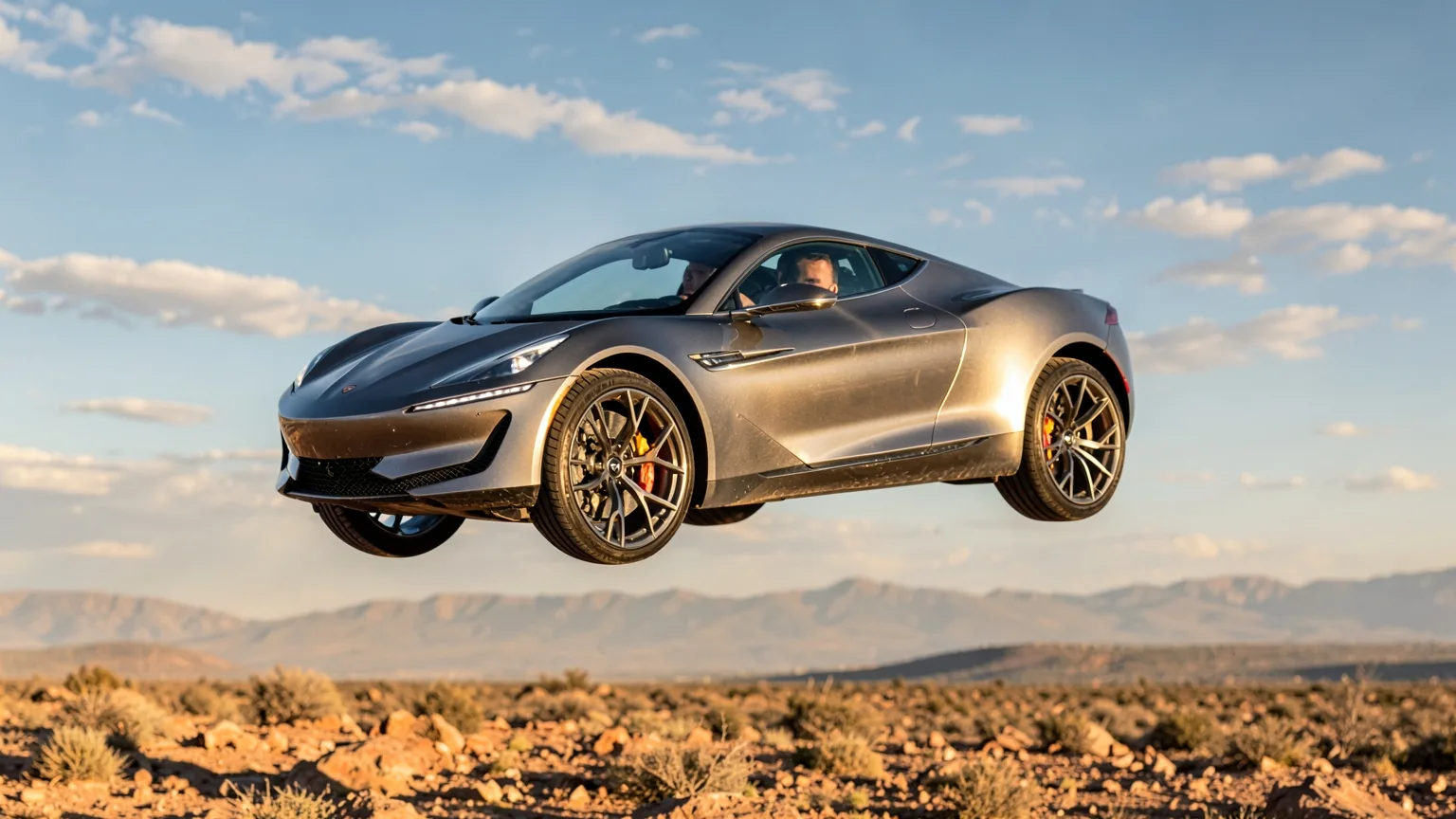
Tesla's new Roadster Rocket flew for a few dramatic moments in Texas, but the price, the delivery date and the legal status of a car that flies are all still open.
A car that drives upside down and then flies over other cars sounds like science fiction, and the headlines since Thursday night haven't made it easier to sort out. Here's a plain guide to what Tesla showed, what it says it plans, and what nobody has confirmed yet.
The flight was real, but it was a short demonstration. The final price hasn't been announced, 2028 is a production target, and the flying version isn't approved for public roads.
What Tesla showed, and how the Roadster is supposed to fly
On Thursday, Oct. 15, Tesla streamed an event from a SpaceX test site in McGregor, Texas, near Waco. A white prototype raced up a curved ramp, clung to it upside down, then vaulted off the end. It flipped in mid-air, hovered slowly and landed, as reported by CNBC. CBS News described the car rolling over 180 degrees in the air to land on its wheels.
The car also used its thrusters to lift itself over a Cybercab, Cybertruck, Tesla Semi, Model Y and Model 3 while moving, according to TechCrunch.
Those were brief maneuvers: a launch, a flip, a hop over vehicles, a slow landing. The coverage doesn't describe sustained flight from one place to another. Musk's own line was that the car can do "crazy gymnastics."
How does it work? There's no jet fuel. Engineering VP Lars Moravy said the car uses 10 thrusters connected to 600 liters of compressed air to lift and spin the car, and that the tank can be recharged, per TechCrunch. Car and Driver reported the thrusters are fed by ultra-high-pressure air tanks the car can recharge itself, and that they're said to produce over 80 kilonewtons of force, a measure of push. A fan system under the car is said to provide suction to hold it to the surface, even upside down.

Tesla sells the car in three trims. Performance is "road ready" and seats two. Thrust is "race ready," seats two and adds rear cold-gas thrusters, which use stored gas rather than burning fuel. Rocket is "air ready," seats one and has 10 cold-gas thrusters around the car. Tesla's website qualifies the flying feature: it is tied to the Rocket trim, and TechCrunch notes that all three trims share 300 miles of range and speeds above 230 miles per hour. Tesla's page also says flight may not be available in all regions.
Musk himself added a caution on stage: "I'm not sure it's necessarily legal in all jurisdictions, but there will be such a car that someone can own."
Price, reservations, and the claimed timeline
Musk didn't name one at the event, and CNBC reports the company didn't disclose specifications for other performance variants either.
Reservation payments are visible, and they aren't the car's price. A reservation is a deposit to hold your place in line. TechCrunch reports Tesla's site is charging US$50,000 to reserve the Performance and US$250,000 for the Thrust. CBS News reported a non-flying version can be reserved online with a US$5,000 deposit, a figure that differs from the other reports, so check Tesla's site yourself. CNBC says Tesla reopened reservations in recent weeks, taking deposits of that same size from buyers in the U.S., Canada and China.
The Rocket trim is invitation-only. Tesla's website says the model with the "full flight system" will be offered by invitation, so you can't put down a deposit for it on your own.
As for timing, Musk said production would start in 2028. Treat that as a plan. Car and Driver noted he said they'd start building it in 2028, "actually," with a laugh. The track record is why caution is fair: Tesla began taking deposits of that size in 2017, CNBC says it has since missed every targeted delivery date, and TechCrunch lists delays in 2020, 2021, 2023 and 2024, plus an Oct. 1 event pushed back by severe weather. Some buyers gave up. Sam Altman got a refund, while Lawrence O'Connor told CNBC he still holds a US$250,000 Founder's Edition reservation from November 2017.
The road-use and flying reality check
Tesla's website says the flying model isn't approved for public road use, as CBS News reports. That's the company's own warning, and it carries more weight than any demo video.
On the aviation side, the FAA said in statements to POLITICO and CBS News that the Tesla vehicle doesn't meet its definition of an aircraft. POLITICO notes that means the agency wouldn't need to certify it as airworthy. But the FAA didn't immediately answer a follow-up about its general jurisdiction over airspace, so that statement doesn't settle every question.
The road side is murky too. The National Highway Traffic Safety Administration typically oversees vehicles but leaves safety certification to the automaker. It said the manufacturer must ensure the car doesn't defy applicable Federal Motor Vehicle Safety Standards, and that drivers must obey local traffic laws. A senior Department of Transportation official, who was skeptical the car will actually take off, acknowledged to CBS News there's no clear answer on who decides whether it's safe.
CNBC says it's unclear whether the vehicle would be street-legal. Musk said on stage, "This is not necessarily a safety-optimized car." If you're thinking of a flying commute, hold off. What Tesla has shown is a short demonstration, and the price, the delivery date and the permissions are all still to come.


