
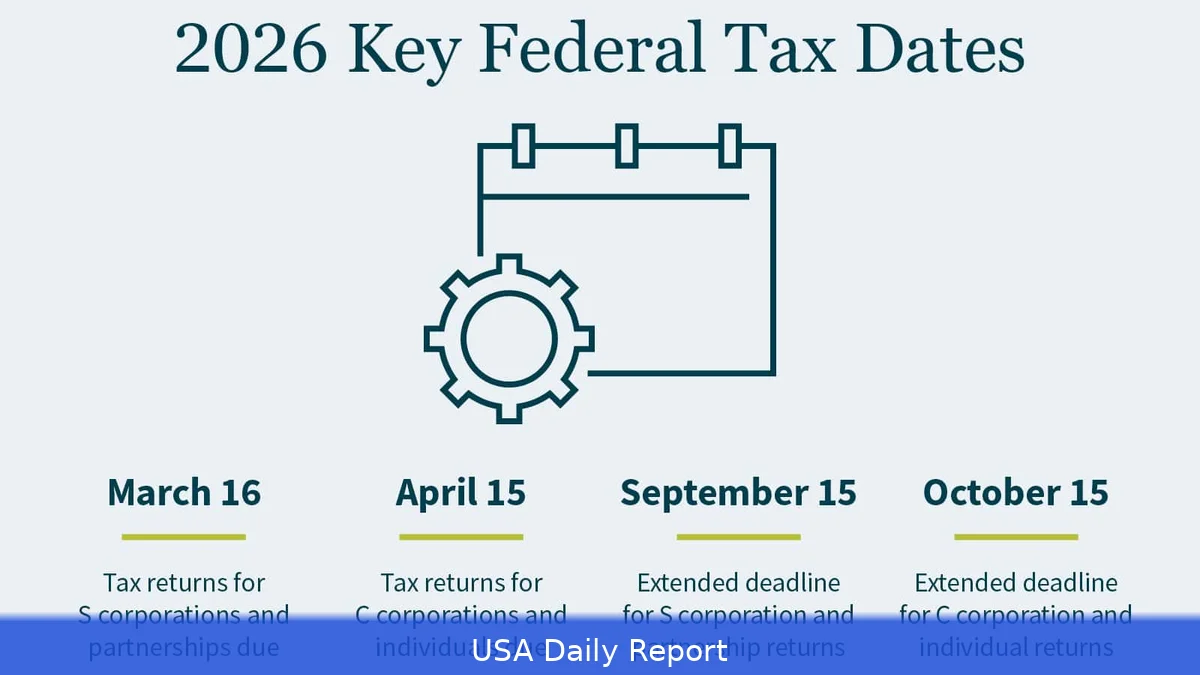
Tax season is just around the corner in 2026. Knowing the key deadlines can help you avoid extra costs and hassle. From IRS filing dates to retirement contribution cutoffs, this guide lays out all the important US tax and financial deadlines you need to mark on your calendar. No matter if you file as an individual, run a business, or are saving for retirement, these dates will help you stay organized and avoid IRS penalties.
Quick Reference: Key 2026 Tax and Financial Deadlines
- January 15, 2026: Q4 2025 estimated tax payment due for self-employed and other taxpayers who pay quarterly.
- April 15, 2026: Deadline to file 2025 federal tax returns or request an extension; Q1 2026 estimated tax payment due; last day to make IRA and Health Savings Account (HSA) contributions for 2025 tax year.
- June 15, 2026: Q2 2026 estimated tax payment deadline.
- September 15, 2026: Q3 2026 estimated tax payment deadline.
- October 15, 2026: Final deadline to file 2025 tax returns if you requested an extension.
- December 31, 2026: Last day to make 401(k) contributions for 2026; deadline for Roth IRA conversions for 2026; final date to take Required Minimum Distributions (RMDs) for those already subject to them.
- October 1, 2026: FAFSA application opens for 2027-2028 academic year, essential for students seeking federal financial aid.
- November 1, 2026 - January 15, 2027: Open Enrollment period for Affordable Care Act (ACA) Marketplace health insurance plans for 2027 coverage.
- October 15 - December 7, 2026: Medicare Open Enrollment period to make changes to Medicare plans.
- January 1 - March 31, 2027: Medicare General Enrollment period for those who missed initial sign-up windows.
Tax Filing Deadlines and Estimated Payments
The biggest tax deadline of the year lands on Wednesday, April 15, 2026. That's when your 2025 federal income tax return is due along with most state returns. Missing this deadline without an approved extension means IRS penalties start accumulating immediately. The failure-to-file penalty kicks in at 5% of unpaid taxes for each month or part of a month you’re late — capping at 25%. On top of that, the failure-to-pay penalty adds 0.5% per month on any unpaid balance, also maxing out at 25%. These penalties can quickly add up, so it’s crucial to file and pay on time.
If you can’t meet the April 15 deadline, the IRS offers an automatic six-month extension. By filing Form 4868 electronically or by mail before April 15, you get until October 15, 2026, to submit your return. However, remember that this doesn’t extend the time to pay taxes owed — you must estimate and pay by April 15 to avoid penalties and interest.
Estimated tax payments happen quarterly for self-employed individuals, investors, and anyone who doesn’t have enough tax withheld from paychecks. For 2026, the deadlines are:
- January 15, 2026 — Payment for Q4 2025 estimated tax due.
- April 15, 2026 — Q1 2026 estimated tax payment due.
- June 15, 2026 — Q2 2026 estimated tax payment due.
- September 15, 2026 — Q3 2026 estimated tax payment due.
If you miss these deadlines, you could face penalties and interest, so be sure to keep them in mind. If a due date falls on a weekend or holiday, payments are due the next business day.
Retirement Contribution Deadlines and Rules
Saving for retirement has some key cutoffs in 2026. For traditional and Roth IRAs, you have until April 15, 2026, to make contributions for the 2025 tax year. The maximum contribution limit remains $6,000 for those under age 50, and $7,000 for those 50 or older (including the $1,000 catch-up).
Keep in mind, your eligibility to contribute to a Roth IRA depends on your modified adjusted gross income.
401(k) contributions for the 2026 tax year must be made by December 31, 2026. The contribution limit is $22,500, with an additional $7,500 catch-up contribution allowed for participants aged 50 and older. Employer contributions can boost this total, but your personal deferrals must stick to the calendar year.
Roth conversions — moving funds from a traditional IRA to a Roth IRA — must also be completed by December 31, 2026, to count for that tax year. The move can trigger taxable income, so timing and tax planning are key.

For those required to take Required Minimum Distributions (RMDs), the deadline to withdraw for 2026 is December 31. This applies to retirees aged 73 or older (as per the current IRS rules). Missing RMD deadlines can result in a hefty penalty of 50% on the amount not distributed.
Health Savings and Insurance Deadlines
Health Savings Account (HSA) contributions for 2025 can be made up until April 15, 2026. The maximum contribution limits for 2025 were $3,850 for individuals and $7,750 for family coverage, with an additional $1,000 catch-up contribution for those 55 and up. HSAs come with three tax advantages: your contributions reduce your taxable income, your earnings grow without tax, and you can withdraw money tax-free for medical costs.
The Affordable Care Act (ACA) Marketplace opens its 2027 Open Enrollment on November 1, 2026, running through January 15, 2027. This window lets you sign up for new health plans, switch plans, or renew coverage. Depending on your income, you might qualify for premium subsidies and lower out-of-pocket costs. Missing this window means you may have to wait until the next year unless you qualify for a special enrollment period due to life changes.
For seniors and Medicare beneficiaries, the Medicare Open Enrollment period runs from October 15 to December 7, 2026. During this time, you can change Medicare Advantage plans, switch from Original Medicare to Medicare Advantage, or update prescription drug coverage. If you miss this window, the General Enrollment period from January 1 to March 31, 2027, lets you sign up but coverage won’t start until July 1, making timely action important.
Education and Other Financial Dates
Students and families should note that the FAFSA (Free Application for Federal Student Aid) for the 2027-2028 academic year opens on October 1, 2026. Filing early improves chances for aid, including Pell Grants, work-study, and federal loans. The FAFSA deadline varies by state and school, but federal aid priority deadlines are typically early in the year. Be sure to check your college’s specific deadlines.
Practical Tips for Staying on Track
Keep a dedicated tax and financial calendar for 2026. Sync key deadlines to your phone or planner. Use IRS Free File or authorized software to file returns and extensions electronically — it’s faster and reduces errors. Set reminders a week before payment due dates so you never miss estimated tax or retirement contribution deadlines.
When possible, pay taxes electronically via IRS Direct Pay or EFTPS to avoid mailing delays. For estimated taxes, consider adjusting withholding on your paycheck to reduce quarterly payments. Consult a tax professional if you have complex situations like self-employment income, rental properties, or investment gains.
Review your health coverage options during the ACA and Medicare enrollment windows. Don’t wait until the last minute — plan your budget and compare plans carefully. For IRAs and HSAs, keep track of contribution limits and deadlines to maximize tax benefits.
Budget Planning for 2026 Tax Season
Estimate your tax liability early in 2026 to avoid surprises. If you expect to owe taxes, plan to set aside money monthly or increase paycheck withholding. Late payments can trigger penalties and interest, so budgeting for April 15 and quarterly estimated payments is smart.
For retirement savings, maxing out contributions to IRAs and 401(k)s can reduce taxable income and boost your nest egg. Remember the 2025 IRA contribution deadline is April 15, 2026, but 401(k) contributions must be made by December 31, 2026. Factor these into your cash flow planning.
Health-related savings like HSAs can also lower your tax bill. Contribute early in the year to maximize potential growth. Consider medical expense deductions if you have qualifying costs exceeding 7.5% of your adjusted gross income.
Finally, factor in health insurance premiums and out-of-pocket costs when planning your budget. Use the ACA Marketplace and Medicare enrollment periods to shop for better coverage or lower costs.
Keep this calendar handy throughout 2026 so you never miss a tax or financial deadline. From quarterly estimated taxes to retirement contributions and health coverage enrollments, these dates matter. Staying organized and planning ahead can save you money and stress all year long.
This article was created with AI assistance.


