
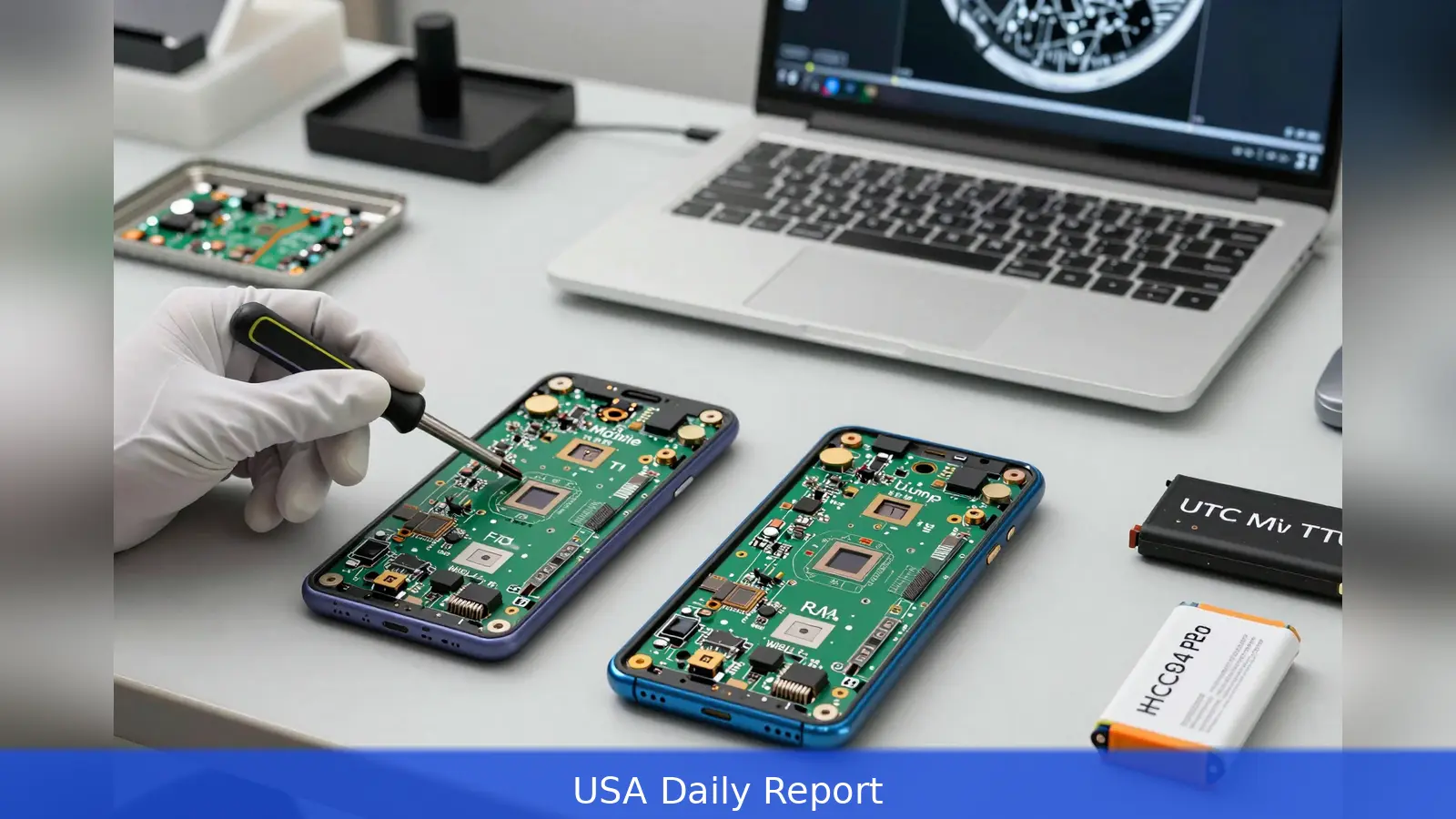
6.78-inch display. That's the single, most visible point of overlap between the Trump Mobile T1 and HTC's U24 Pro, according to a technical teardown by iFixit using an NBC News media sample and CT scanning. The analysis finds near-identical internal hardware, identical screw placement and mainboard architecture, and a successful transplant of an HTC U24 Pro mainboard into a T1 chassis that left the phone working. Trump Mobile's earlier claim of an American-made handset has been undercut by the findings, and the company hasn't provided a full public schedule for fulfilling preorders.
6.78-inch display.
IFixit's teardown, performed on an NBC News media sample and supported by CT scans, goes beyond surface comparison to document what it calls functional interchangeability between the two phones. Technicians removed rear covers and individual components, inspected the internal layout, and then reassembled a working device after installing an HTC U24 Pro mainboard inside the T1 chassis. The group flagged the same component layout, the same screw placements and the same mainboard architecture as evidence that the T1 isn't a unique, from-scratch design.
Teardown and technical match
The detailed work shows only trace-level changes between the T1 and the U24 Pro. IFixit identified small cosmetic adjustments such as a repositioned flash and flex cable and a different speaker grille pattern that appears to be a machining variation on the aluminum chassis rather than a redesigned acoustic module. Component differences stop mostly at supplier selection and a battery swap: the T1 uses a slightly larger battery cell manufactured in the Philippines that supports a 30W charging cap, while the U24 Pro's equivalent cell was sourced elsewhere and carries different charging specifications.
Memory suppliers differ too. IFixit found that while chipset packages supply the same specifications on both phones, Trump Mobile's T1 uses memory parts from Micron while the U24 Pro uses parts from SK Hynix.

Those supplier-level substitutions are consistent with phones assembled from a common design but populated with different vendor parts for cost, availability or contractual reasons.
The teardown's most striking demonstration was practical: the HTC U24 Pro mainboard powered and operated inside the T1 chassis. That transplant, combined with CT-scan evidence and identical fastener and component positions, is the strongest technical proof iFixit offers that the two models share a common third-party manufacturing lineage rather than one being a wholly distinct American design.
The Verge noted that HTC has told reporters it "does not design or manufacture phones for third parties," a statement that heightens the probability both devices were built by a contract manufacturer using shared parts and designs after HTC sold most of its smartphone business in 2017. IFixit and NBC News documented supply-chain traces that point to Taiwanese and Chinese manufacturing and parts sourcing consistent with the HTC U24 Pro's production, rather than full domestic assembly.
CNET's hands-on review, which ran a T1 as a daily driver for 96 hours, underlined how those origins show up for buyers. The review found the main camera trailed a three-year-old Samsung Galaxy S23 Plus in image speed and color accuracy, and it said the T1's matte gold finish collected fingerprints easily. CNET also traced the product's commercial path: Trump Mobile announced the T1 in June 2025 alongside a $47.45-a-month plan and initially pledged an American-made handset with an August 2025 launch, then delayed the product and quietly dropped the explicit "made in the US" claim as large-scale domestic manufacturing proved not possible.
Trump Mobile told CNET it faced production delays while testing parts for quality, and that statement accompanied confirmation that the handset would begin shipping to customers. CNET's unit was an expedited review sample; the company didn't provide a public, detailed rollout schedule and hasn't responded to additional requests about preorder fulfillment status. That leaves open whether all preorder customers have received their phones.
The practical distinction consumers can use when comparing the T1 to the U24 Pro is narrow but tangible: a slightly larger battery in the T1 made in the Philippines and a 30W charging cap, plus different memory suppliers. Beyond that, the two phones are functionally and physically almost clones, the combined reporting shows, with machining and cosmetic tweaks applied to the shared chassis design.
For buyers focused on where a phone is built, the teardown removes ambiguity. The evidence points to a shared supply chain and likely contract manufacturing in Asia rather than to a handset engineered and assembled at scale in the United States. For buyers focused on performance and camera speed, CNET's 96-hour verdict suggests the T1 performs like a contemporary midrange device with a camera that lags the performance of a three-year-old flagship.
Related Articles
- Google Gemini brings AI to World Cup, raises error risk
- San Francisco shuttle curb visits down 40% since 2019
- Momax Q.Mag X cuts phone charging heat with graphene
One concrete number remains central: Trump Mobile's $47.45-a-month plan, which the company advertised when it launched the T1 in June 2025. Originally reported by The Verge.
This article was created with AI assistance.


