
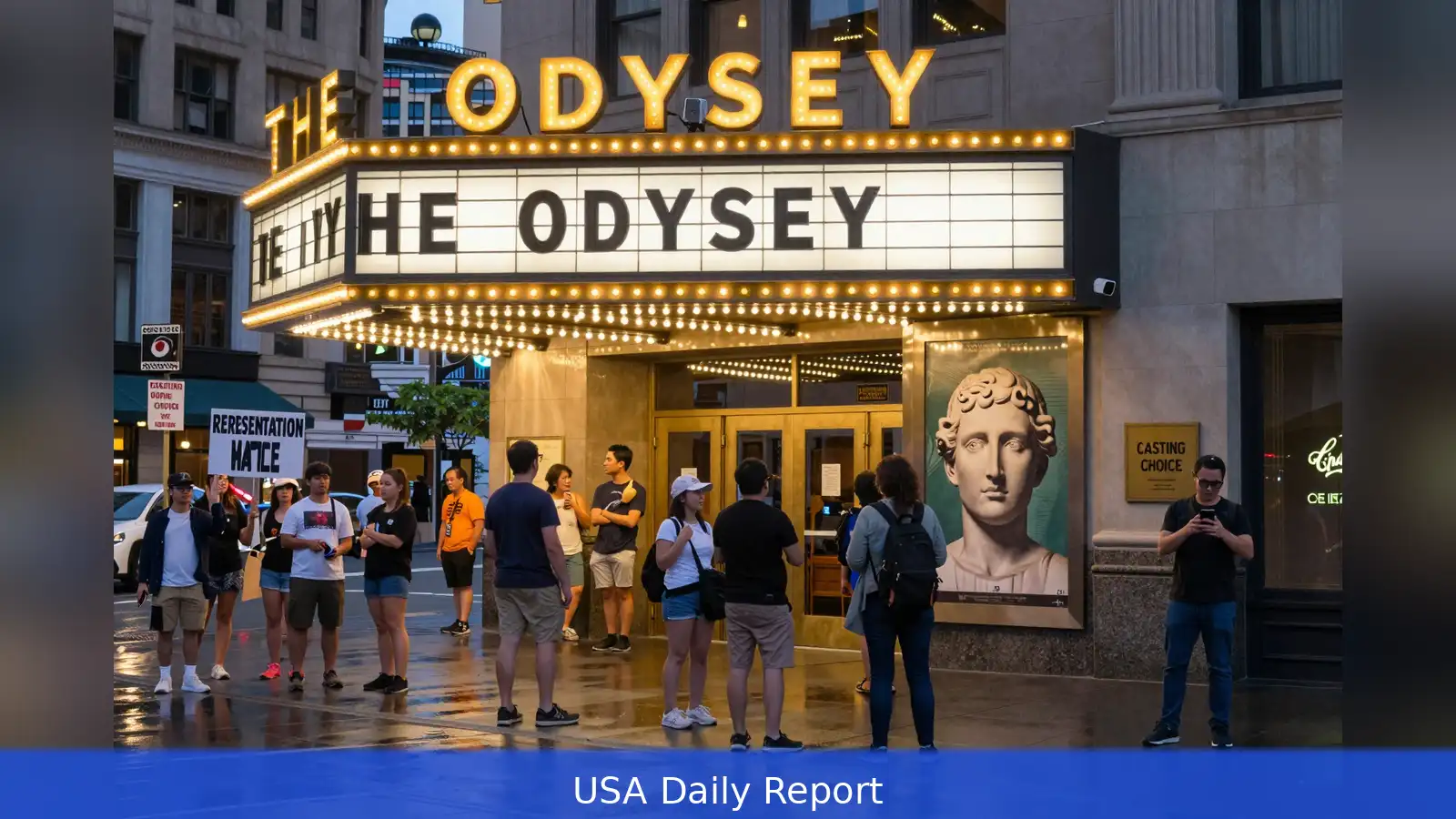
$250 million. That's the reported production budget for Christopher Nolan’s The Odyssey, which has become this summer’s high-profile release and a lightning rod for a loud right-wing backlash after Lupita Nyong'o was cast as Helen of Troy. The casting announcement, alongside early ticketing delays reported by Variety, turned what should have been straightforward blockbuster publicity into a culture-war flashpoint. Whether the controversy dented mainstream appetite will be measured by box office receipts and critics when the film opens this summer.
$250 million sets the commercial frame for how the industry is reading The Odyssey: Universal Pictures and Nolan marketed the movie as a large-scale, starry adaptation of Homer’s epic meant to anchor summer box office. The ensemble includes Matt Damon as Odysseus, Anne Hathaway as Penelope, Tom Holland as Telemachus, Zendaya as Athena, Charlize Theron as Calypso, and Lupita Nyong'o as Helen. Early ticket demand was strong enough that Variety reported technical problems during pre-sales, with some AMC customers waiting up to an hour and intermittent lag on Fandango’s site, producing separate negative headlines even before the film opened widely.
Casting and the culture-war flashpoint
The choice of Nyong'o to play Helen prompted a cascade of online outrage from conservative commentators and influencers who argued a Black actress didn't fit their traditional visualization of a Greek figure. High-profile figures on X criticized the casting, with some dismissing the idea of a Black Helen as an affront to historical or cultural authenticity. Christopher Nolan pushed back publicly, saying he chose Nyong'o for the character’s strength and poise and praising her ability to convey layered emotion beneath the role. Nyong'o framed the project as mythological storytelling in an interview with Elle, saying, "This is a mythological story. Our cast is representative of the world. I’m not spending my time thinking of a defense. The criticism will exist whether I engage with it or not," and declining to make the debate the focus of her publicity.
The online backlash hasn't been purely about one cast member. Tech figures and high-reach accounts on X amplified some of the worst commentary, giving it wider visibility than it might otherwise have achieved and sharpening the political frame around what was billed as a trade story about a tentpole release.
Why the response looks familiar to classicists
That mix of literary purism, nationalist tropes about cultural ownership, and influencer amplification looks familiar to Emily Wilson, chair of classical studies at the University of Pennsylvania, who has faced a similar cycle of outrage. Wilson’s modern-language translation of the Odyssey in 2017 drew intense online commentary after she rendered the Greek epithet polytropos as "complicated" rather than choosing older literalizing options. Critics accused her of imposing modern agendas on an ancient text, a pattern she describes as coming from "armchair classicists" who treat philological choices as culture-war bait. Wilson pushed back directly, saying, "Complicated isn't an insult," and casting the hostility as a misreading of careful interpretive decisions.

The parallels Wilson outlines matter because they show how debates over classical material have migrated from academic journals to social feeds. Casting choices that once might have been discussed among critics and scholars now become viral controversies.
For a studio, that creates a double-edged market dynamic: the headlines feed awareness, but the same coverage can reframe marketing narratives into debates over representation and ownership of cultural heritage.
Industry observers and the studios involved have been explicit about the creative logic behind the casting. Universal and Nolan presented the film as a mythic retelling populated by an international ensemble, a choice rooted in interpretive rather than documentary aims. Nolan and several cast members have spoken in defense of those choices, and Nyong'o has emphasized the performative demands of inhabiting a mythic figure rather than conforming to a literalized standard of historical appearance.
So far the commercial signals have been mixed in tone but not in scale: ticketing systems showed strain from demand, yet the political noise reframed coverage away from production values and star power toward larger conversations about who gets to claim cultural touchstones. The risk for studios now isn't simply lost revenue but reputational drag: culture-war controversy can sap earned publicity and force marketing teams to spend energy on damage control rather than selling spectacle.
For Nolan, Universal, and the cast, the next measurable tests are obvious and concrete: opening-weekend receipts and reviews. The film’s budget and roster make expectations explicit, and the studio will be watching whether mainstream audiences respond to the spectacle as much as to the controversy. If pre-sales are any indicator, curiosity and demand exist. But the political frame will be part of the box office story the moment ticket holders start posting opening-night takes and critics publish reviews.
Related Articles
- Amazon Prime launches in South Africa at 59 rand
- 28 Tips to Upgrade ChatGPT Prompts Fast
- Siri AI: Google cloud power, on-device privacy
Opening-weekend box office and early reviews will show whether the backlash dented the film's commercial and cultural standing. Originally reported by Wired.
This article was created with AI assistance.


