
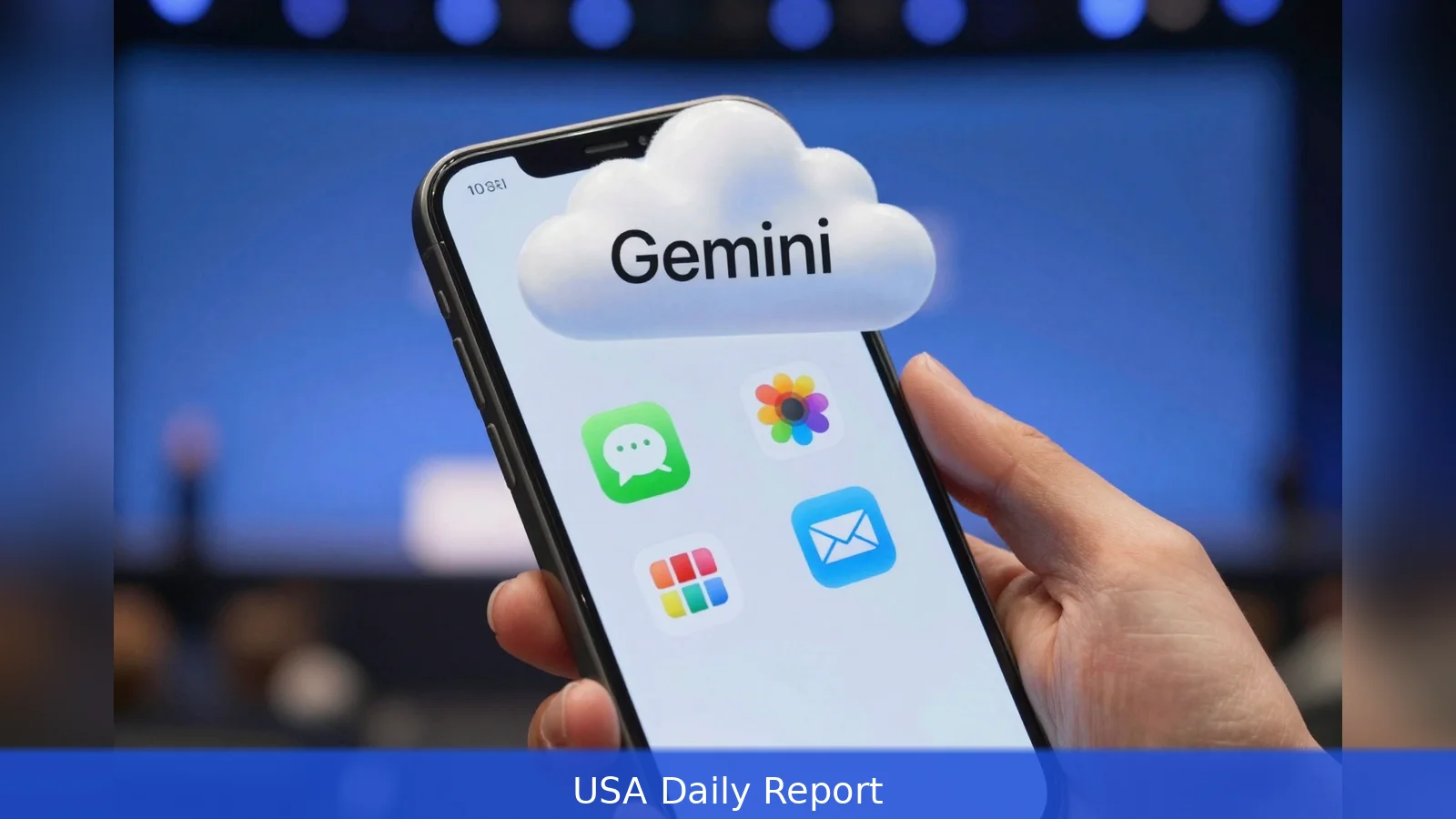
Google's Gemini supplies the heavy lifting, but Siri keeps the personal data on your iPhone. Apple unveiled the rebuilt assistant at WWDC as part of iOS 27, and a developer beta tested by a reporter already shows the hybrid model in action. The system pairs a Gemini-powered cloud model with local indexing of messages, photos and email so many routine requests run entirely on-device while harder tasks escalate to the cloud. Apple says the feature, branded under Apple Intelligence, will roll out to consumers later in 2026 on supported iPhone models with staged regional availability.
On one side Siri calls on a cloud model from Google, and on the other it reads a user’s private content locally to answer questions with personal context. That contrast is the design point Apple demonstrated at WWDC and that surfaced in hands-on testing of the iOS 27 developer beta.
How Apple mixes Gemini with on-device data
The assistant uses a hybrid architecture. Local indexing gives Siri access to calendar events, email, Messages and Photos without moving raw personal data to Apple servers for many queries. When a request requires broader reasoning or work the phone can't comfortably handle, the system sends some context to a cloud model running on Google Gemini technology. Apple frames that combination as Apple Intelligence under the hood.
In the beta the mix is visible in everyday interactions. For simple requests the assistant responds using only data already indexed on the device, which testers say feels faster and more private. For more complex tasks, such as drafting a longer message that pulls details from multiple apps, the assistant escalates processing to the cloud model while attempting to minimize what leaves the device.
Apple also rebuilt where Siri lives. The assistant appears in the iPhone search bar and as a standalone Siri app, and conversations are saved in a dedicated history users can revisit. Replies in the beta tend to stick to one compact paragraph with highlighted keywords for faster scanning, and short voice prompts can be followed by typed or tapped follow-ups rather than forcing each interaction to act like a fresh command.
Siri now reads the current screen and pulls context across apps. That on-screen awareness lets it find an address buried inside Messages, draft an email using details stored in Notes, or use recent Photos to answer questions about locations or objects.

The assistant can compose drafts, suggest group-text replies based on conversation history, and sync Siri conversations across devices.
Testers reported improved natural-language understanding and fewer irrelevant link dumps than older Siri versions. They also note the assistant supports natural follow-up questions and remembers context across turns, so a short voice query can turn into a back-and-forth that mixes speech and typed prompts.
At the same time the beta remains early and occasionally inconsistent. Apple warned at WWDC that performance and the feature set may change before public release, and hands-on reports show some unevenness in how the assistant escalates work to the cloud and how reliably it pulls context from different apps.
Rollout plans are concrete but staged. Apple shipped Siri AI in the iOS 27 developer beta and said the assistant will reach consumers later in 2026. Early reports identify device constraints, with some coverage listing compatibility with iPhone 15, 16 and 17 models. Some reports say Apple won't initially enable the feature in the European Union and China for regulatory and infrastructure reasons, making availability vary by device capability and region.
The practical outcome is that many users will see a noticeably different Siri experience: faster simple answers, more capable handling of cross-app tasks, and a conversational flow that feels less command-driven. For those with supported hardware in supported regions, the assistant promises tighter integration with the phone’s private data without broad elevation of that data to Apple's servers for routine requests.
There is a philosophical split baked into the design. Reviewers who compared Siri AI to Google’s Gemini described Gemini as a general conversational model, while Apple’s Siri is deliberately an orchestrator of phone functions that pulls private context to complete real-world tasks. That difference shapes behavior: Siri aims to finish work inside the ecosystem of apps and personal data, rather than to be a standalone conversational partner.
Technically, the hybrid approach is Apple’s attempt to balance capability and privacy. Local indexing supplies personal context that earlier Siri versions lacked, and cloud escalation gives the assistant the heavy reasoning power it needs for larger tasks. Testers say that mix makes the assistant feel both quicker for basic chores and more capable when asked to pull together information from across the device.
Apple still faces the usual beta caveats. Performance may shift before the public release, and the company will refine how much context is sent to the cloud and how the assistant handles user privacy while performing complex work. The next practical milestone is Apple’s consumer iOS 27 rollout later in 2026, when the company will move Siri AI out of developer beta and expand availability to supported phones and regions.
Related Articles
- Siri at WWDC, High Stock and Higher Expectations
- Apple faces $250M settlement as it reboots Siri
- 5 Android Auto Mistakes That Slow Your Drive
Siri AI leaves developer beta when iOS 27 ships to consumers later in 2026.
This article was created with AI assistance.


