
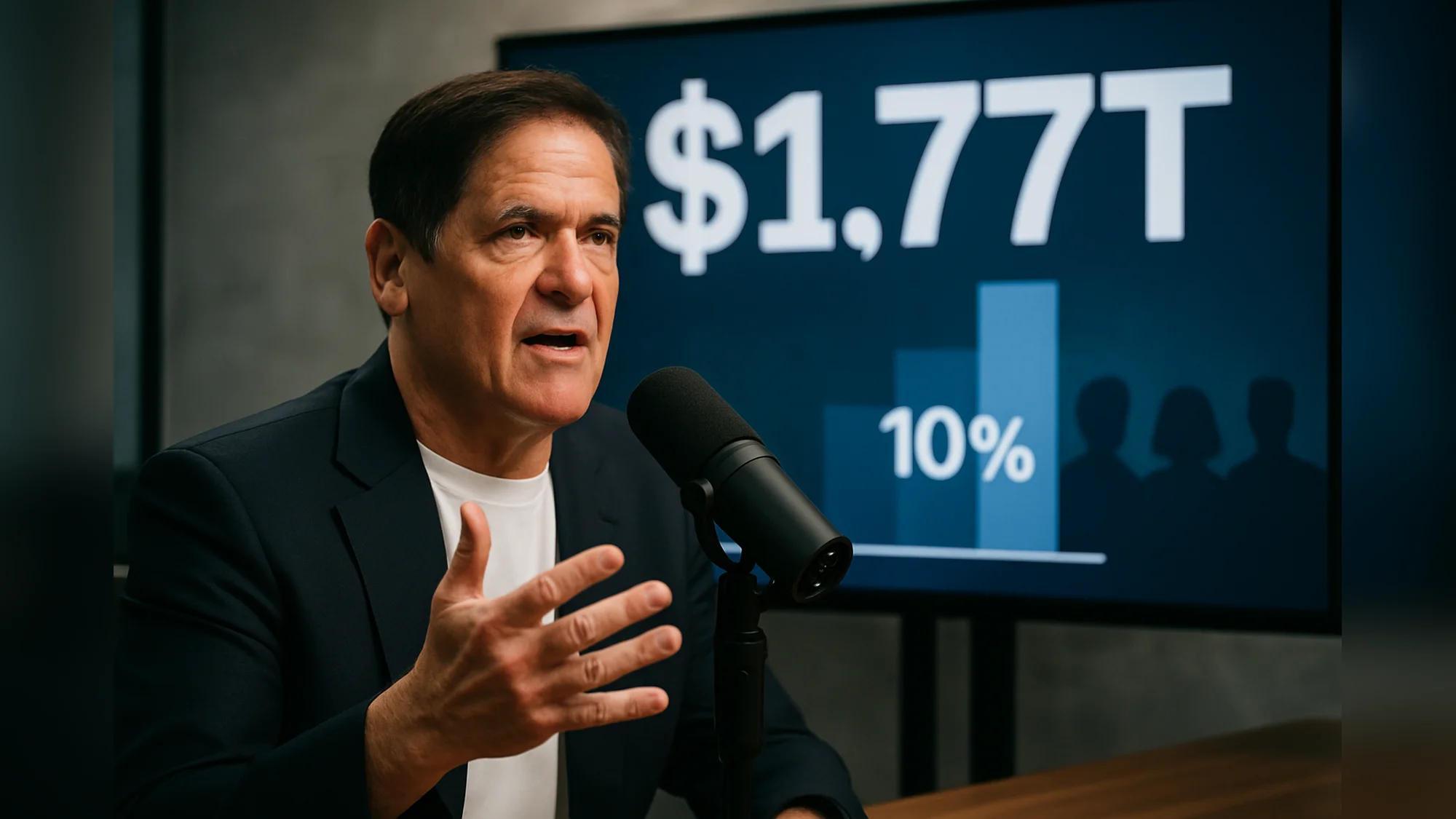
$1.77 trillion. That is the market value SpaceX’s IPO created, and it prompted Mark Cuban to renew his call for companies to give every worker an ownership stake. Cuban says broad employee equity, not higher wages alone, will let ordinary workers share gains and help narrow rising CEO-to-worker pay gaps. He laid out the idea on the "What It Takes" podcast and suggested tax incentives to encourage adoption.
10 percent was the illustrative rate Cuban used to explain his proposal. But he says if a CEO receives stock equal to 10 percent of their cash compensation, every employee should receive the same percentage of their own pay in stock, options or warrants. Cuban framed the idea as proportionality, not equal dollar amounts, saying, "The way you’re going to reduce income inequality for anybody who works with somebody is making sure they get shares of stock and then they benefit," on the What It Takes podcast from Unmoderated News. And he described the model as voluntary but argued governments could provide incentives to scale it.
Who would be affected, Cuban says, includes rank-and-file workers across sectors, investors and corporate tax policy. Cuban pointed to his 1999 practice at Broadcast.com, where he granted equity to all 330 employees and says roughly 300 became millionaires after Yahoo acquired the company. Still he and others cited broader data on pay gaps: the AFL-CIO reports S&P 500 CEOs made 285 times the median worker pay in 2024, up from 268 times in 2023, a gap Cuban argues equity sharing could help narrow.
Why push the idea now? Cuban pointed to recent headline IPO windfalls as proof of who captures corporate gains.
Meanwhile he referenced SpaceX’s 1.77 trillion dollar IPO and media reports that the offering minted thousands of millionaires as sharpening the debate. Coverage he cited also notes CEO pay has been rising faster than typical worker pay, including a reported 11 percent real-terms CEO pay rise in 2025 compared with roughly a 0.5 percent rise for average workers in that period.
How would a tax-code incentive work in practice? Cuban suggested using the corporate tax rate as a lever. He referenced a 21 percent corporate tax rate and proposed governments continue to offer lower rates only to companies that give rank-and-file employees the same percentage of stock relative to cash pay that executives receive.
Cuban said firms that don't meet the proportional-equity threshold should face higher taxes, explaining the math with a simple example: "So if the CEO gets $100,000 worth of stock because they make $1 million in cash, and the janitor makes $50,000, then they deserve, you know, the same percentage in stock, and that will change the game," Mark Cuban said.
Has Cuban promoted this idea before? Yes. The recent podcast remarks reiterate a long-standing advocacy line rather than a new regulatory proposal. Cuban has publicly pushed employee equity for years and has applied the approach in past exits, using Broadcast.com as a proof of concept. He tied the call to current headlines about major IPO windfalls and to the AFL-CIO figures on widening CEO-to-worker pay gaps for 2024.
Related Articles
- Blue Origin seeks $10B at $130B valuation
- SpaceX IPO hands public near-zero control, despite $80B bet
- How Retail Investors Can Access SpaceX Before It Goes Public
Cuban proposed using a 21 percent corporate tax benchmark as the lever: companies that match executives’ stock percentages for rank-and-file employees would keep the lower rate, while firms that do not would face higher taxes, he said. Originally reported by Fortune.
This article was created with AI assistance.


