
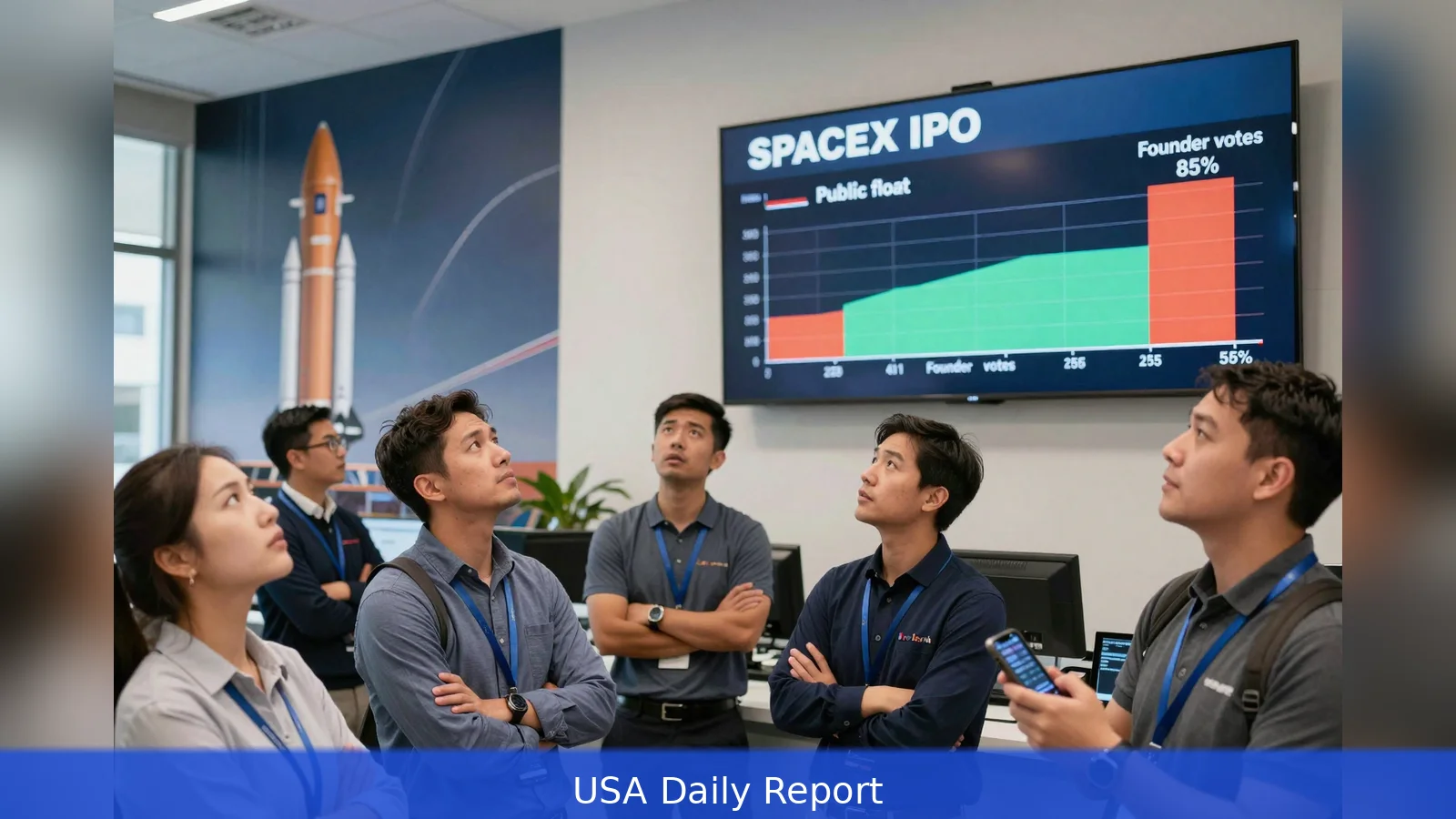
Elon Musk will control roughly 85 percent of SpaceX’s voting power, leaving public shareholders with almost no practical influence. The S-1 shows a dual-class system that gives Class B shares 10 votes apiece and funnels most low- or no-vote stock to new investors, while the listing will probably raise about $80 billion and is set to proceed this week. Reuters reported on June 8, 2026 that SpaceX’s 2025 revenue was under $20 billion, underscoring the gap between near-term sales and the valuation narrative. Who ends up with liquidity and influence will hinge on allocation mechanics and the timing of the listing.
Retail households, brokerages and long-term institutions will be the most exposed because the offering skews allocation and governance toward insiders, according to the filing analysis and reporting around the deal.
Concentrated control baked into the S-1
Public investors will have almost no practical governance influence because the S-1 cements a classic founder-control route, granting Class B shares 10 votes apiece and leaving Elon Musk with roughly 85.1 percent of voting power. The filing also says Musk will remain chief executive officer, chief technology officer and board chairman, and that SpaceX intends to claim "controlled company" status. That designation would exempt SpaceX from Nasdaq rules that typically require a majority-independent board, removing an important exchange-level governance safeguard.
Analysts and filing reviewers flagged the combination of roles and voting concentration as a key risk. The S-1's risk section lists founder dependence among the hazards, and outside analysts point to the compounded effect of Musk's multiple executive duties plus the company’s stated plan to operate as a controlled company. In practice, ordinary shareholders will have little formal recourse to influence strategy, leadership succession, or executive compensation.
The market story backing the IPO rests on very large total addressable market figures and long-term returns from capital-intensive programs, even as the filing itself warns some projects, including deep-space ambitions, may never be profitable. The S-1 anchors a headline TAM figure and discloses those program risks, but public valuation targets sit well above current sales. Reuters reported on June 8, 2026 that SpaceX’s 2025 revenue was under $20 billion, a detail many commentators have cited when weighing the gap between near-term fundamentals and the offering's implied valuation.

Coverage of SpaceX's history of government business also factors into the governance questions. Analysts cite roughly $13.5 billion in federal benefits to Musk-related companies and at least $9.5 billion in Department of Defense contracts tied to those businesses. That web of federal support and contracting has prompted multiple federal inquiries and congressional attention about potential conflicts where Musk's private interests intersect with agencies that regulate or contract with his companies.
Those relationships add a political and regulatory overlay to the economic case investors are being asked to make.
The IPO departs from standard distribution norms by earmarking a substantially larger slice of shares for retail buyers. Multiple reports note SpaceX has set aside about 30 percent of the offering for retail investors, versus an industry norm nearer 5 to 10 percent.
Broker behavior has shifted to accommodate that allocation: at least one large brokerage lowered account minimums for access to the deal from six figures down to a few thousand dollars. Commentators and retail-trader communities have pushed back, arguing that large retail allocations can create exit liquidity for long-term insiders and leave smaller investors holding stock if demand fades after the initial run.
That dynamic changes the economic trade-off facing anyone buying shares. Investors now weigh potential upside from ambitious, capital-intensive programs against virtually no governance leverage over how those programs are run. For households and many long-horizon institutions, the ordinary protections of public ownership will be limited while upside remains concentrated in management's strategic choices.
Key-person risk is explicit in the filing. The S-1 names Musk's multiple roles and the company's reliance on his leadership as material risks. Combined with the voting structure and the controlled-company claim, that raises the chance that a single individual's decisions will determine resource allocation across high-cost programs, regulatory strategy, and contractual relations with federal agencies.
Related Articles
- Paramount folds BET+ as Warner bid draws scrutiny
- Serena Williams' $35M property portfolio draws attention
- Inside the four-team plan to send Kevin Durant to the Timberwolves
Shares are due to begin trading this week; allocation rules and the timing of when trading starts will decide immediate liquidity and which holders can sell the largest slices of the float.
This article was created with AI assistance.


