
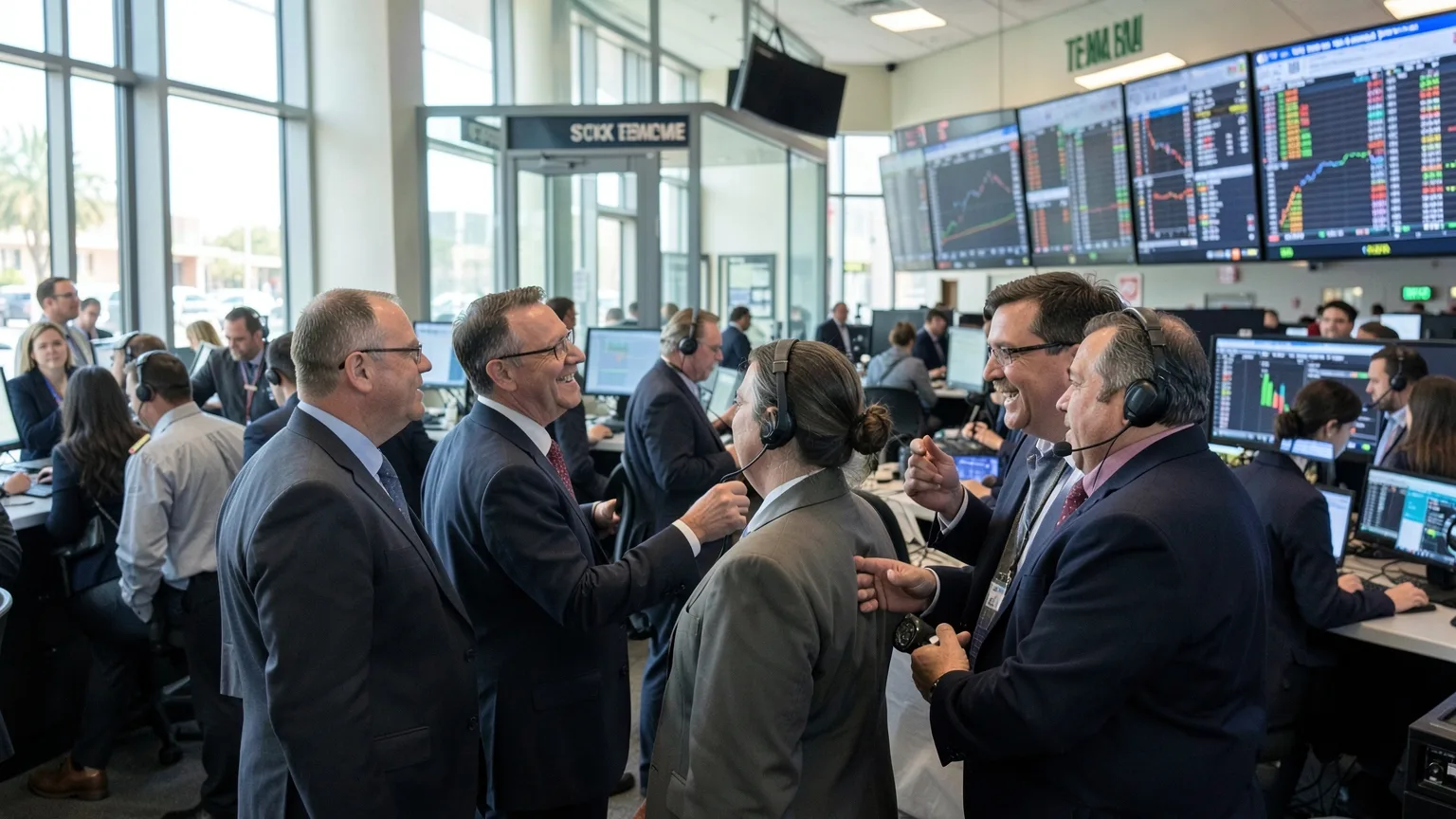
The Dallas-based Texas Stock Exchange began production trading this year, has landed a small slate of primary listings the Dallas Express says are worth roughly US$100 billion and, FinTech Futures reports, has raised large backing from Wall Street firms, but whether it will win sustained liquidity and scale remains uncertain.
A new exchange is operating from Dallas
FinTech Futures reports that the Securities and Exchange Commission approved the Texas Stock Exchange’s application in 2025 and that the exchange launched production trading this year, rolling out trading for national market system symbols in July and beginning ETF listings in September www.fintechfutures.com. The exchange is headquartered in Dallas and has said it moved into corporate primary listings as part of a phased rollout.
The new market is a distinct, Dallas-based venue that explicitly sets out to compete with the New York Stock Exchange and Nasdaq; it is not the longstanding Wall Street incumbents, and the exchange’s backers frame it as another listing destination for U.S. issuers. Former Rep. Jeb Hensarling, a strategic adviser who spoke about the exchange’s ambitions, said Texas is “becoming the economic center of gravity,” and, according to Fox News, supporters call the effort “Y’all Street” www.foxnews.com.
The early listing wins: what they do and do not prove
The Dallas Express reports that Energy Transfer and three related Energy Transfer-affiliated companies (Sunoco, SunocoCorp and USA Compression Partners) moved their primary listings beginning October 5, and that Dillard’s transferred its Class A common stock and trust securities the same day, putting “nearly US$100 billion in corporate market value” onto the exchange with those Energy Transfer-affiliated moves dallasexpress.com. The paper also notes that ETF listings had earlier transferred to the exchange and that October 5 was the first major test for corporate primary listings.

FinTech Futures adds named examples and dates beyond those transfers, reporting that Dillard’s began primary listing on TXSE at the market open on October 5, that CECO Environmental planned to move from Nasdaq on October 19, and that Charles Schwab planned a dual listing on TXSE on October 7 while keeping its primary listing on the NYSE.
Those initial wins are evidence of traction: companies have changed their primary listing venue rather than simply ensuring their shares can be traded on another platform. But the moves by a handful of issuers are not proof that TXSE has displaced the incumbents or reached comparable scale. Observers and the exchange itself describe the transfers as the start of competition for listings, while noting that trading in a security can occur on multiple venues even when one exchange holds the primary listing relationship.
How TXSE says it will compete: capital, backers and a Texas pitch
FinTech Futures reports that TXSE Group has raised a total of US$430 million in capital and that institutional investors including BlackRock, J.P. Morgan, Charles Schwab, Goldman Sachs, Citadel Securities and Bank of America were among the backers in that round. The article says those investors contributed more than three-quarters of the round, and that TXSE reported over US$250 million in capital after a second round closed in November 2025 and an initial raise of nearly US$120 million in June 2024.
TXSE’s executives present that financial backing and its electronic trading infrastructure as the practical means to attract issuers and liquidity. The company has said it is supported by entities directing public companies with more than US$4 trillion in combined market value and by ETF sponsors representing US$11 trillion in assets under management, and it has announced corporate and ETF onboarding plans and listing eligibility updates from major index providers. The exchange’s pitch to issuers emphasizes a Texas-based market and an issuer-friendly listing alternative; the company has also described a strategy of improving market conditions by advocating for issuers against what it calls legacy exchanges’ shifting priorities.
It’s important to separate claims from verifiable operations: the funding figures and backers are reported by FinTech Futures as statements from TXSE and its filings; the exchange’s operational steps (production trading, ETF admission and scheduled corporate listing transfers) are documented in the exchange’s rollout and in public filings and notices. Practically, a company’s incorporation or corporate headquarters is a separate matter from the exchange on which its stock is primarily listed; primary listing status defines the exchange that handles listing compliance and the issuer’s listing relationship even though shares may trade across multiple venues.
The incumbents’ response and the hurdles ahead
Coverage notes that NYSE and Nasdaq remain well-established, with deep liquidity, long lists of listed issuers and mature technology and services. TXSE’s backers and executives frame the new exchange as a third listing alternative; at the same time, observers and reporters describe the move as an early test rather than a market seizure. Fox News summed up the broader uncertainty, saying that whether Texas can “truly rival Wall Street remains an open question”.
What remains uncertain and will determine whether TXSE can build durable business are several practical challenges: whether more issuers follow the first movers, whether trading on TXSE attracts sustained liquidity from market-makers and institutional investors, and whether the exchange can convert its capital and backers into a competitive, long-term listing and trading franchise. The early primary-listing transfers show that some companies are willing to change listing relationships; they do not by themselves show that TXSE has matched the incumbents’ scale in technology, order flow, price discovery or ancillary services that large issuers and investors expect.
This article was created with AI assistance.


