
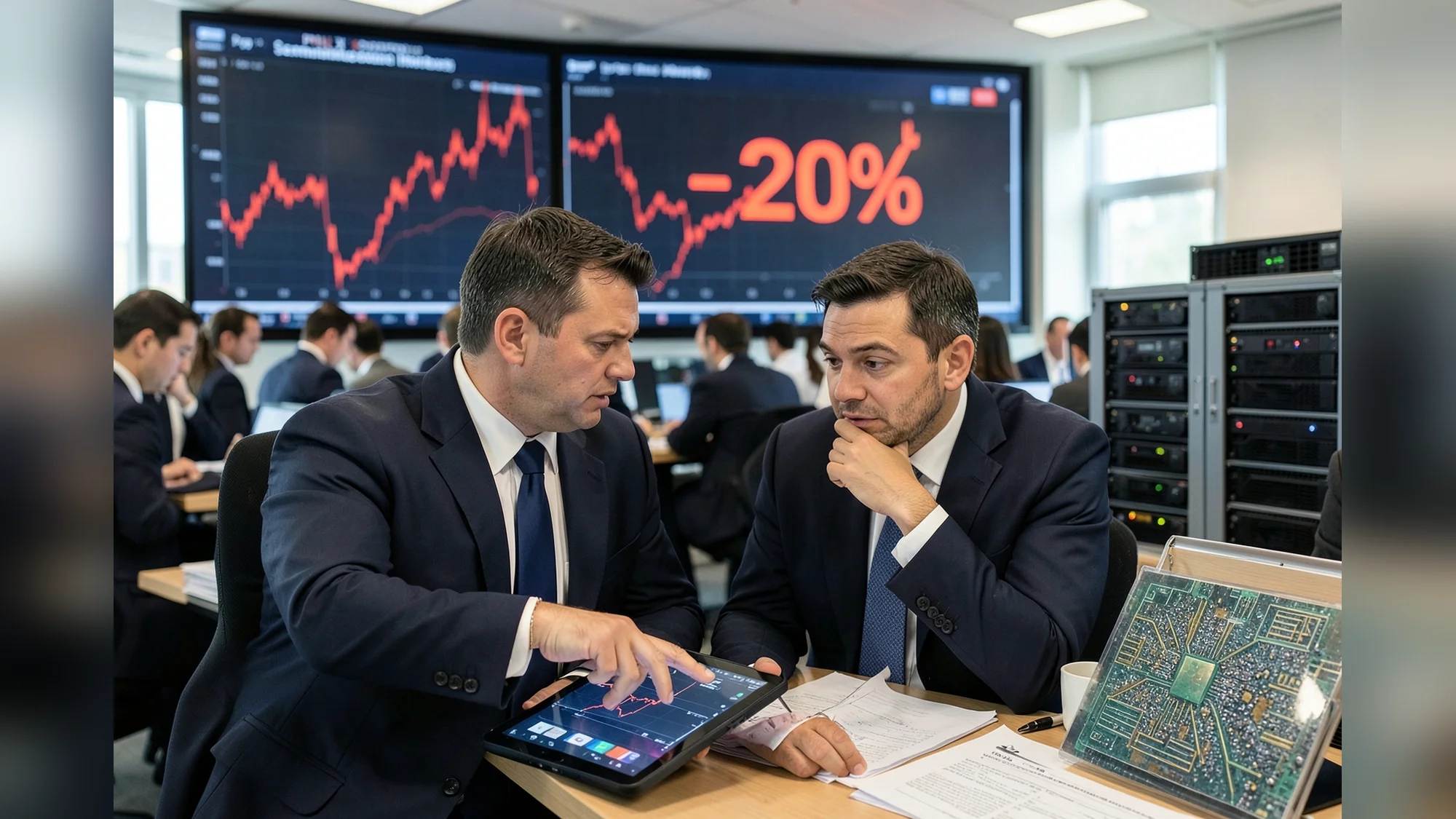
Portfolio managers face a sharper decision after the PHLX Semiconductor Index slid into a technical bear market, trading roughly 20 percent below its all-time closing high following a roughly 10 percent drop last week that investors tied to a new Chinese AI model and heavy profit-taking. The rout forced a public split on Wall Street, with JPMorgan flagging a seasonal summer buying moment for semiconductors while Morgan Stanley urges clients to concentrate exposure in hyperscaler-related positions. Company reactions intensified the sell-off: IBM plunged about 25 percent on one trading day after a preliminary second-quarter update that showed $17.2 billion in revenue, roughly $660 million below Wall Street estimates, and adjusted earnings of $2.93 a share versus a $3.03 consensus.
The immediate effect is clearer segmentation in the technology trade, and the cause is the market reassessing where growth and profit will actually land. Investors re-priced memory and AI infrastructure specialists after fresh demand and valuation questions surfaced, and that re-pricing showed up in both company earnings reactions and index moves. Memory suppliers were among the hardest hit as traders weighed whether the AI-driven memory boom can sustain current pricing.
JPMorgan and Morgan Stanley now offer opposing playbooks. JPMorgan has argued the pullback, combined with the mechanics of memory pricing, creates a tactical entry for investors who want exposure to the AI build-out. Morgan Stanley has counseled a different path, recommending a narrower position tied to the hyperscalers and platform providers most likely to capture the lion's share of AI infrastructure spending, and warning against broad semiconductor bets. That divergence has become the focal point for portfolio managers deciding whether to add cyclical chip exposure or remain concentrated in cloud and hyperscaler franchises as the AI cycle evolves.
The split follows a volatile stretch for individual names. IBM's one-day plunge of about 25 percent followed its preliminary second-quarter numbers showing $17.2 billion in revenue, roughly $660 million below Street estimates, and adjusted EPS of $2.93 versus a $3.03 consensus.
Market analysts linked part of IBM's miss to customer capital spending shifting into servers, storage and memory to lock in supply, a move that helped push some chip and memory stocks lower even as server and component makers reported strength. Taiwan Semiconductor Manufacturing Company delivered a strong earnings beat that nevertheless failed to calm traders, underscoring the uneven response across chipmakers.

At a structural level, the sell-off widened a split inside technology where chip profits and software performance no longer move in lockstep. The 52-week correlation between the iShares Expanded Tech-Software Sector ETF and the iShares Semiconductor ETF has dropped toward lows not seen in decades, reflecting investor treatment of chips as a distinct, infrastructure-oriented trade while software budgets face more discretionary pressure.
Macro and geopolitical factors amplified the moves, with earnings calendars and global risk sentiment helping to swing risk-on and risk-off flows through mid-July.
Market participants say the debate now boils down to allocation style. One camp sees the downturn as a buying opportunity tied to memory shortages and infrastructure demand and favors a broader semiconductor tilt.
The other camp sees rising competition among AI models and valuation risk as reasons to concentrate bets on the hyperscalers and the platform providers that sell them capacity. That practical split matters because it affects not just which stocks get bought but how portfolios are rebalanced across sectors and regions.
Trading patterns have followed the argument. The PHLX index's roughly 10 percent weekly drop crystallized the debate inside investment desks, according to MarketWatch, and the move was the sector's worst such weekly performance since April 2025. For portfolio managers, the choice is tactical timing on a wider semiconductor rebound or a strategic tilt toward a narrower set of companies expected to capture the bulk of AI infrastructure spend.
Related Articles
- Morgan Stanley keeps 8,000 S&P target; warns Fed won't rescue
- TSMC Q1 Profit Jumps 58% to a Record
- Samsung stock falls 7% despite 19-fold profit surge
The next concrete signpost is the mid-July earnings calendar and accompanying shifts in global risk sentiment; those results should determine whether the banks' divergent guidance narrows or the split becomes the new default for tech allocations. Originally reported by marketwatch.com.
This article was created with AI assistance.


