
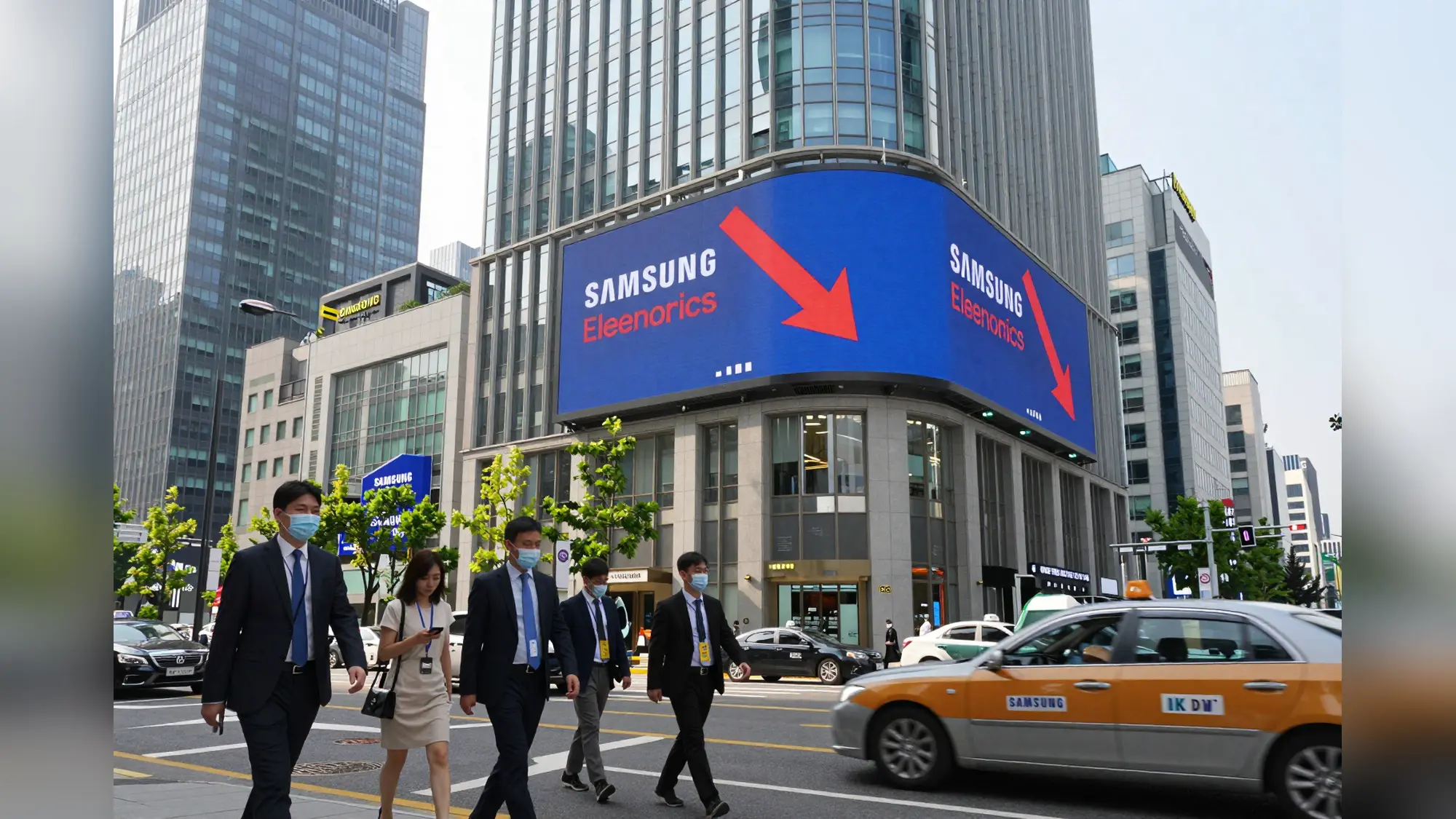
Shares plunged as much as 10% intraday and closed about 7% lower in Seoul on July 7, 2026 because traders locked in gains after Samsung reported a preliminary second-quarter operating profit roughly 19 times higher than a year earlier. The company posted operating profit of 89.4 trillion won for the three months to June, versus 4.68 trillion won a year earlier, and revenue of about 171 trillion won against 74.6 trillion won, MarketWatch reported using FactSet figures. MarketWatch said the sell-off was driven by profit-taking after a sharp run-up in the stock this year, with Samsung up about 50% in the prior three months and nearly 150% year-to-date in 2026. Full second-quarter financial statements will arrive at the end of July 2026, giving investors the complete picture.
The stock plunged because the market had already been positioned for exceptionally strong results, prompting widespread profit-taking, MarketWatch reported. Traders who bought into the rally earlier this year moved to lock in gains after the preliminary numbers, sending Samsung down as much as 10% intraday. That pattern matched a classic "sell on the news" move, MarketWatch said, reflecting how stretched the rally had become after the stock returned roughly 50% in the prior three months and almost 150% year-to-date.
The numbers were historic. Samsung’s preliminary operating profit for the quarter was 89.4 trillion won, compared with 4.68 trillion won in the year-earlier period, and revenue was about 171 trillion won versus 74.6 trillion won a year earlier, according to MarketWatch citing FactSet. The operating-profit figure slightly topped the FactSet consensus of 87 trillion won, which helps explain why analysts mostly kept positive stances rather than cutting forecasts.
The semiconductor division was the principal driver, with higher average selling prices for high-bandwidth DRAM and NAND memory cited as the core reason for the earnings jump. Coverage linked the strength to robust demand from AI server deployments and premium memory sales, which pushed operating margins and cash generation sharply higher in the quarter. Tight supply conditions for memory also lifted pricing, boosting profitability across the segment.
Analysts remained broadly constructive despite the share-price reversal. JPMorgan kept an overweight rating with a price target near 480,000 won, and Citi set a 530,000 won target while calling Samsung well positioned as an end-to-end AI supplier. The FactSet mean target cited in the coverage was about 487,000 won, and the reporting noted that most recommendations stayed positive, suggesting the market reaction reflected short-term trading dynamics rather than a fundamental downgrade.
Short-term traders and recent buyers who chased the rally were most vulnerable to the quick reversal, while long-term investors and firms with structural exposure to AI-driven memory demand stand to benefit if elevated pricing persists. The coverage highlighted that analysts expect supply-demand dynamics to sustain favorable memory pricing into the second half of 2026, which would support margins. Investors will get the full second-quarter financial statements at the end of July 2026, when Samsung releases detailed results.
Related Articles
- Samsung may push DRAM prices 20% and weigh U.S. listing
- Micron stock jumps 15% after $41.46B quarter
- Morgan Stanley keeps 8,000 S&P target; warns Fed won't rescue
Samsung will publish full second-quarter results at the end of July 2026.
This article was created with AI assistance.


