
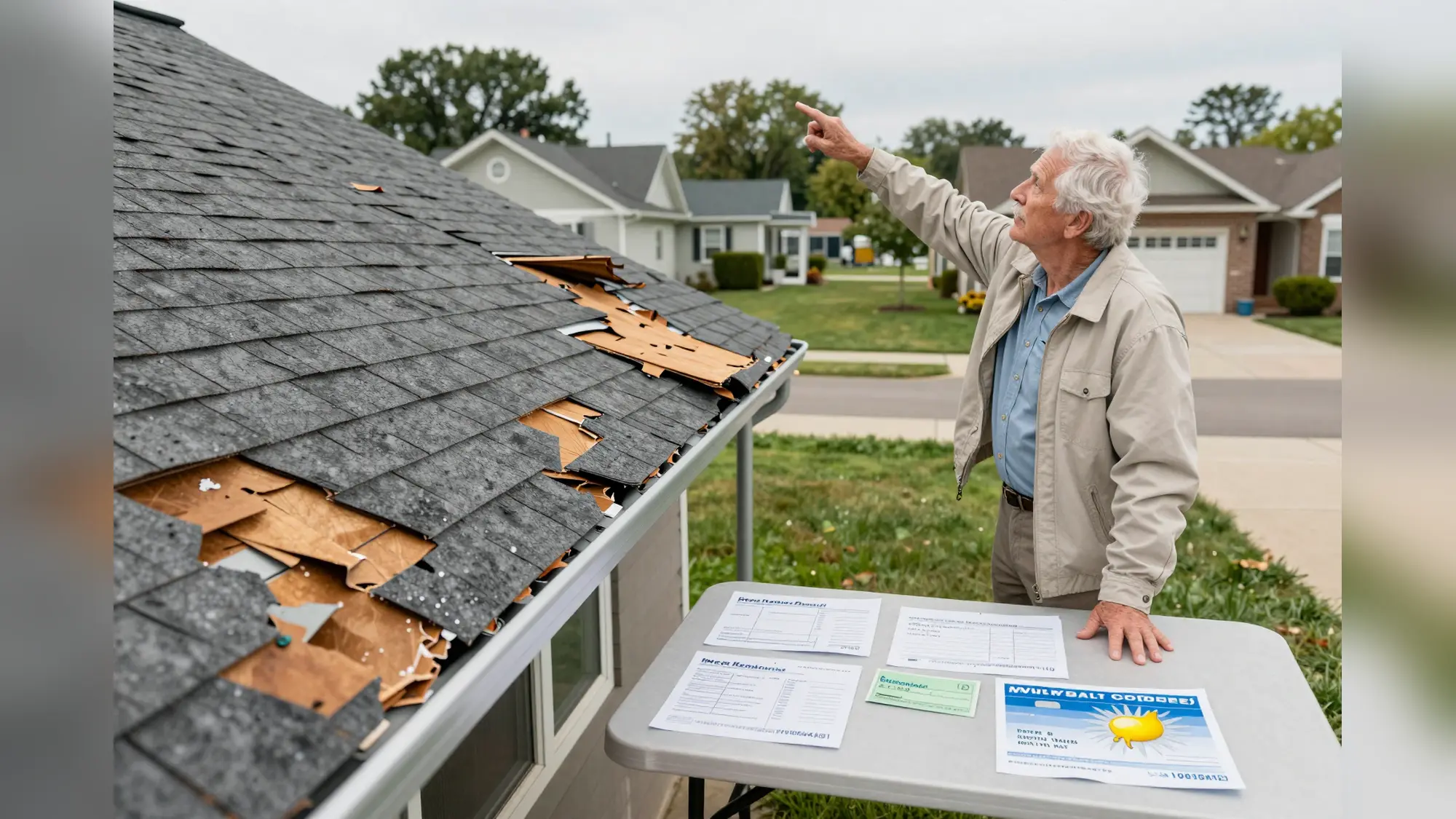
$10,000 was the revised damage estimate loss adjusters ultimately attributed to a single storm that a homeowner says lifted and blew off multiple shingles and damaged gutters. The claimant, a disabled senior who has held homeowners coverage since 1982 and with the same company since 2008, initially received an insurer estimate that left them with under $600 after the policy's $2,000 deductible. The first adjuster limited replacement to the front portion of the roof, and the homeowner refused to accept the small payment. After compiling weather reports and three independent roofing estimates, a second inspection raised the insurer's estimate to about $10,000 before the deductible.
$10,000 was the price tag after a second inspection expanded the claim to include hail damage across the entire roof and replacement of the gutters. The policy carries a $2,000 deductible, the figure that decided how much the homeowner would pay out of pocket under the insurer's initial scope. That first scope, limited to the front portion of the roof, produced a settlement of less than $600 once the deductible was applied. The homeowner declined to sign or deposit the check because they didn't want the payment treated as acceptance of the settlement. Three independent roofing estimates changed the picture. Two contractors recommended replacing the entire roof but still said the homeowner would owe nearly $5,000 beyond the insurer's initial payment. A third contractor documented hail damage across the roof and the gutters and concluded both needed replacement. When the homeowner's roofer raised the hail finding with the insurer's agent, the agent told the roofer there had been no hail in the area for more than a year. The homeowner then compiled weather reports, government data and news coverage documenting hail at the time of the storm, and after repeated requests the insurer sent a second adjuster. That second inspection confirmed hail damage to the entire roof and gutters and produced an increased estimate of about $10,000 before the $2,000 deductible. The homeowner retained recordings, written estimates and insurance documents to support the expanded claim. They say the discrepancy between the first and second adjusters is alarming because many policyholders would have accepted the small initial payment and paid for the remaining repairs themselves. Quentin Fottrell, the Moneyist columnist who answered the homeowner's letter, said it's impossible without seeing the adjusters' reports to determine whether the first inspection reflected carelessness or incompetence rather than malice. He recommended that if the insurer doesn't accept the documentation the policyholder notify their state insurance regulator. The sequence illustrates how scope, deductible and documentation drive what policyholders actually receive. First, a narrow initial scope that limits replacement to part of a roof can yield an award that looks negligible once a deductible is subtracted. Second, independent contractor estimates that recommend full replacement can change the economics for a homeowner, but they require paperwork and persistence. Third, weather data and published reports can be decisive when an insurer disputes whether hail occurred. In this case the homeowner assembled multiple forms of evidence and secured a second inspection that substantially changed the insurer's view. For homeowners making a similar claim the practical steps taken here are all spelled out in the record: don't endorse a settlement you believe is incomplete, get independent contractor estimates, collect contemporaneous weather and news records, and keep written and recorded communications. If those measures don't produce a fair outcome, the homeowner was advised to bring the dispute to the state insurance regulator.Related Articles
- Golf buddy adviser ended friendship after 2 years
- $6.5 Million at 50: Quitting a $200K Job Is Doable
- US Building Insurance vs Contents Insurance 2026 — What You Need
The claim now stands at roughly $10,000 before the $2,000 deductible. If the insurer refuses the documentation, the homeowner has been advised to notify their state insurance regulator. Originally reported by MarketWatch.
This article was created with AI assistance.


