
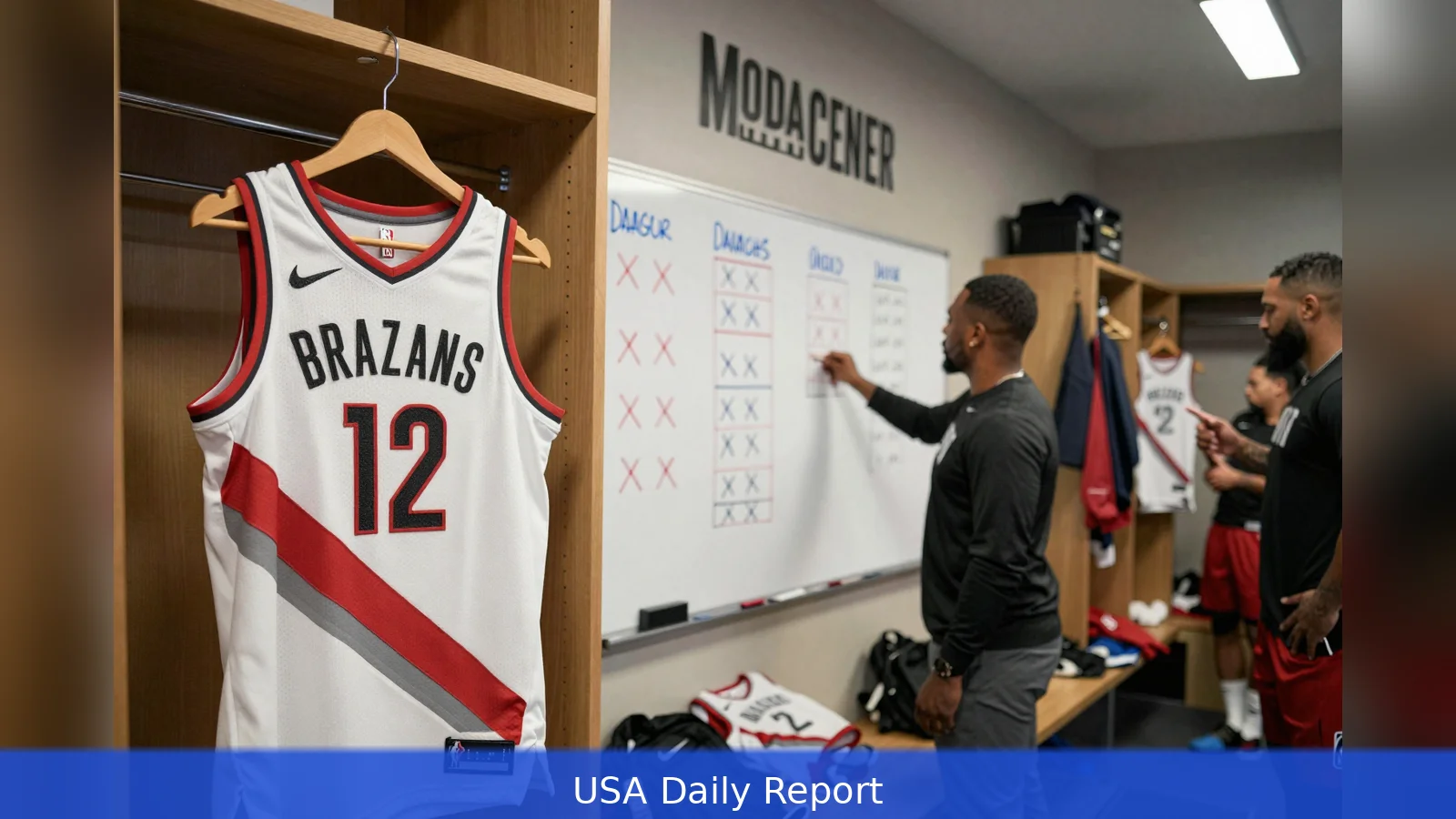
Inside the Moda Center locker room on Monday a Trail Blazers jersey bearing Ja Morant's name hung on a peg, a visible signal that Portland is committing to a costly roster pivot. The Blazers acquired Morant in a three-player trade with Memphis that sent Jerami Grant and Kris Murray to the Grizzlies and delivered Morant's remaining two-year contract to Portland, a roughly $87 million combined commitment, Reuters reported. Portland is betting that a two-time All-Star will accelerate its push from a first playoff return since 2021 into sustained contention while accepting both a large near-term salary load and reputational risk tied to Morant's availability. The move reshapes backcourt choices around Damian Lillard, Jrue Holiday and emerging guards, and it forces new calculations for luxury-tax and cap planning.
Whiteboards in Portland's coaches room were already scribbled with new lineups Tuesday as staffers tried to picture how Ja Morant fits into the rotation, and how minutes might be carved with Damian Lillard, Jrue Holiday and younger guards. The visual was immediate and practical: a franchise that returned to the playoffs after a multi-year absence now must reconcile two All-Star level ball handlers in a single backcourt, plus the defensive and spacing questions that arrangement creates.
Portland sent Jerami Grant and Kris Murray to Memphis in exchange for Morant. Grant was one of Portland's primary scorers last season. Murray, a wing and rotation piece across three seasons, has provided limited production and is on an expiring contract next summer. Those are immediate, functional pieces rather than future first-round capital, which makes this a short-term, win-now roster design.
The prize is Morant, 26, a two-time All-Star under contract through 2027-28 whose remaining salaries are listed at $42.17 million for 2026-27 and $44.89 million for 2027-28, a combined commitment of roughly $87 million, Reuters reported. On the court Morant brings elite playmaking upside: across 327 career games through 2026 he averaged 22.4 points, 7.4 assists, 4.6 rebounds and one steal per game. That production is the core of Portland's calculation: elite creation that can transform a roster’s offensive ceiling.
Risk and roster logistics
The trade also brings well-known risks. Morant has been limited by injuries and league discipline in recent seasons. He played 20 games last season and 79 over the past three years, missing more than 100 games in his career for injuries and a 25-game suspension in 2023 after an incident involving a firearm on social media. Those gaps in availability and episodes of off-court conduct have reduced his recent on-court efficiency and are part of the reputational trade-off Portland accepted.

From a construction standpoint Portland now faces several choices. League reporters said coaching discussions might include pairing Morant with Lillard in the starting backcourt, a union that would concentrate the team’s primary creation in the guard spots. That would push Jrue Holiday to more specialized minutes and force the team to re-evaluate usage rates for breakout wing Deni Avdija and young guards Scoot Henderson and Shaedon Sharpe.
The club will also need to account for the sizable near-term salary load in luxury-tax and cap calculations.
For Memphis the trade accelerates a clear rebuild. The Grizzlies finished 25-57 last season and have already moved on from the core that delivered consecutive Southwest Division titles in 2021-22 and 2022-23. Earlier deals sent Desmond Bane to Orlando and Jaren Jackson Jr. to Utah. With Grant returning and Murray added, Memphis signaled a roster reset centered on younger assets, including Cameron Boozer, the No. 3 pick in the 2026 draft, while also taking back Grant's veteran presence and Murray's cost-controlled upside.
Portland's choice to accept immediate veteran salary rather than hoard draft capital frames its timeline. The Blazers traded for established floor-level production and star power aimed at accelerating postseason ambitions rather than pausing for longer-term rebuild choices. That's consistent with a franchise that just made the playoffs for the first time since 2021 and that evidently values a quicker path back to deeper postseason runs.
The human and commercial side of the swap will be visible in both cities. Earlier-season attendance, merchandise and local sponsorship narratives in Memphis and Portland are likely to reflect the change. For Portland the boost in star power arrives with increased public-relations scrutiny because of Morant's history. For Memphis the reset offers a cleaner slate and an infusion of younger, lower-cost talent that aligns with a multi-year rebuilding calendar.
Contract and cap work will keep front offices busy. Morant remains on contract through 2027-28 and will be eligible for free agency in 2028, a date that frames Portland's medium-term options. The Blazers also accepted the immediate luxury-tax implications that come with Morant's remaining salary and the shifted roles for players on more modest contracts.
Related Articles
- Hovland wins Travelers in Monday playoff, upends FedEx Cup and betting markets
- Record tappable home equity fuels lender rate competition
- 99% Adoption, 7% Confidence: Rethink Financial Marketing
The 2026-27 season will be the first test of how Morant and Portland's retooled backcourt fit together. Morant's free agency eligibility in 2028 now sets the timetable for whether the franchise doubles down or treats this as a two-year audition.
This article was created with AI assistance.


