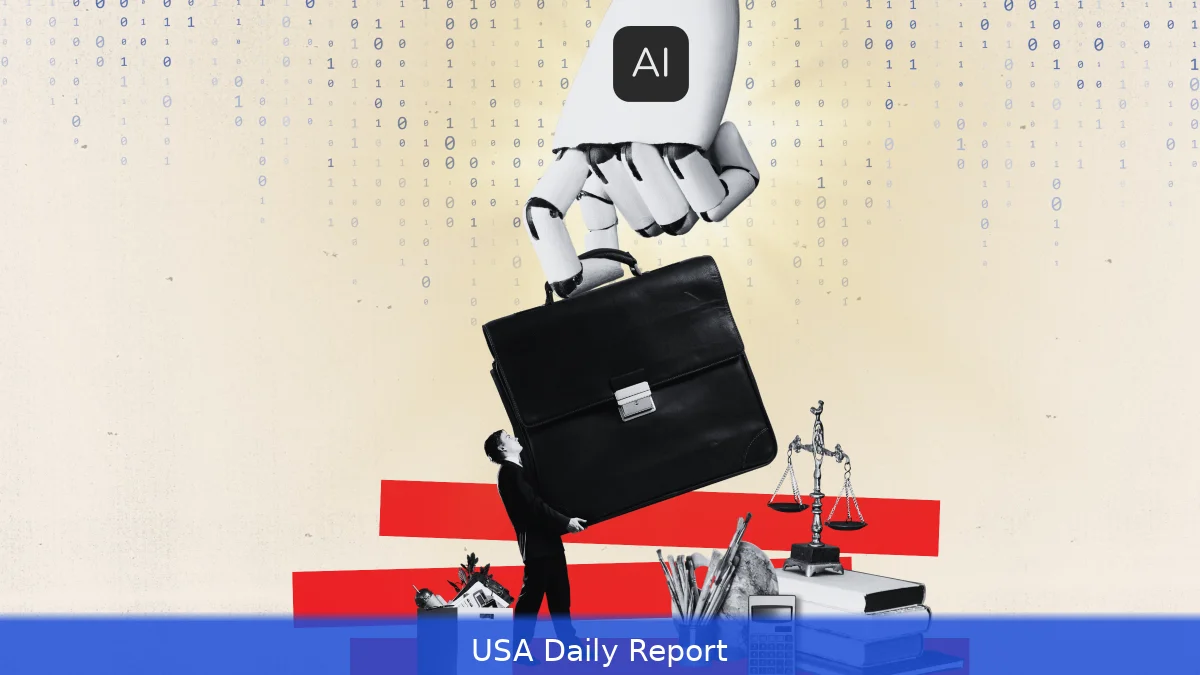
AI isn’t just a future threat anymore; it’s already changing the U.S. job market. By 2026, many roles, especially entry-level white-collar and routine jobs, will face serious disruption. But not all jobs are equally vulnerable, and some sectors and regions will feel the impact more than others.
Current State of AI and Job Risk in the U.S.
Artificial intelligence is reshaping the American workforce faster than many expected. According to a 2023 Goldman Sachs report, generative AI could affect around 300 million jobs worldwide. In the U.S. Alone, this translates to a huge share of the workforce facing changes — with estimates that 25% to 50% of tasks within many roles may become automatable by 2026. This isn’t about small changes—whole workflows are being rebuilt to work with AI.
Automation has already transformed sectors like manufacturing, where roughly four million jobs have disappeared over recent decades, as Andrew Yang, a former presidential candidate, has pointed out. Those job losses were largely due to robotics and mechanical automation. Now, AI threatens to upend white-collar work previously considered safe from automation. Entry-level consulting roles, paralegal positions, and some legal research jobs are increasingly at risk as AI tools can quickly analyze documents, draft reports, and even generate legal arguments.
Meanwhile, AI-powered chatbots and virtual assistants have started replacing customer service representatives in call centers across the U.S., signaling a shift in how routine communication tasks are handled. The legal, financial, and administrative sectors are all undergoing transformations, with AI supplementing or supplanting tasks that were once thought to require a human touch.
Key Developments Driving Job Risk
Jobs at highest risk usually involve routine tasks that AI can do well. Goldman Sachs classifies jobs into three risk levels based on task automation potential, with specific examples:
- High risk: Data entry clerks, customer service representatives, bookkeepers, telemarketers, basic paralegals, bank tellers, travel agents, tax preparers, mail sorters, and basic content writers face the highest threat. These roles involve repetitive tasks that AI systems already perform with increasing accuracy and speed. For example, AI transcription and data extraction tools can complete in seconds what took humans hours. In call centers, AI chatbots handle up to 70% of routine inquiries, reducing demand for human reps.
- Medium risk: Accountants who focus on routine data processing and report generation are vulnerable, but advisory roles remain safer. Junior programmers face medium risk as AI coding assistants like GitHub Copilot can write and debug simple code snippets, although complex software development still requires human expertise. Radiologists and other medical imaging specialists are seeing AI tools capable of reading scans and spotting anomalies faster, but final diagnosis and patient care remain human-led. Financial analysts and translators also fall into this category, as AI can automate data crunching and initial translations but not nuanced decision-making or cultural context.
- Low risk: Skilled tradespeople such as electricians and plumbers, healthcare workers like nurses, therapists, social workers, teachers, surgeons, creative directors, emergency responders, and childcare workers are least threatened. These jobs require complex manual skills, emotional intelligence, creativity, or critical judgment that AI can't replicate effectively. For instance, AI may assist surgeons with imaging or diagnostics, but it won’t replace hands-on surgical procedures anytime soon.
It’s important to note that AI tends to replace specific tasks rather than whole jobs. According to McKinsey’s 2022 research, about 60% of all U.S. Jobs have at least 30% of tasks that could be automated. This means most workers won’t be fully replaced but will need to adapt by focusing on tasks AI can’t do well—like management, creativity, or interpersonal skills.
Industry Impacts and Regional Differences
Wall Street has been one of the earliest adopters, using AI for algorithmic trading, risk assessment, and customer service automation. Major financial firms such as JPMorgan Chase and Goldman Sachs are investing heavily in AI-driven tools to streamline operations and reduce costs.
For example, JPMorgan’s COIN platform analyzes legal documents and contracts, cutting down manual review time from 360,000 hours annually to seconds.
In the legal sector, firms are deploying AI to handle contract analysis, due diligence, and discovery. Companies like IBM with Watson Legal and startups such as LawGeex automate routine legal work. This trend is causing entry-level paralegal jobs to shrink, while demand for lawyers with AI oversight skills is rising.
The healthcare industry is adopting AI in diagnostic imaging, patient monitoring, and administrative tasks. Radiology AI tools by companies like Zebra Medical Vision and Aidoc assist in detecting conditions from X-rays and MRIs faster than traditional methods. However, clinical roles involving patient interaction remain largely unchanged.
Manufacturing and logistics continue to integrate AI and robotics for predictive maintenance, inventory management, and quality control. Regions like the Midwest, historically reliant on manufacturing jobs, face ongoing disruption. However, new AI-driven roles in tech development and system oversight are emerging in tech hubs such as Silicon Valley and Austin.
AI’s effects differ a lot depending on the region. Urban centers with strong tech ecosystems absorb AI-driven change more quickly and create new job categories. Rural and manufacturing-dependent areas face tougher transitions, as roles there are more routine and less adaptable to AI augmentation. For example, the Rust Belt states report higher risks of job displacement compared to metropolitan areas with diversified economies.
Expert Views on AI and the Workforce
Experts emphasize that AI is a tool that can either displace jobs or boost productivity depending on how businesses and policymakers respond. Erik Brynjolfsson, a leading AI economist at MIT, points out that "AI will automate routine work but also create new tasks requiring human judgment and collaboration." He stresses the importance of workforce retraining and education to prevent widespread unemployment.
Labor economists warn of short-term disruptions that could widen inequality if displaced workers lack access to reskilling programs. The Brookings Institution highlights that workers in low-income and minority communities are disproportionately employed in high-risk roles, raising concerns about economic fairness.
On the policy front, the Biden administration has rolled out initiatives like the National AI Initiative Act of 2020, which allocates funding for AI research and workforce development. The U.S. Department of Labor launched the AI Apprenticeship Program in 2023 to train displaced workers in AI-related skills. Still, experts argue more aggressive measures are needed to support transition for vulnerable workers.
What’s Next: Preparing for the AI Shift
As 2026 approaches, the U.S. Workforce faces a turning point. Companies are expected to increasingly adopt AI tools, accelerating task automation. Job seekers and workers will need to focus on skills that complement AI, such as critical thinking, creativity, emotional intelligence, and complex problem-solving.
Education systems are beginning to integrate AI literacy and digital skills into curricula. Tech companies like Microsoft and Google offer AI training programs accessible to millions. Meanwhile, industries that combine human expertise with AI tools—like healthcare, education, and creative fields—are poised for growth.
Policy experts suggest expanding social safety nets and creating incentives for lifelong learning. The ongoing dialogue around AI governance includes ethical AI use, data privacy, and preventing bias in automated systems—all crucial to ensuring AI benefits society broadly.
In sum, AI will reshape many American jobs by 2026, but the extent depends on adaptation efforts from workers, businesses, and governments alike. The coming years will test the country’s ability to manage this technological shift without leaving large segments of the workforce behind.
AI will shake up many American jobs by 2026, especially those built on routine tasks. High-risk roles like data entry, telemarketing, and basic legal work face big changes. But skilled trades, healthcare, and creative professions remain more secure, emphasizing the need for workers to adapt and acquire new skills to stay relevant.


