
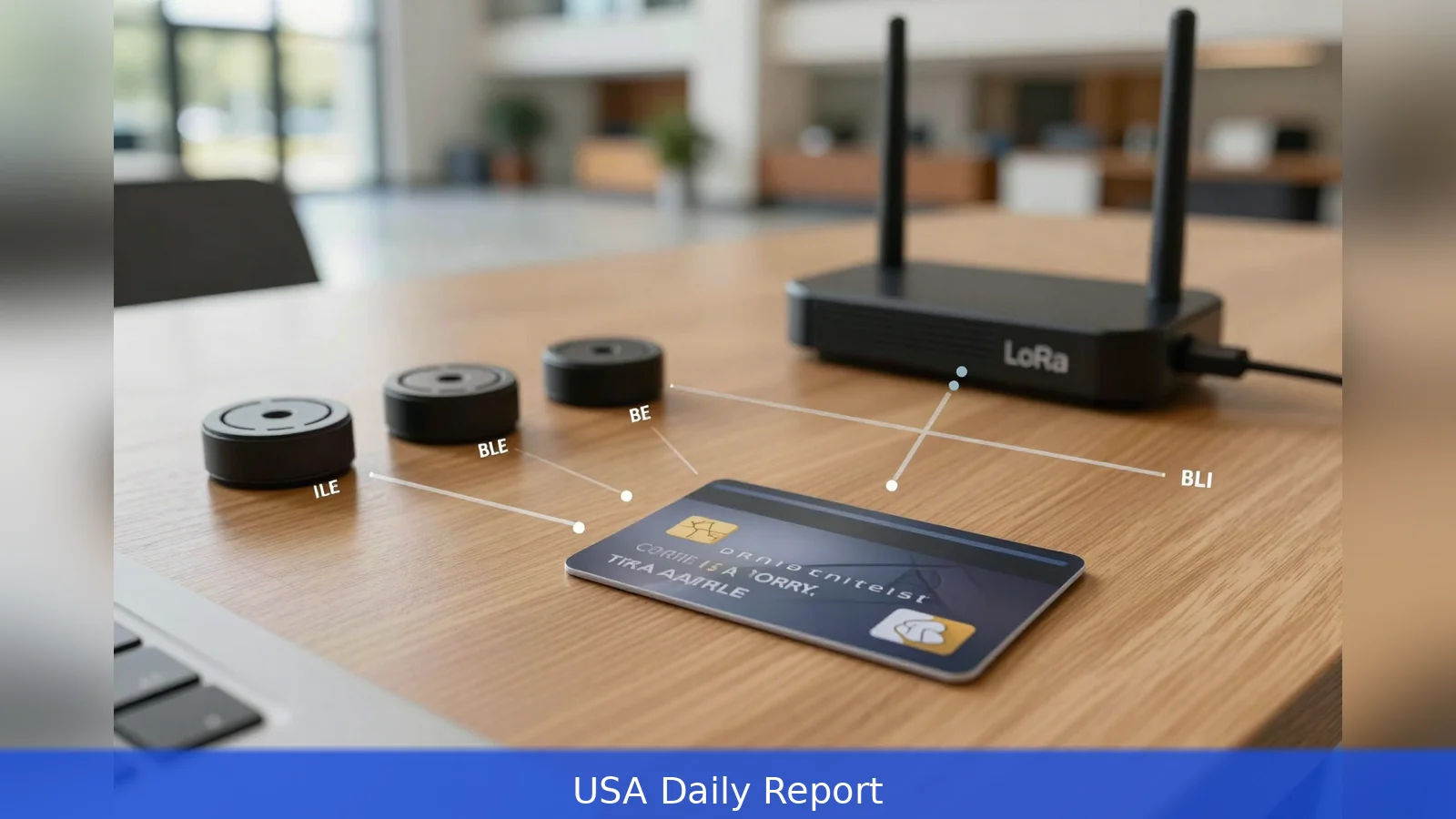
Buildings and campuses can now track lost items without Wi-Fi or cellular backhaul because small Bluetooth tags calculate precise coordinates locally and then report them over LoRa mesh or LoRaWAN. Seeed Studio’s SenseCAP T1000-E pairs a Bluetooth Low Energy radio and BLE-based positioning logic with LoRa mesh and LoRaWAN connectivity, letting trackers compute location by trilateration and push that data long range. The device supports two positioning modes, an accelerometer that drives power-saving reporting, and a panic button that sends an immediate SOS over LoRaWAN. Seeed Studio bundles the card into its SenseCraft Solution platform and starter kits to simplify campus rollouts and reduce the number of gateways required.
Fewer gateways are required because the trackers do the heavy lifting: they range to nearby BLE beacons, compute x,y coordinates at the edge, and transmit those coordinates over low-power, long-range LoRa links to a single receiving gateway that can serve many nodes.
That is the basic idea behind Seeed Studio’s SenseCAP T1000-E, a compact, IP65-rated card-sized tracker that combines onboard GPS, a BLE radio for indoor ranging, and LoRa transceivers compatible with common LoRa bands. Product listings and a hands-on review describe the unit as both a BLE tag for fine-grained indoor sensing and a LoRa node for long-range reporting. The design aims to untether asset and personnel tracking from Wi-Fi and cellular infrastructure by moving positioning into the tracker and using LoRa for telemetry backhaul.
How the positioning works
The T1000-E implements two positioning modes described in Seeed Studio’s documentation. When a tracker detects three or more BLE beacons, it runs high-precision trilateration to compute an x,y coordinate inside a floorplan. When only one or two beacons are visible, it falls back to a simpler zone-based proximity mode that reports which beacon region the tag is in rather than an exact coordinate. The card also supports sensor-driven reporting: an onboard accelerometer can keep the tracker asleep until movement is detected, which preserves battery life in many asset-tracking deployments.
Once the tracker has a position fix, it sends that information via LoRa mesh or LoRaWAN to a gateway. Because LoRa has long range and very low power usage, a single gateway can accept location reports from dozens or hundreds of trackers across a building or campus. That concentration of reporting reduces the number of gateways installers must deploy compared with systems that require numerous Wi-Fi access points or cellular uplinks per floor.

Hardware, software, and the deployment trade-offs
The T1000-E ships as a mesh client out of the box, and the hands-on reviewer at ZDNet noted the device can be flashed with alternative firmware and exposes many features through a maker-focused app. The card supports firmware updates, sensor-driven reporting, and an SOS function: a panic button on trackers will send an immediate distress message over LoRaWAN. Community projects and roundups also list the T1000-E among partner hardware supported by Meshtastic, which makes it attractive to hobbyists building mesh-based tracking or off-grid messaging systems.
But the trade-offs are practical. The ZDNet review measured battery life at two to three days under frequent BLE scanning and reporting in the reviewer’s test conditions, and the reviewer highlighted that the tracker uses a proprietary magnetic charging cable. Seeed Studio’s technical documentation frames battery life differently, saying that with best low-power settings the tracker can last up to six months for many asset-tracking deployments. That divergence reflects the difference between vendor estimates targeted at low-duty commercial setups and hands-on usage that stresses the radio and positioning frequently.
Installers should also plan for a learning curve. Beacon placement, gateway configuration, and firmware choices matter to accuracy and battery life. Seeed Studio’s SenseCraft Solution platform is built to shorten that curve: it walks users through campus-level BLE beacon positioning and offers starter, standard, and enterprise kit options that automate gateway, beacon, and tracker setup, either via a one-click deploy on the SenseCraft platform or by self-hosting with a Docker install. For integrators who want alternative trade-offs in battery life, radio power, or standalone operation, broader mesh projects and other hardware options remain available.
The small size and flexibility of the T1000-E are common points of praise in reviews and community discussion. The card’s GPS helps outdoors, BLE handles indoor ranging, and LoRa carries data back across long distances. That mix makes the device a low-cost, interoperable alternative when the goal is long-range independent reporting combined with fine-grained indoor positioning without relying on commercial Wi-Fi or cellular backhaul.
Still, adopters should match configuration to use case. High-frequency BLE scans and frequent position reports will shorten battery life but improve real-time accuracy.
Conservative duty cycles, accelerometer-driven wake logic, and zone-based reporting extend battery life but deliver coarser tracking. The platform and the card expose those choices; the right balance depends on whether the priority is minute-by-minute location or months between charges.
For makers and small teams, the fact that the T1000-E appears in Meshtastic community hardware lists makes it an easy entry point into mesh tracking. For commercial deployments, Seeed Studio’s SenseCraft kits and documentation aim to reduce integration friction and scale a BLE beacon grid across a facility.
Related Articles
- Data center rule lapses, 70% of Americans oppose new builds
- FBI replica town trains 1,400 agents to fight cyberattacks
- 4 Floodlight Cameras That Improve Nighttime ID
The SenseCAP T1000-E is available from Seeed Studio, sold with SenseCraft starter and enterprise kits. Community projects such as Meshtastic also support the card. Originally reported by zdnet.com.
This article was created with AI assistance.


