
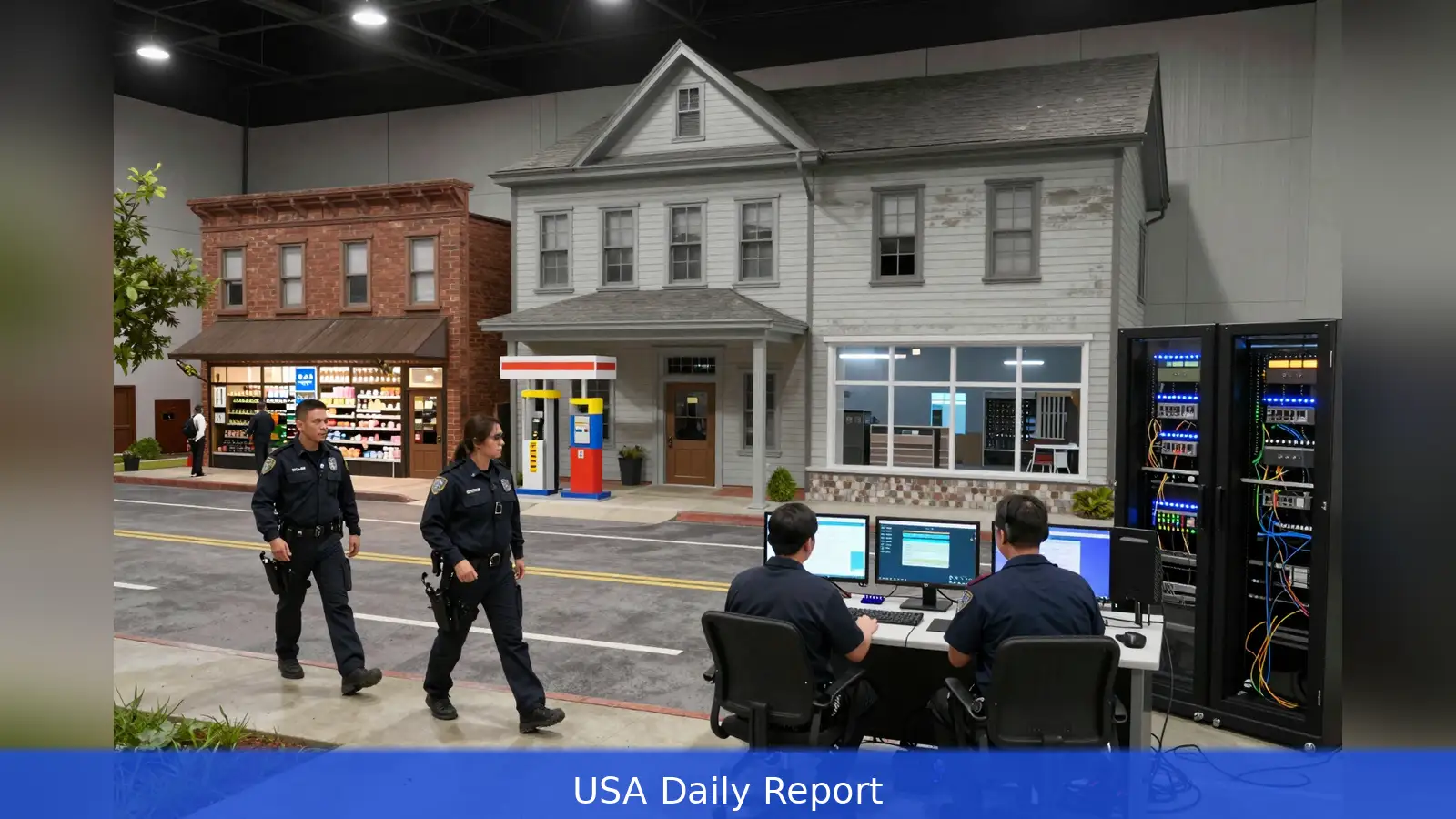
A lifelike American small town that looks ready for block parties now exists to host simulated cyberattacks, not community life. The FBI opened the 22,000-square-foot Kinetic Cyber Range on its Huntsville, Alabama campus in February 2025 to give investigators hands-on practice in simulating and investigating real-world intrusions. The facility recreates houses, a hotel, a gas station, a grocery, a hospital, a courthouse and a power company, all wired to behave like live infrastructure while remaining isolated from the public internet. This bureau says the range trains teams to weigh containment, mitigation and public-safety trade-offs when outages threaten human safety, and it has taught more than 1,400 students since opening.
The kitchen table in one model house shares the same wiring logic as the checkout system at a grocery mart, but the intent isn't realism for its own sake: it's realism to be attacked and defended. The Kinetic Cyber Range pairs physical storefronts and municipal systems with a networked back end and a data center so trainees can experience how cyber intrusions cascade across both digital and physical domains.
The facility occupies 22,000 square feet and is laid out like a small town, with fully furnished homes, a hotel, a gas station, a grocery mart, an arcade, a courthouse, a hospital, a power company, roads and traffic lights. Each building is fitted with functioning systems and connected devices that respond as they would in the field, while exercises run in isolation from the public internet so a simulated breach can't spill outward. The site also houses a data center with more than 200 physical servers running a mix of Windows and Linux to replicate the corporate environments agents encounter during breach response and forensic work.
The setup lets trainers stage scenarios that reproduce downstream consequences of attacks. In some exercises, instructors take hospital systems offline to force investigative teams to prioritize containment and mitigation against patient-safety risks. Those drills are meant to press teams into making high-stakes incident-response decisions under time pressure, including coordinating on-site searches while preserving volatile evidence and executing digital forensics amid operational stress.
Training the investigators who respond to ransomware and more
The range opened to move training beyond classroom instruction and to test the intersection of physical operations and live networked systems. Since February 2025, it has trained more than 1,400 students, including FBI personnel and partners from other federal and local agencies. The bureau framed the investment as a response to the scale of recent cybercrime: the FBI's 2025 Internet Crime Report recorded a record $20.9 billion in U.S. cybercrime losses, a 26 percent increase over the prior year, with ransomware identified as the top ongoing threat to critical infrastructure.

On the technical side, the Kinetic Cyber Range is a place to practice advanced digital-forensics techniques. Trainers teach methods for extracting data from modern devices, and trainees use forensic tools that can interrogate and recover information from encrypted or locked hardware.
The FBI's public description of the program notes those tools operate by exploiting vulnerabilities that aren't disclosed to device makers, a point that has drawn controversy because the tactics defeat protections companies such as Apple and Google build into their products.
Dave Beachboard, the range's program manager, summed up part of the thinking by describing the data center servers as "cold, cramped, noisy, dark, miserable," and said the environment is intended to approximate the real technical conditions investigators face. That blunt appraisal reflects the bureau's effort to strip away classroom polish and force trainees to work in the messy, equipment-heavy conditions they will meet at incident sites.
Beyond technical extraction, the range is about operational trade-offs that don't exist in sanitized labs. Trainers can force a choice between shutting down a compromised power company to blunt a ransomware spread and keeping it live to avoid outages that endanger the public. Those aren't hypothetical trade-offs in the field. Rehearsing them at scale is the explicit purpose of the Huntsville facility.
The location continues a long-standing FBI presence in Huntsville as a hub for technical work. The bureau said the Kinetic Cyber Range supplements other training and readiness investments at the campus, where operators and analysts run exercises that pair digital intrusion scenarios with search-and-seizure practice and chain-of-custody procedures. This controlled environment also allows the FBI to exercise techniques that rely on undisclosed vulnerabilities without exposing those tactics to the wider ecosystem.
That containment is central to how the bureau defends its use of opaque tools. By keeping exploited vulnerabilities isolated to a closed test bed, the FBI argues it can train investigators without creating a pathway for those same weaknesses to be copied or turned into broader attack vectors. Critics counter that any use of undisclosed flaws unsettles device security models and complicates relationships with manufacturers whose protections investigators sometimes need to bypass during criminal probes.
For now, the agency's calculation rests on two linked facts from its recent reporting: cybercrime is rising in scale, and ransomware remains the top threat to critical infrastructure. The Kinetic Cyber Range is the bureau's practical answer to both trends, a place to translate incident-playbook theory into on-the-ground decisions under pressure.
Related Articles
- 4 Floodlight Cameras That Improve Nighttime ID
- 6.78-inch Trump phone mirrors HTC U24 Pro, teardown shows
- Google Gemini brings AI to World Cup, raises error risk
Here's the number that matters: the FBI's 2025 Internet Crime Report recorded $20.9 billion in U.S. cybercrime losses. Originally reported by techcrunch.com.
This article was created with AI assistance.


