
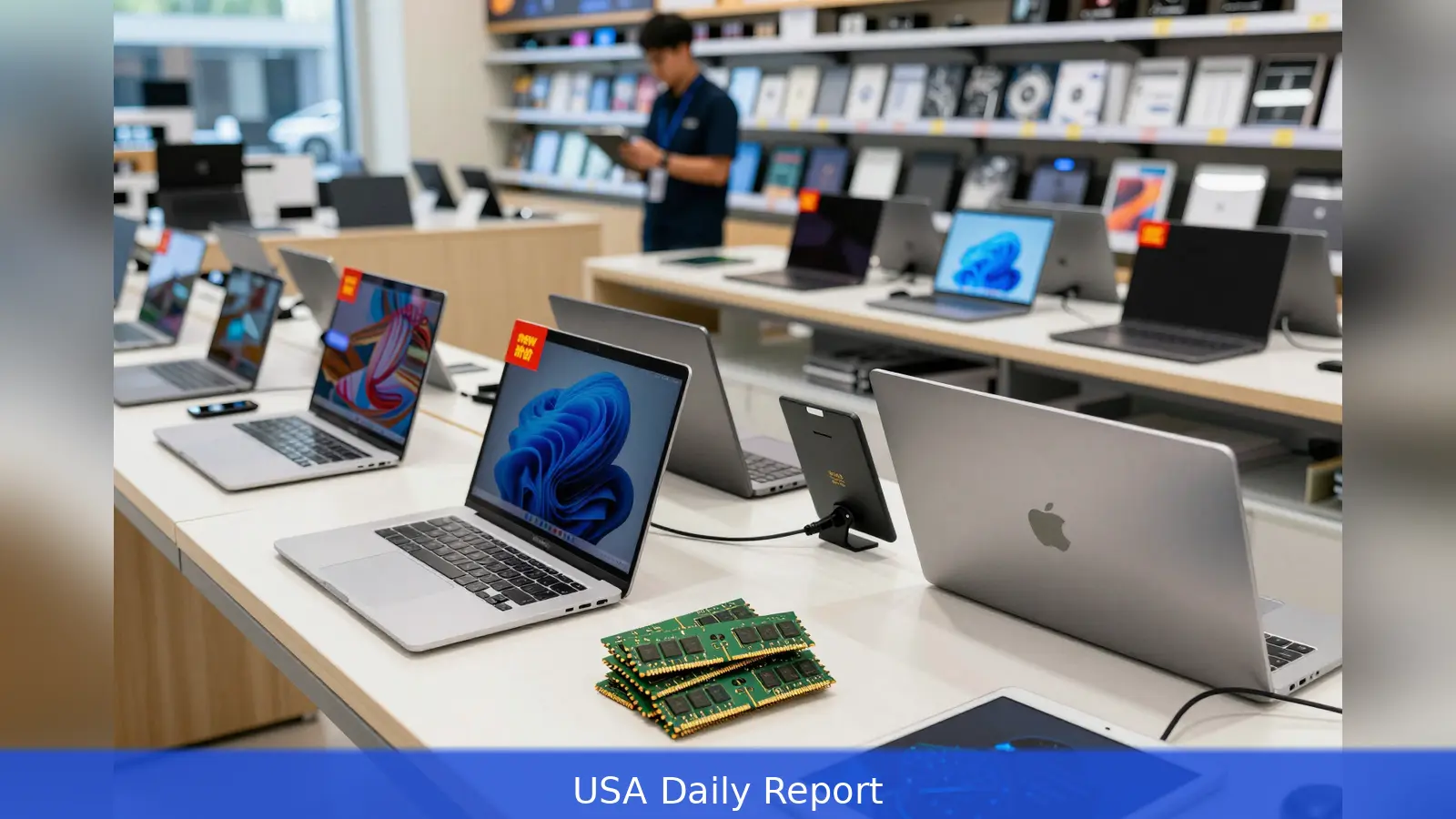
PC prices are set to jump about 17 percent in 2026, and smartphone prices roughly 13 percent, Gartner projects. Those increases trace to a memory squeeze as cloud and AI hardware buyers lock up DRAM, high-bandwidth memory and NAND, leaving fewer chips for consumer devices. Apple on Thursday said surging component costs tied to AI data-center demand forced immediate price increases for affected MacBook and iPad models on its online store, calling the move a challenge for the consumer electronics industry. Best Buy’s incoming CEO Jason Bonfig told reporters the retailer expects its computing division to be hit hardest, and that extra inventory pulled into the first quarter only delayed the pain.
Retailers are reporting higher average selling prices and softer unit demand because cloud providers and AI hardware buyers have been locking up large volumes of DRAM, high-bandwidth memory and NAND flash for AI servers, leaving fewer chips for consumer devices.
AI demand versus consumer supply
CNBC reported that companies including Nvidia, Advanced Micro Devices and Google scrambled to secure RAM for AI workloads, and that aggressive buying by data center customers has tightened supply for device makers. The result isn't a generalized chip shortage but a concentrated shift in memory demand toward AI infrastructure, a change that has wider consequences along the device supply chain.
Gartner senior director analyst Ranjit Atwal said this episode differs from past memory cycles in both scale and duration. He told analysts that the extent to which memory prices are rising is unusual, and he warned regional pricing may not normalize until the end of 2027. That stretch would keep pressure on manufacturers and retailers as they plan inventory and product road maps.
Apple said the price moves were driven by component costs and applied them immediately to its online store, a rare public attribution of retail pricing to memory cost pressure. Best Buy moved in a different direction to blunt the near-term impact: Jason Bonfig said the company pulled extra inventory into the first quarter to smooth the transition, but he cautioned that strategy can only delay the pain. Bonfig said the retailer saw staggered price increases in the first quarter and expects average selling prices and unit demand to be affected in the second quarter.

Market research projections and early retailer signals indicate how those pressures could play out. Gartner projections cited by CNBC estimate global PC shipments will fall about 10.4 percent in 2026 while smartphone shipments will drop about 8.4 percent. The same projections show PC prices rising roughly 17 percent and smartphone prices rising about 13 percent compared with 2025.
Analysts told CNBC that some manufacturers will pass costs through to consumers, others will cut specifications, and some retailers have already pulled forward inventory purchases to blunt short-term cost hits.
The effect for consumers is likely to be gradual but tangible. Many buyers upgrade on multi-year cycles, so higher prices may not immediately change buying behavior. Still, companies that make and sell lower-margin devices will face hard choices: reduce promotions, trim features to preserve price points, or raise retail prices and accept slower sales.
Retailers with deeper margins and stronger inventory positions can delay passing on costs, but those cushions are temporary. The combination of locked-in cloud demand and constrained memory supply means device makers will have to decide whether to absorb higher component costs or shift them to buyers.
Beyond phones and PCs, the coverage noted price and specification moves from console makers and other device vendors who have cited rising RAM and storage costs when announcing changes. That suggests the memory squeeze is cascading across multiple segments of the consumer electronics market, not just traditional computing devices.
For investors and corporate planners, the situation changes the arithmetic of product cycles. Higher component costs and the potential for weaker unit demand force rethinking of promotional calendars, inventory turns and feature road maps. Retailers that relied on promotional cadence to drive traffic will find those levers less effective if manufacturers tighten margins or limit discounting.
One operational response has been to accelerate procurement to secure parts before prices climb further. But analysts and executives who spoke to the press said those purchases only buy time. At some point, supply and pricing have to clear through to the consumer, and that process will determine whether the market shifts toward higher-priced premium models or toward lower-spec, lower-margin alternatives.
Related Articles
- Iger: Disney nearly bought Twitter, held talks with Apple and eyed Bond
- Siri AI: Google cloud power, on-device privacy
- Apple faces $250M settlement as it reboots Siri
Retailers expect the impact to show up in the second quarter, and Gartner’s prediction that memory prices stay elevated through 2027 means pricing, inventory and product road maps for 2026 are already being rewritten. Originally reported by CNBC.
This article was created with AI assistance.


