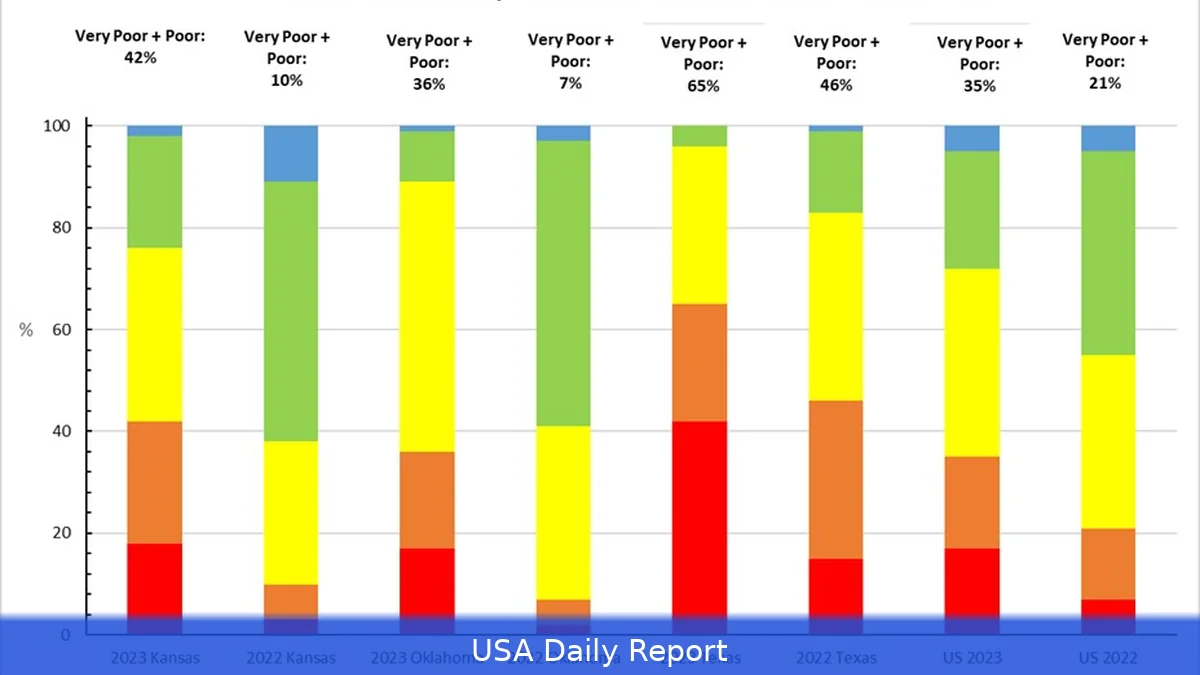
Wheat futures surged to their highest levels in over half a year last week, driven by fears over the U.S. Plains winter wheat crop. Traders are growing more concerned about supply tightness because planting and growing conditions are tough for the hard red winter wheat crop.
Sharp Gains in Wheat Futures
Last Friday, May hard red winter (HRW) wheat futures climbed 8 1/2 cents to $5.85 1/4 per bushel, marking a seven-month peak. Meanwhile, soft red winter (SRW) wheat futures jumped 13 1/2 cents to $5.80 1/4, hitting a 6.5-month high. These gains reflect rising concern over the health of the winter wheat crop that grows across the U.S. Plains, a region critical for overall wheat production.
Both wheat futures contracts closed the week with their strongest gains in months, up 31 1/2 cents on HRW and 38 1/4 cents on SRW. Technical charts show bullish weekly closes, so the rally might continue into early this week. Still, the markets look overbought, so prices might pull back soon.
Crop Worries and Market Dynamics
The rally is driven by several environmental pressures hitting the U.S. winter wheat crop. Dry weather and delayed planting in key Plains states have raised alarms about potential supply shortages. Traders are keeping a close eye on whether the crop recovers as the season moves forward.
Improved trade relations have also boosted grain futures overall. The U.S. Has recently secured agricultural trade deals with global partners, encouraging expectations for stronger demand. But a recent Supreme Court ruling that struck down parts of the Trump administration’s tariff regime introduces uncertainty. That decision could complicate U.S. Trade agreements, making buyers hesitant to lock in purchases and adding volatility.
Broader Grain Market Implications
Because wheat and corn share planting and demand cycles, wheat’s strength often affects corn futures. May corn futures edged up 3 1/2 cents to $4.39 3/4 last Friday, even though the weekly result showed a slight decline.
Corn traders are likely to track the wheat markets closely for cues on price direction this week.
South American corn supplies, particularly Brazil’s second or safrinha crop, are also under the microscope. Planting lags behind last year and the five-year average due to less-than-ideal weather. Some rain is forecasted soon, but moisture remains a key factor for crop potential. Still, no areas are currently in severe drought, which helps ease some concerns.
What This Means for Buyers and Sellers
Farmers and grain buyers now face more urgent decisions about marketing and hedging due to the rally. Wheat growers might see an opportunity to lock in higher prices if the market holds, but the specter of a correction means timing will be critical. Buyers, meanwhile, face the challenge of navigating price swings amid uncertain crop prospects and trade policies.
Grain markets will also react quickly to any changes in U.S. trade policy or global demand. The Supreme Court ruling has cast a shadow of doubt over the stability of recent trade deals. If the U.S. Government pursues legal workarounds to reinstate tariffs, or if trading partners react negatively, prices could see renewed volatility.
In the coming weeks, traders and analysts will watch weather updates and crop reports closely. The Plains winter wheat crop condition reports released by the U.S. Department of Agriculture will be particularly important for gauging the market’s next moves.
With winter wheat spreads at seven-month highs, the market stands at a crossroads. Crop fears and trade uncertainties loom large, leaving traders and farmers alike on edge as they await fresh signals from weather patterns and policy developments.


