
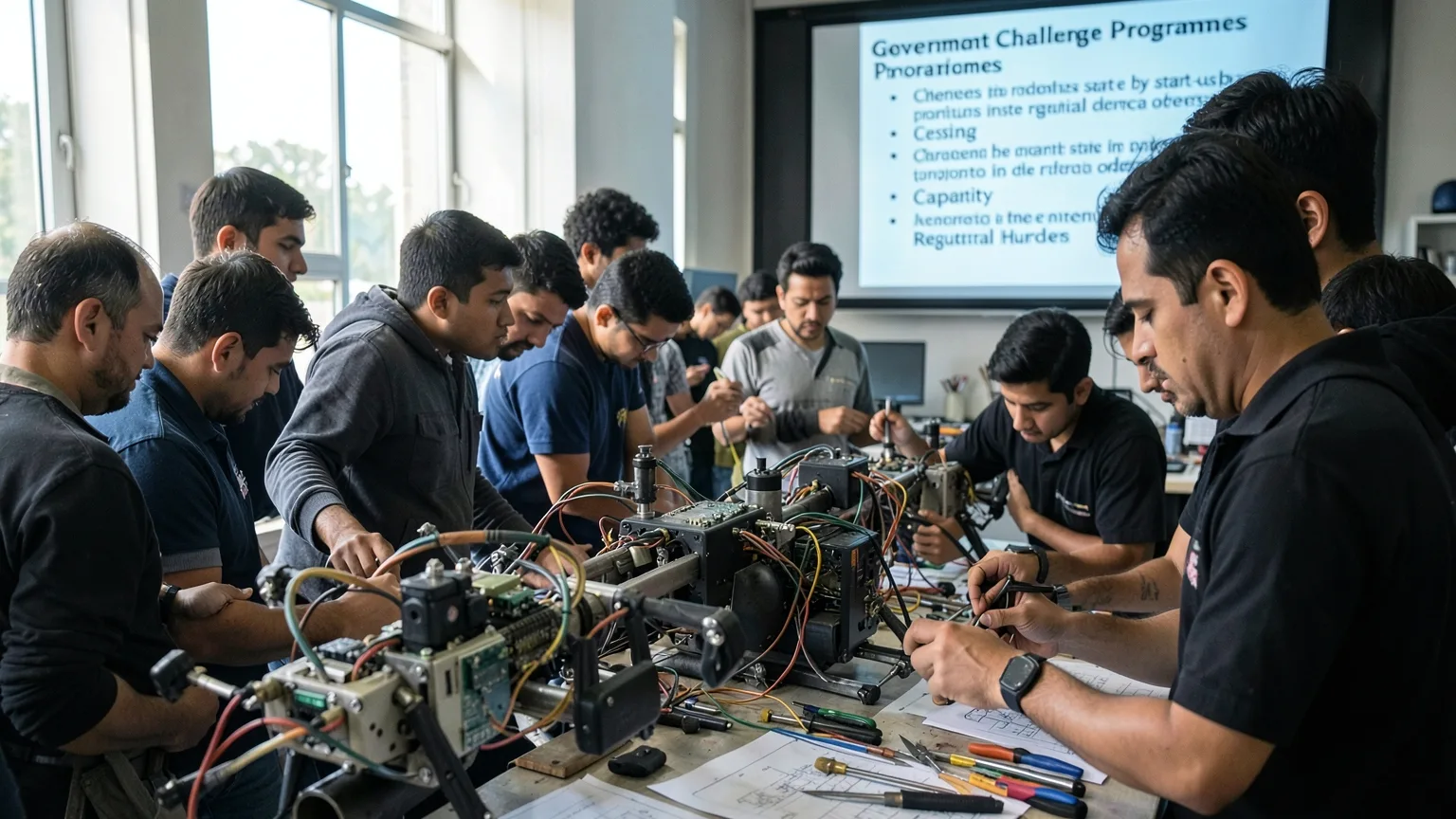
Government challenge programmes have pushed hundreds of Indian start-ups to build military-grade prototypes, but turning those prototypes into regular defence orders still runs into testing, capacity and procurement limits.
The opportunity, and what counts as a defence start-up
Demand from the forces and defence public sector undertakings for home-grown answers has drawn many suppliers: software firms building artificial-intelligence and communications tools, teams making sensors and cameras, companies building autonomous aerial and surface platforms, materials and camouflage systems, and deep-tech projects such as quantum or electronic-warfare components. iDEX challenges and related schemes accept applications from start-ups, MSMEs and individual innovators. They can compete for the same problem statement, but those labels are distinct categories. The Government frames the effort as intended to create functional prototypes and early commercialisation inside the defence establishment; it does not treat every participant as an already-qualified vendor.
The Ministry’s published figures show how many innovators have signed on: by February 2026 roughly 676 start-ups, MSMEs and individual innovators had participated in iDEX, and hundreds of challenge problems and contracts were under way, marking rapid growth since 2018.
How iDEX and ADITI support innovation
iDEX runs a challenge-led route. A defence user, an armed force, Coast Guard, Defence Space Agency or a DPSU, identifies an operational problem as a Problem Statement. Competitors propose solutions; winning teams receive milestone funding, mentoring, access to testing and sometimes a development contract. The basic iDEX award has commonly provided grants up to Rs 1.5 crore for prototype work; iDEX Prime provides larger support up to Rs 10 crore for higher-cost projects; and ADITI was set up to back critical and strategic deep technologies with much higher grants. The ADITI sub-scheme carries an explicit budget envelope and rules: the published ADITI design allows up to Rs 25 crore per project and typically covers up to 50% of the Product Development Budget (PDB), and the ADITI programme was planned within a Rs 750 crore allocation spanning 2023-24 to 2025-26.
At the National Defence Industries Conclave on 19 March 2026, Raksha Mantri Rajnath Singh launched the 14th Defence India Start-up Challenge (DISC-14) alongside the fourth round of ADITI challenges, together putting more than 100 fresh problem statements into the system.
Two practical points about these awards: first, the scheme paperwork distinguishes between a grant or a design-and-development contract and a separate procurement order, money to develop a prototype is not a guarantee of a large or recurring purchase. Second, ADITI and iDEX awards are designed for technologies at different maturity and cost levels, so the size of the award reflects the intended depth of development rather than a guaranteed market.

The difficult bridge from prototype to procurement
Getting a device or software from a working prototype to a fielded product is a long, multi-stage process. The sequence typically runs: prototype development under milestone funding; demonstration to the user; formal testing and qualification to military standards; platform integration and security vetting; and finally production planning and procurement through defence acquisition procedures. Each stage takes months or years and can uncover new requirements.
Public examples illustrate the point. The Indian Army awarded a first iDEX-route procurement contract on 14 March 2023 for an Integrated Mobile Camouflage System supplied by a start-up; other prominent iDEX winners have later been contracted for larger field use. Separately, one start-up’s anti-drone system was reported to have won Ministry contracts exceeding Rs 200 crore, showing that substantial orders are possible. But the MP-IDSA analysis and official commentary both warn that a challenge award or a design-and-development contract does not by itself establish a large or recurring order: firms still need to meet qualification tests, expand manufacturing capacity and pass procurement procedures before repeat business follows.
Two procedural hurdles stand out in the public record. One is financing: many schemes require the start-up to provide half of the Product Development Budget (50% of PDB) themselves, creating cash-flow pressure during long testing cycles. The other is institutional timing: iDEX winners and analysts have noted that procurement timelines and quantities are often undefined, so companies face uncertainty about whether a successful prototype will translate into known production volumes or only one-off buys.
What the numbers show, and do not show
The programme publishes several, separate counts; they track different things and it matters which you read.
- Problem statements (challenge problems launched): by early 2026 more than 500 challenges had been launched under iDEX rounds and sub-schemes. Those counts measure activity and user demand for solutions, not items bought.
- Design-and-development contracts: the Ministry’s tallies rose sharply, from 430 signed contracts reported by mid-2025 to 548 design-and-development contracts reported as of February 2026. These contracts fund prototype and development work, and they may include milestone payments and technical assistance.
- Prototypes cleared for procurement: by February 2026, 58 prototypes had reportedly received procurement clearance; the Ministry and press accounts attach an estimated procurement value to that set of clearances of about Rs 3,853 crore. A clearance indicates the user has approved the product for acquisition, but it does not always spell out volumes or schedule.
- Procurement contracts signed: fewer projects reach the procurement stage. By February 2026 there were 45 procurement contracts reported, with a combined value near Rs 2,326 crore. Procurement contracts are the clearest public evidence of a buyer committing funds to acquire systems from the developer.
These counts overlap but are not equivalent. The 548 design-and-development contracts are the pool from which prototypes may be cleared, and a still smaller subset becomes procurement contracts. Older figures, such as 619 participating firms and 430 contracts recorded in early 2025, are consistent with the later tallies but show that contracts and participants have continued to grow.
What the public figures do not show, or do not show in full, are the recurring volumes, multi-year purchase schedules, the workshare for serial production, and how many of the procurement contracts become long-term supply relationships. Where a page reports a procurement value for items “procured from iDEX-supported startups and MSMEs,” that is an aggregate of purchases to date, not necessarily evidence of an established, sustained supply chain.
The outlook for founders, investors and India
For founders, the opportunity is concrete: the forces now publish user problems, fund development and in some cases buy the results. For investors, the iDEX pipeline and the addition of higher-value strands such as ADITI and iDEX Prime widen the kinds of projects that can attract institutional money. The schemes also create routes to test and validate products with end users, an advantage many commercial markets do not offer.
But the risks are also clear in the published material. Companies remain dependent on government buyers for large orders, so their revenue models can be lumpy. Start-ups often must fund half the PDB themselves and survive long testing and qualification phases before payment, creating acute cash-flow needs. The MP-IDSA brief also reminds readers that intellectual property stays with the company but that the government can reserve Government Purpose Rights or even march-in rights in the national-security interest; MoD export control rules apply to projects that generate exportable technologies. Scaling from prototype to mass production requires either deep in-house capacity or credible industrial partners; policy steps to link winners with DPSUs and larger manufacturers are intended to help, but public accounts show that translating a successful demonstration into a manufactured, exportable product remains work in progress.
Measured against national goals, the programmes are already contributing to domestic capability: hundreds of challengers, hundreds of development contracts and scores of procurement-stage projects indicate that innovation is being channelled into the forces. Whether that converts into a steady stream of sustainable defence companies will depend on successful qualification, production scaling and the emergence of repeat orders, steps that the public data record separately from the prototype counts.


