
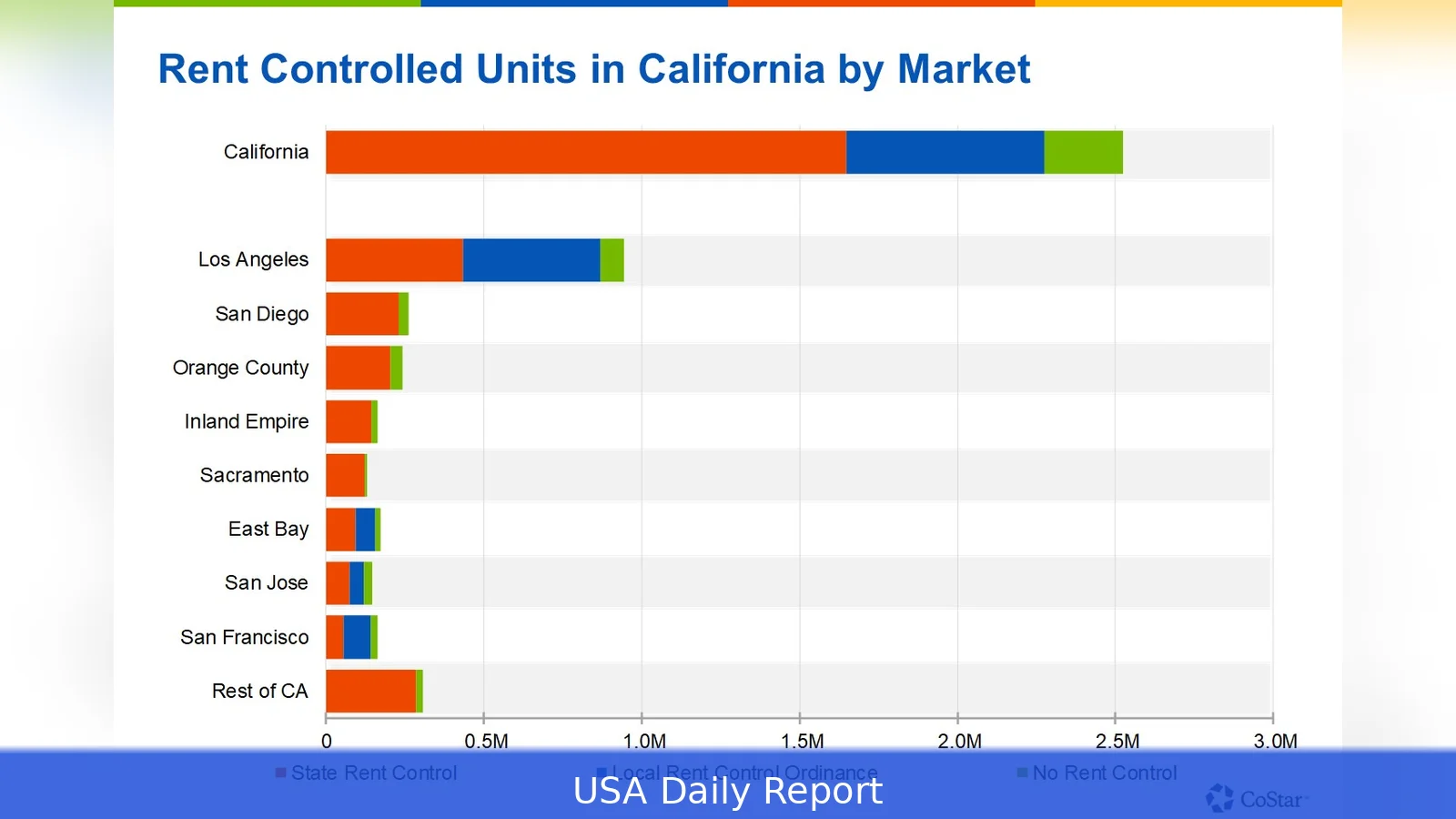
Rent control rules in California have affected how millions pay for housing. This 2026 guide explains the statewide cap, what cities can add, and the steps renters and landlords need to take. Quick reference: - State cap: annual increases limited to 5% plus regional CPI, up to 10% (AB 1482; in effect Jan. 1, 2020). - Just-cause: landlord must state a qualifying reason to evict after 12 months of tenancy. - Notice required: 30 days for rent increases under 10%; 90 days for increases of 10% or more. - Common exemptions: new construction within 15 years, some single-family homes/condos (owner-provided notice required). - Local rules: cities like Los Angeles, San Francisco, Berkeley, and Santa Monica add stricter controls. Santa Monica median rent was $2,328/month in April 2026 (down about 8.1% year-over-year).
Why 2026 matters
Rents have flattened in many parts of California in 2026, but affordability is still a crisis. Policy that's in place now — the statewide rent cap from AB 1482 plus dozens of city ordinances — defines what landlords can charge and when tenants can be evicted. That means knowing both state law and local law. Don’t assume one covers every situation.
Prerequisites: what you need to check first
Before taking action, gather these items:
- Current lease and any prior written rent notices.
- Move-in date and proof of payments (bank records, receipts).
- Unit address and building age (year built).
- Any written notices from the landlord about exemptions or rent increases.
- Contact info for your city’s rent board or housing department.
Here are some helpful official links: California Department of Housing and Community Development, the state legislative text for AB 1482, and federal housing assistance. For tenant rights and a plain-language landlord/tenant guide, see the California Department of Consumer Affairs: https://www.dca.ca.gov/publications/landlordbook/.
Here's a step-by-step guide for renters to confirm coverage, calculate limits, and challenge increases.
1. Confirm whether state law covers your unit. AB 1482 applies to many apartments statewide. Exemptions include most units built within the last 15 years, and many single-family homes or condos where the owner isn't a corporate entity — but the owner must provide written notice if the unit is exempt.
2. Check local ordinances. Cities can put their own rent-stabilization rules in place that are stricter than state law. If you live in Los Angeles, San Francisco, Berkeley, Santa Monica or another city with an ordinance, the local rules usually control. Find the city rent board or housing department website — for example, Los Angeles Housing Department (HCIDLA) is at https://hcidla.lacity.org.
3. Calculate the allowable increase. For units covered by AB 1482, the cap is 5% plus regional CPI—capped at 10% total per 12-month period. To compute it: take last year’s rent, multiply by (1 + lesser of (5% + regional CPI) or 10%). Use the U.S. Bureau of Labor Statistics CPI for your region for the CPI figure.
Example: If rent was $2,000 and the regional CPI change is 1.5%, the allowable maximum increase = 5% + 1.5% = 6.5% → new maximum rent = $2,130.

4. Verify landlord gave required notice. Under California law (Civil Code Section 827), landlords must give 30 days’ written notice for increases under 10% and 90 days’ notice for increases of 10% or more. If your landlord raised rent without adequate notice, the increase can be challenged.
5. Take dispute steps. Send a written request for explanation and documentation (keep copies). If the landlord claims an exemption, ask for the written exemption notice. If the increase appears unlawful, file a complaint with your city rent board or housing department. Meanwhile if no local board exists, get legal help: find help at LawHelpCA (https://www.lawhelpca.org) or your county legal aid office.
6. If needed, seek emergency relief. For illegal evictions or no-fault moves, some cities require relocation payments; others impose penalties on landlords who violate rules. File promptly — many administrative windows and statutes of limitations are short.
Landlords can follow these steps to raise rent legally in 2026.
1. Verify coverage and exemptions. Confirm whether AB 1482 or a local ordinance applies. If the unit is exempt (e.g., new construction within last 15 years or qualifying single-family home), document that status and deliver any required written exemption notice to the tenant.
2. Calculate the legal cap. For covered units use the 5% + regional CPI formula, not to exceed 10% in any 12-month period. For locally controlled units follow the local formula, which may use a different CPI or fixed percentage.
3. Give proper notice. For rent increases below 10% give 30 days’ written notice. For increases of 10% or more give 90 days’ written notice. Include the dollar amount, date of increase, and reference to the legal basis for the change.
4. Keep records. Save proof of notice delivery, tenant communications, receipts for repairs or capital improvements (if passing costs is allowed under local law), and registration documents if your city requires unit registration.
5. Register where required. Many cities require landlords to register rental units and pay annual fees. Check your city housing department for registration rules and fees — failing to register can limit your ability to raise rent or evict.
Costs, fees and eligibility details to know
• Rent increase notice: no filing fee for most routine notices, but administrative or registration fees may apply at the city level. • Local registration: amounts vary. Los Angeles requires landlords of rent-stabilized units to register; fees depend on unit count and city schedules. Check your city housing website for exact dollar amounts. • Legal help: free or low-cost tenant legal aid is available through county programs and nonprofits. Private attorneys bill hourly — expect $200–$500/hour or flat rates for eviction defense in many markets. • Relocation payments: some city ordinances require cash relocation for no-fault evictions. Amounts differ by city and by income of tenant; check local law before assuming none is due.
Alternatives and comparisons
If rent control doesn’t fully protect a tenant, try these options: negotiate a longer fixed-term lease to lock current rent; ask for repairs or improvements in exchange for a modest increase; apply for rental assistance programs through county social services; or look for rent-stabilized units where local ordinances apply. For landlords, alternatives include offering renewal incentives, applying for building permits for legal rent increases tied to capital improvements (where allowed), or using mediation services to resolve disputes without court.
Tips
- Always get everything in writing. Verbal promises don’t hold up in court or before a rent board.
- Check both state law and your city’s rules. Local ordinances often provide stronger tenant protections.
- Keep a clear timeline: moves in, notices, and payments. That timeline is often decisive in disputes.
- Use official sources for CPI numbers: U.S. Bureau of Labor Statistics (https://www.bls.gov).
Common mistakes to avoid
1. Assuming AB 1482 covers or exempts every building without checking the 15-year new-construction exemption and single-family/condo exceptions. 2. Accepting a rent increase verbally. Always require written notice that meets the 30/90-day rule. 3. Missing local registration and fee requirements — that can limit enforcement of rent increases or evictions. 4. Failing to calculate the CPI correctly — AB 1482 uses regional CPI, not a national or unrelated index. 5. Waiting too long to act. Administrative complaints and court deadlines can be short; act as soon as a problematic notice arrives.
Related Articles
California rent control in 2026 is a two-layer system: a statewide cap and a patchwork of city rules. Know whether AB 1482 applies, check local ordinances, calculate the 5% plus regional CPI cap (max 10%), and follow the 30/90‑day notice rules. For disputes, document everything, contact your city housing department, and get legal help early. Santa Monica’s median rent was $2,328 in April 2026 — a reminder that rents vary city by city and the law you need to follow depends on where you live.
This article was created with AI assistance.


