
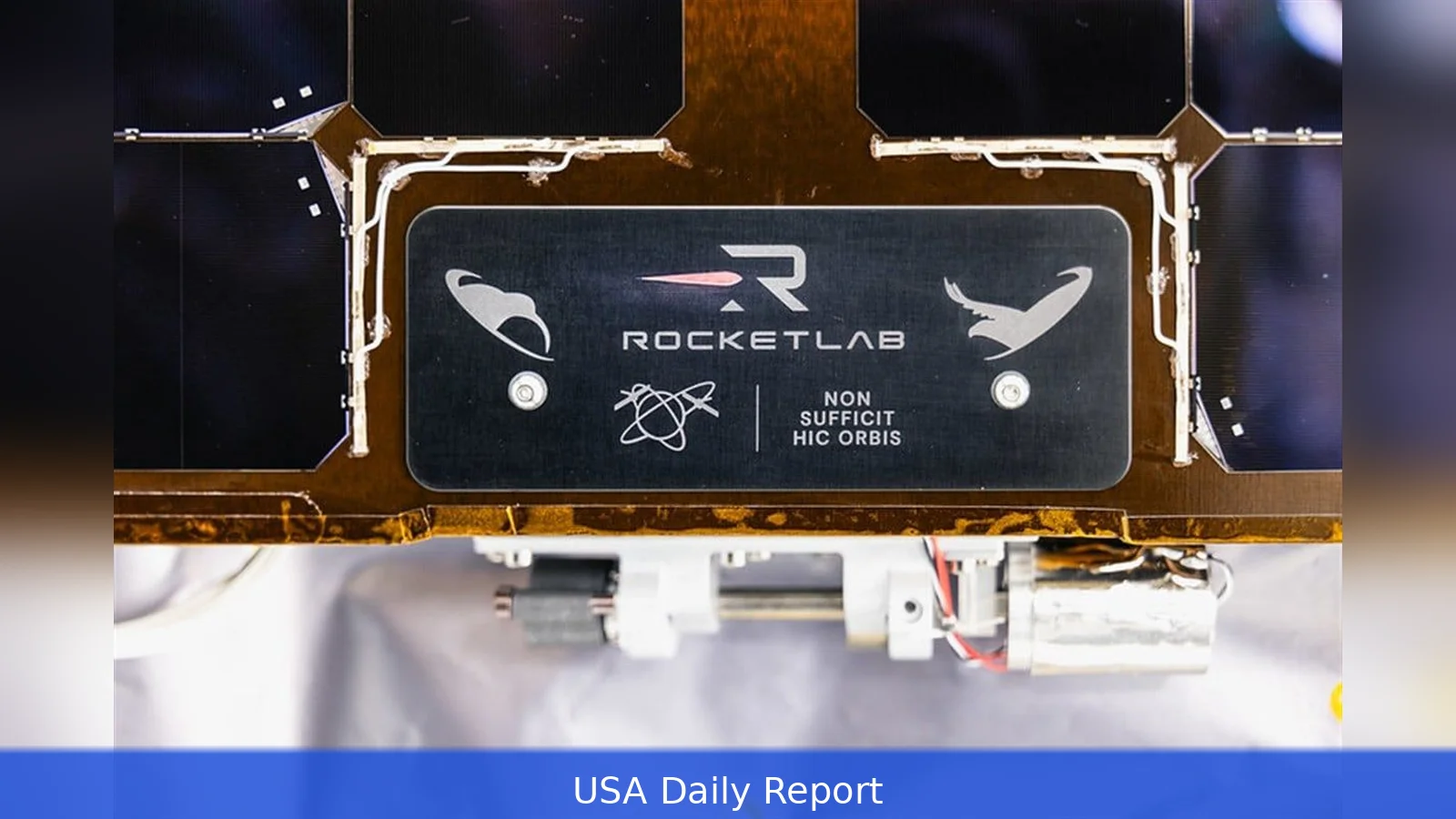
Rocket Lab shares jumped 9% Tuesday to about $80.
Market move tied to contracts, tech and CEO signal
Rocket Lab Inc. shares rose as investors reacted to several corporate moves and growing interest in space-related stocks. The stock climbed roughly 9% in intraday trading to near $80, driven by fresh technology rollouts, a high-profile management commitment, and continued NASA and government contract activity.
Chief Executive Peter Beck has made a visible bet on shareholder upside. He cut his salary to $1 and relinquished $392,155 in restricted stock units, a move investors treated as a show of confidence in the company's long-term plan. At the same time, the company sped up development of new launch systems and satellite parts.
Revenue growth and backlog underpin investor optimism
Rocket Lab reported record fourth-quarter fiscal 2025 revenue of $179.65 million, a year-over-year increase of about 36%. The company ended the quarter with a backlog of roughly $1.85 billion, up about 73% from a year earlier. That pipeline gives investors a clearer line of sight to revenue in coming quarters.
For the current quarter, Rocket Lab guided revenue to a range of $185 million to $200 million, which implies continued strong growth versus the prior-year period. Management said the company is shifting from a startup to a more stable industrial business, blending launch services with regular satellite hardware sales.
Analysts have responded to the results and outlook with generally positive ratings. Consensus price targets have moved higher in recent weeks, reflecting expectations that the company's expanding service mix — launch, satellite components and in-orbit services — will produce more predictable cash flows over time.
New products aim to solve supply constraints
Rocket Lab has focused heavily on introducing new technologies. The company introduced a high-volume electric propulsion system known as Gauss, an in-house Hall thruster and supporting subsystems designed for large-scale satellite constellations.
Rocket Lab says it has set up production capacity to manufacture more than 200 Gauss thrusters per year.
"Proliferated constellations are now the norm for commercial and national security space users, but the propulsion systems needed to maneuver these spacecraft in orbit have simply not been reliably available at any kind of scale," said Sir Peter Beck, Rocket Lab founder and chief executive. "Rocket Lab is solving this bottleneck with Gauss."
The company contends the Gauss thruster will deliver higher specific impulse than chemical systems, letting satellites carry less propellant for a given mission profile. That efficiency matters for operators running networks of dozens, hundreds or thousands of small satellites where mass and cost per unit are tightly constrained.

Shaun O'Donnell, Rocket Lab's chief engineer of special projects, said the company looks to fill supply-chain gaps through internal development and selective acquisitions when customer needs point to structural shortages. Management has previously scaled production on other subsystems to thousands of units annually, and executives say the company intends to apply that manufacturing playbook to electric propulsion.
Neutron launch program and acquisitions add to the narrative
Beyond satellite parts, Rocket Lab is advancing its Neutron medium-lift rocket program. The company filed launch-permit paperwork that targets a maiden Neutron launch window between July 1 and Dec. 31, 2026. Neutron is positioned as a reusable, medium-lift vehicle that could compete for commercial launches and national-security payloads.
Rocket Lab also expanded its capabilities through acquisition. The company closed on Mynaric — a maker of laser communications gear for space and airborne platforms — for approximately $155.3 million, a deal management says broadens its in-space services and national-security relevance.
Combining launches, satellite parts, laser communications, and electric propulsion, Rocket Lab aims to offer a full suite of services to its customers.
Sector momentum and policy catalysts
Rocket Lab's investor appeal also comes from broader industry trends. A cluster of positive developments across the space industry has pushed money into equities tied to launches, satellite networks and defense contracts.
The White House's space nuclear memorandum — National Science and Technology Memorandum 3 — and a series of NASA contract awards have amplified expectations for government spending on next-generation space capabilities. Those policy moves are boosting names with direct or potential government revenue streams.
Reports about a big private launch company planning a public offering have boosted sentiment across the space sector. Traders say the prospect of a large-cap space company going public could draw institutional flows that lift smaller and midcap peers.
Valuation, risks and what to watch
Even with recent gains, Rocket Lab is still evolving. The shares were down year to date prior to recent gains, and sentiment among retail discussion boards has been mixed. The stock can be volatile around operational milestones such as Neutron's first flight, Gauss production ramp, and contract awards from government agencies.
Analysts warn that the company faces real risks in execution. Scaling production of complex space hardware, certifying a new rocket for flight, and integrating acquired technologies all present technical and schedule hazards. Delays or higher-than-expected costs could pressure margins and push out revenue recognition tied to launches and hardware deliveries.
On the flip side, each successful launch, propulsion unit produced at scale, or government contract awarded would strengthen the company's revenue visibility and could move consensus estimates higher. Investors will be watching Quarters for revenue beats and backlog growth as near-term confirmation of the story.
For now, investors appear to be pricing a tighter link between Rocket Lab's public-market value and the operational milestones management has set for 2026. That connection is part strategic and part symbolic — chief executives who tie compensation to long-term outcomes often draw favorable investor attention.
How That could affect the space supply chain
If Rocket Lab hits its production and launch targets, the company could change supplier dynamics across the small-satellite industry. Reliable, high-volume propulsion delivered at lower unit cost would reduce a key bottleneck for constellation operators and national-security programs that require scalable on-orbit maneuvering.
That structural change would also favor satellite manufacturers that can integrate Rocket Lab's subsystems at scale, while increasing competition among propulsion vendors for volume contracts. The upshot for customers could be faster deployment cycles and lower per-satellite costs — provided manufacturers can sustain quality at volume.
Investors will want to track order activity for Gauss thrusters and watch for statements from government agencies that name contracted suppliers. Those items will offer clearer evidence that production is meeting real market demand rather than early-stage interest.
Related Articles
"Rocket Lab is solving this bottleneck with Gauss," said Sir Peter Beck, Rocket Lab founder and chief executive.
This article was created with AI assistance.


