
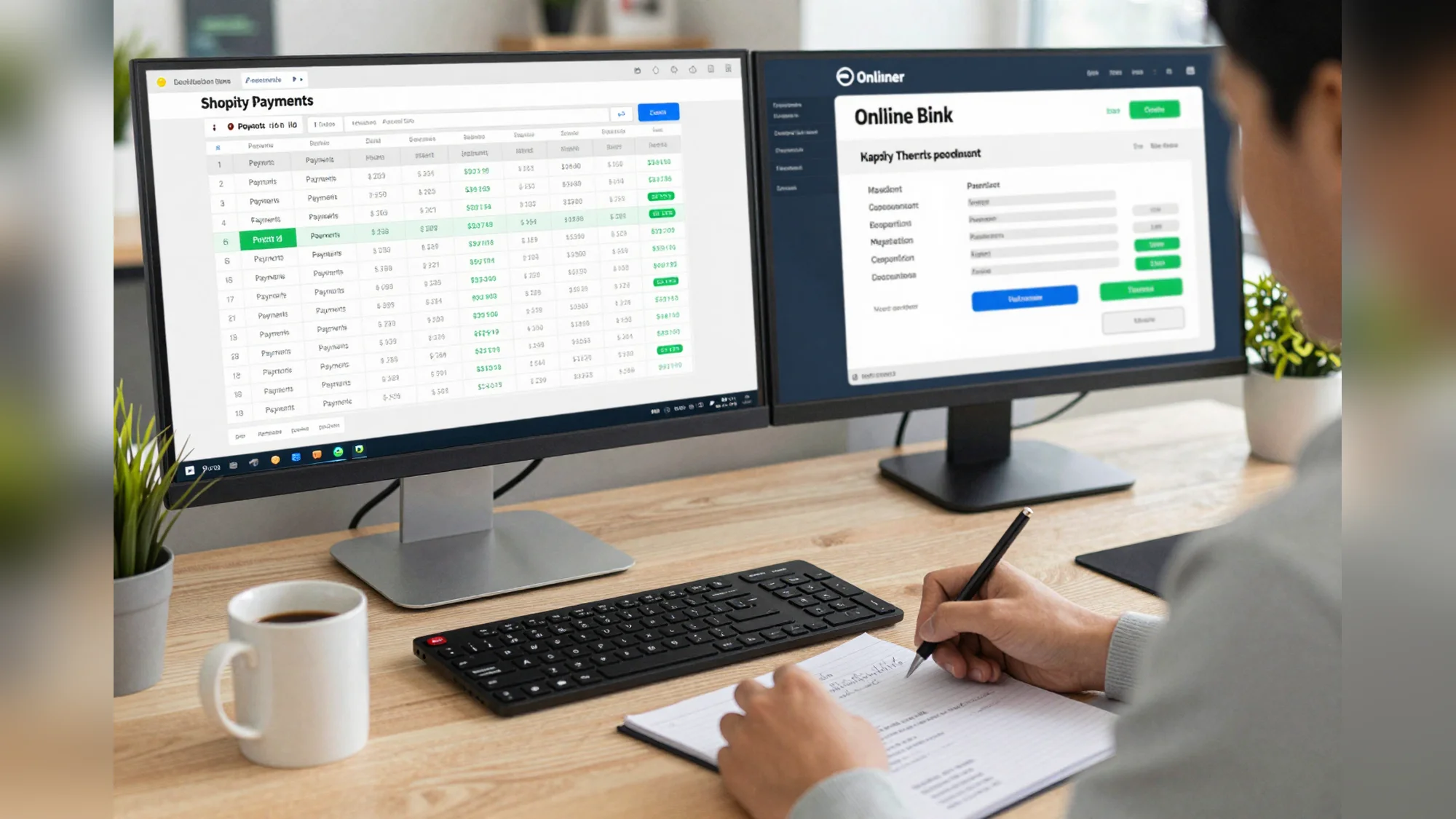
Seventy-eight percent of retailers say they spend more than five hours per week on manual Shopify payout reconciliation, while a correct hand method reduces each payout to four components that should sum exactly to the bank deposit. That stark contrast frames the daily problem for small and midmarket ecommerce finance teams, where near-matching figures create time drains and downstream errors. The 78 percent figure tracks to a Shopify Plus Blog finding cited in industry summaries from 2024, and how-to guides published in July 2026 lay out a repeatable manual workflow built around the Shopify Payments payout export. For teams not yet automated, the guides point to a single operational move that closes most gaps: treat each payout as the unit of work and separate the pieces that make the net deposit.
Small and midmarket ecommerce operations carry the reconciliation load even though the practical fix starts with a single export from Shopify Payments. Begin every reconciliation with the payout export, not the store sales total. For each payout, record one row keyed to the payout id and capture the payout date, the Shopify net payout, the bank deposit amount and date, and the components that actually make the net. Industry how-to material from July 2026 recommends capturing gross charges included, refunds, chargebacks or dispute fees, payment-processing fees, sales tax collected, and any adjustments or reserves. Think of the math this way: net payout equals gross sales minus refunds minus fees plus or minus adjustments. That equation reduces a confusing single deposit into four simple accounting drivers: gross sales, refunds, fees, and adjustments. When those components post to their proper ledger accounts the net ties to the bank while the ledger shows true sales and costs. Post gross sales to revenue, post refunds to a contra-revenue account, record processing fees as an expense, and put chargebacks or reserves in the appropriate liability or expense account. A large part of the wasted time comes from unexplained, near-matching numbers industry writing calls "believable inaccuracy." Webgility research summarized in July 2026 uses that phrase to describe why bookkeepers chase phantom mismatches. Labeling the variance before escalating saves time. Practical one-word labels that the guides recommend are Timing, Refund, Chargeback, Fee, Adjustment, Sales Tax, Missing Deposit, and Duplicate Deposit. Attach a one-line cause and a source document to each variance so the next reviewer doesn't have to guess. Timing differences cause the biggest headaches at month end. A sale recorded on the 31st can settle in the next payout period. The accounting answer is to book the sale when it occurs and carry the unsettled cash in an in-transit receivable or undeposited funds account, then clear that receivable when the payout lands. That keeps reported revenue and bank cash aligned across month-close. A disciplined payout-by-payout worksheet removes the generic complaint "Shopify doesn't match the bank." Leave blanks where components are missing and flag them for review. The worksheet becomes a repeatable checklist: First, confirm the payout id and bank deposit. Second, split the components across revenue, contra-revenue, fees, taxes, and adjustments. Third, record any timing in-transit amounts. Fourth, label and attach source documentation for any variance. The guides and vendor pieces that appeared in June and July 2026 converge on one more point: automation pays. Multiple summaries report that done well, reconciliation can take minutes per payout rather than hours, and automation reduces common errors and speeds month-end close. High-growth merchants reconciling multiple gateways, currencies, or marketplaces are most exposed because deposits often fold many fees and marketplace charges into a single net amount that obscures margin unless items are separated in the books. If automation isn't yet in place, the hand method still provides an auditable trail an accountant needs. Anchor every row to the Shopify payout id, label variances with a one-line cause and source document, and use an in-transit clearing account for timing gaps so month-end sales and cash agree. Those steps convert vague mismatches into discrete investigatory tasks and cut the repeat hours bookkeepers spend each week.Related Articles
Multiple July 2026 summaries report that, when done well, reconciliation can take minutes per payout rather than hours.
This article was created with AI assistance.


