
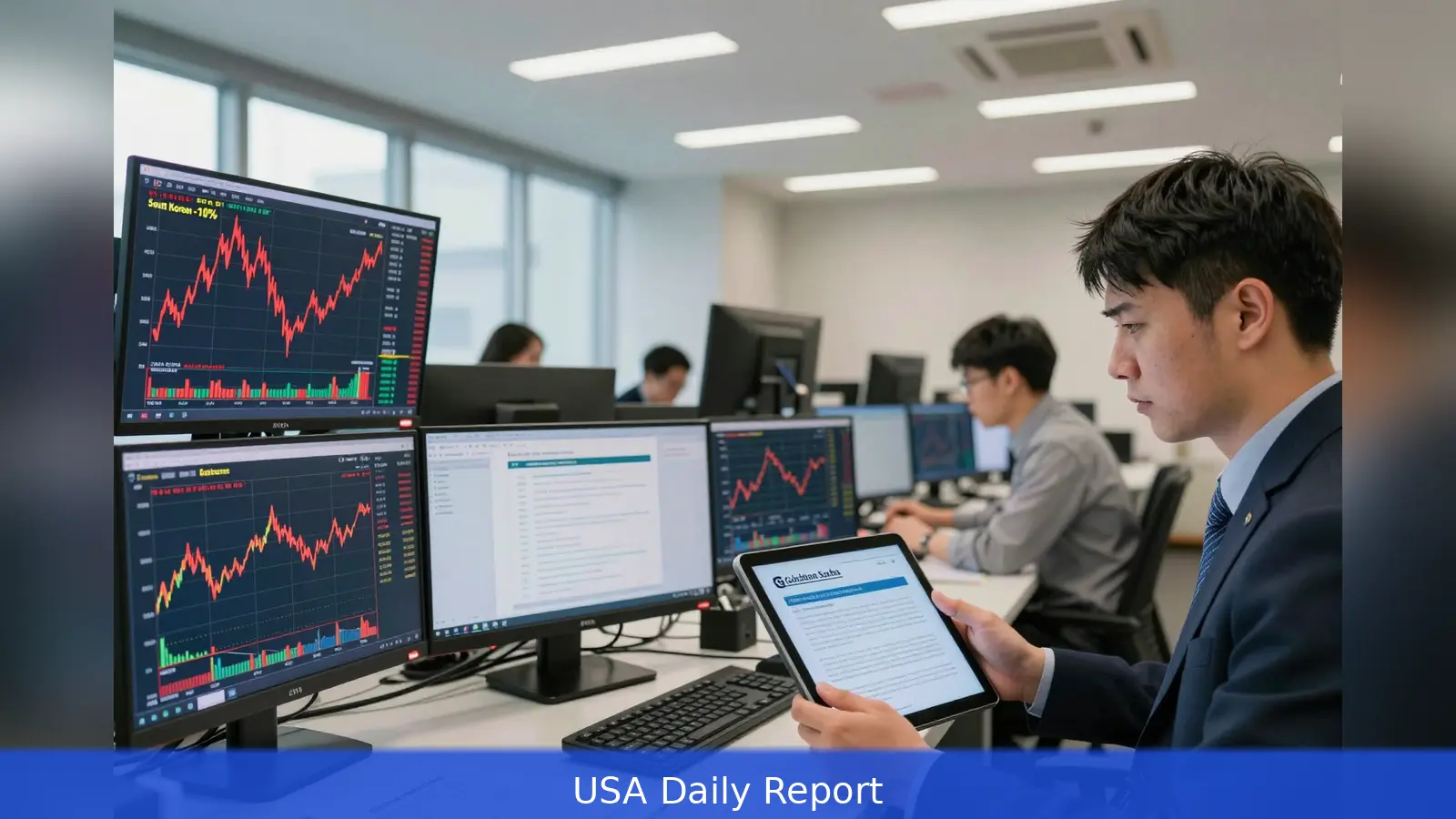
"The tension between favorable fundamentals and high valuations continues to grow," Goldman Sachs strategists Dominic Wilson and Vickie Chang wrote. The warning arrived as tech-linked markets felt strain after South Korea's stock market plunged about 10% on Tuesday. Goldman told clients late Monday that investor expectations for the artificial-intelligence trade are beginning to outpace what the technology can realistically deliver, and advised protecting portfolios against downside risk. The bank flagged the upcoming CoreWeave IPO as a potential litmus test of appetite for high-growth, capital-intensive AI firms.
"The tension between favorable fundamentals and high valuations continues to grow," Goldman Sachs strategists Dominic Wilson and Vickie Chang wrote.
Goldman framed the note as both a market signal and a strategic read for investors who have crowded into richly priced tech names. The bank says the AI investment boom remains on track, but that elevated valuations leave the sector vulnerable if revenue and margin improvements fall short of the high bar traders have set. The caution landed against a backdrop of a roughly 10 percent selloff in South Korea, which traders and strategists alike saw as an acute sign of how quickly risk appetite can reverse in tech-heavy markets.
Why Goldman is cautious
Goldman's note, sent to clients late Monday, singles out three mechanics that could sap returns. First, lofty valuations reduce the margin for error when companies fail to deliver quicker revenue growth or margin expansion than already priced in. Second, customers are starting to push back on runaway usage costs, a dynamic that could force price competition and compress margins for premium model vendors. Third, investors are increasingly reallocating capital toward firms that can show a clearer path to cash flow rather than chasing market-share capture backed by heavy capital spending.
That investor pivot is already visible in market commentary. StoneX analysts point to a shift in focus from raw AI demand to profitability, funding costs and execution risk. StoneX noted that shares such as Oracle fell despite stronger than expected earnings because investors fretted about large future spending commitments for AI infrastructure. The reaction, StoneX argues, shows growing willingness to penalize companies that need oversized capital to compete, rather than reward headline growth metrics alone.

Commercial economics under pressure
Industry reporting amplifies the concern that product economics could test investor patience. Forbes reported that major providers such as OpenAI and Anthropic face pressure to cut prices as corporate customers clamp down on runaway token spending. The reporting cited enterprise customers limiting usage and deploying cheaper open-source or lower-cost provider models for routine tasks, moves that would squeeze margins for premium model vendors.
That squeeze matters because optimism about AI is often framed around rapid adoption. Analysts cited by Forbes project model spending will rise sharply in 2025-26. But higher aggregate spending doesn't guarantee healthy unit economics for every vendor, especially those that charge premium rates for large-scale model usage.
Further caution comes from academic work. Some studies find many enterprise generative-AI pilots produce little measurable profit in the short term. Put bluntly, the early phases of corporate AI deployment often produce experimentation rather than immediate returns. Goldman and others read that reality as evidence investors may be pricing faster and larger payoffs than current deployments are producing.
The combined signals sketch a three-part stress test for the AI trade. First, valuation levels mean any knock to execution can trigger oversized share-price reactions.
Second, customer pushback on token costs invites price competition that will pressure margins. Third, capital is rotating toward clearer paths to cash flow, increasing the funding cost penalty for firms that remain focused primarily on scaling market share.
For portfolio managers that has practical implications. Protecting against downside risk can mean trimming exposure to the most richly valued names, reallocating to firms with demonstrable cash generation, or hedging through option structures rather than simply holding long positions. Goldman's note read as a reminder that the trade is still on, but that the terms of reward versus risk have shifted.
Market participants will now look for tests of investor appetite beyond earnings headlines. One such test is the widely watched CoreWeave IPO. Analysts flagged the offering as a potential litmus test for demand for capital-intensive, high-growth infrastructure firms whose value depends on long-term scale and hefty upfront investment.
Related Articles
- ChatGPT memory upgrade: personalization vs distortion
- Morgan Stanley keeps 8,000 S&P target; warns Fed won't rescue
- 63% of PE Deals Show Value in 12 Months, AI Accelerates
Watch the CoreWeave IPO next. Analysts say the offering will show whether investors still prize growth at any cost or now favor firms with clearer near-term paths to cash flow.
This article was created with AI assistance.


