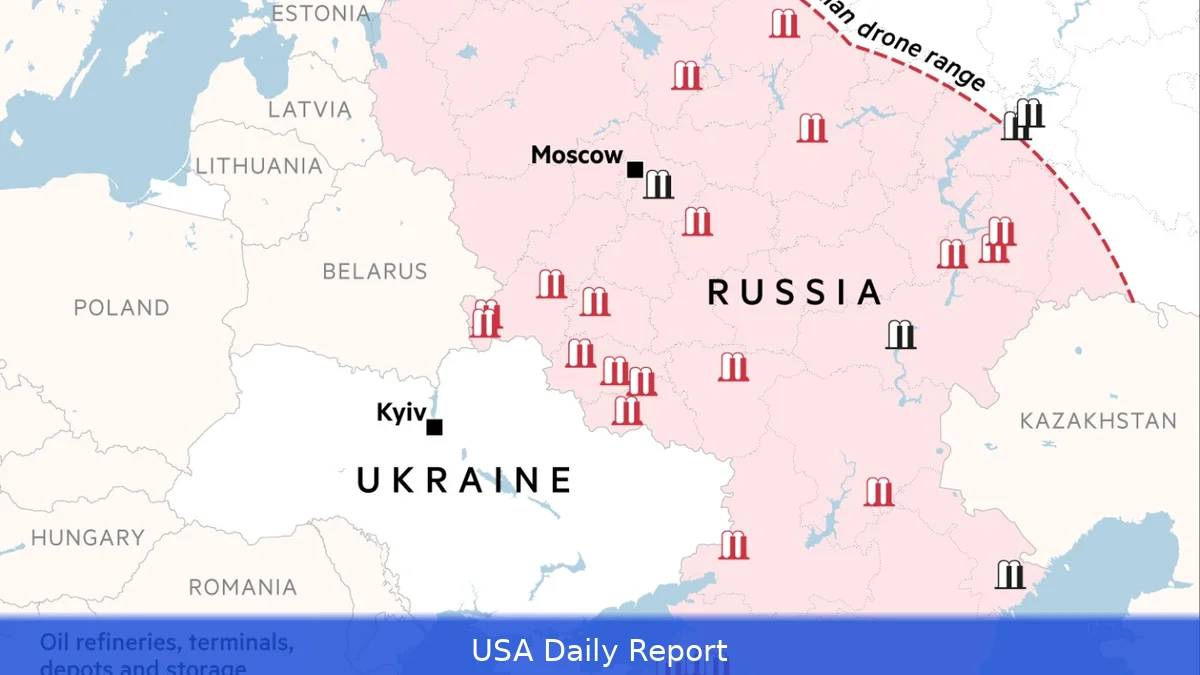
Ust-Luga, one of Russia’s biggest Baltic Sea ports, went up in flames after a major Ukrainian drone attack. The strike dealt a fresh blow to Moscow’s oil export infrastructure, cutting into the country’s crude oil shipments by millions of barrels daily.
Drone Swarm Hits Deep into Russian Territory
In the early hours of March 25, Ukraine launched a large-scale drone assault targeting Russia’s Leningrad Oblast, with Ust-Luga port bearing the brunt. Local officials confirmed fires broke out at a major energy terminal, forcing a swift shutdown of the port area. Emergency teams scrambled to contain the blazes, which engulfed several oil storage tanks critical for Russia’s energy exports.
Ukrainian military sources claimed responsibility for the operation, highlighting the involvement of multiple branches including Special Operations Forces and intelligence agencies. The strike targeted Novatek’s fractionation and transshipment complex at Ust-Luga, a facility capable of processing nearly seven million tons of gas condensate annually into petroleum products. These fuels are a key part of Russia’s maritime export network, including shipments via the so-called "shadow fleet."
Authorities said 56 drones were shot down over the region as part of a wider Ukrainian campaign that saw hundreds of unmanned aerial vehicles intercepted across 13 Russian regions and Crimea. The attack also caused temporary disruptions to air traffic at St. Petersburg’s Pulkovo Airport.
Strategic Importance of Ust-Luga and Primorsk
Ust-Luga stands as a vital outlet for Russian crude oil and refined products, located west of St. Petersburg. The port’s role grew substantially after the Soviet Union collapsed, as Russia sought to reroute oil exports through its own Baltic hubs instead of neighboring countries.
This shift aligns with long-standing policies pursued by President Vladimir Putin to secure energy trade routes under Russian control.
Just days prior, another drone attack ignited fires at Primorsk, Russia’s largest oil-loading port on the Baltic Sea. Primorsk serves as the terminus of the Baltic Pipeline System, funneling Siberian crude oil to tankers for export. Though previous strikes have temporarily halted operations at these ports, the latest attacks caused damage severe enough to suspend activity indefinitely.
Impact on Russian Oil Exports and Global Markets
Reuters estimates that Ukraine’s recent strikes, combined with pipeline disruptions and tanker seizures in Europe, have effectively taken offline around 40% of Russia’s crude oil export capacity—roughly 2 million barrels per day. This marks one of the most serious interruptions to Russian oil shipments in modern history, threatening to reshape the global energy landscape.
While Russia continues to supply oil to China through major pipelines like Skovorodino-Mohe and Atasu-Alashankou, and through the port of Kozmino, these routes combined deliver about 1.9 million barrels daily—less than what’s been lost in the Baltic Sea region. Shipments from far eastern projects also contribute around 250,000 barrels per day but can’t fully compensate for the lost volume.
Experts say ongoing disruptions to Russian energy exports might push global oil prices up, hitting consumers in Asia and Europe hard. The attacks also add pressure on the European Union, which remains divided over financial aid to Ukraine amid ongoing disputes over Russian oil transit, particularly with Hungary blocking resolutions.
New Military Capabilities Signal Prolonged Disruption
Security analysts point to Ukraine’s evolving drone warfare as a game-changer in this conflict. Previously, Ukrainian forces struggled to inflict lasting damage on Russian Baltic ports; now, fires have raged for days, crippling key infrastructure. Without functioning storage tanks, port operations can’t continue.
We don’t yet know the full damage—some gear might be wrecked without catching fire—but both Ust-Luga and Primorsk are definitely not running right now. How long the shutdown will last is uncertain, but the blow to Russia’s energy export system is undeniable.
Recent Ukrainian drone strikes have opened a new phase in the conflict, showing that Russia’s energy gateways are no longer as secure as before. Nearly half of Russia’s crude oil export capacity is offline, putting more economic pressure on Moscow as global markets react to the reduced supply. Now, the key question is how Russia will handle this new threat and what it means for global energy trade going forward.


