
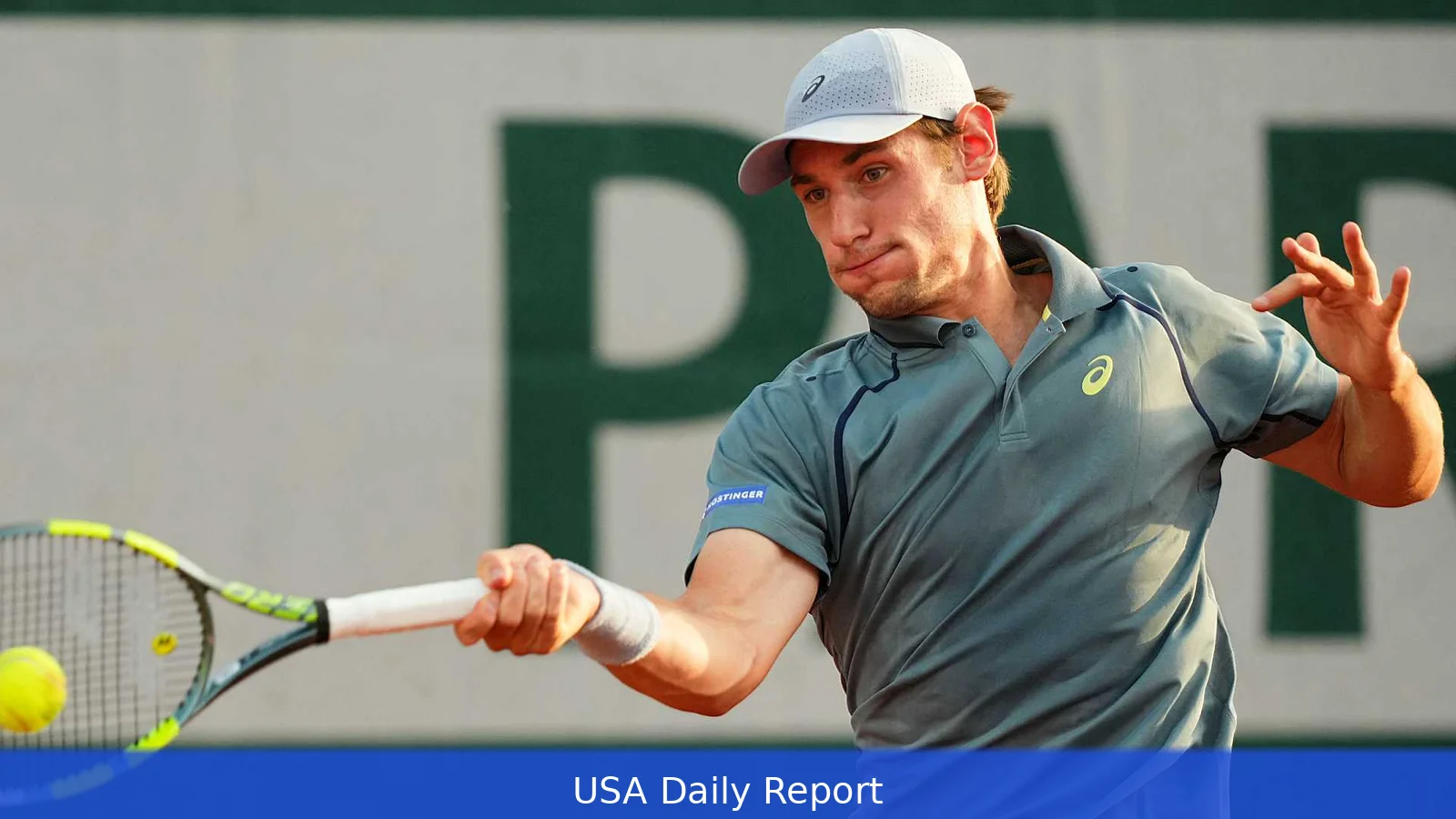
23. That's Valentin Royer’s age as he prepares to step onto Court Philippe-Chatrier to face Novak Djokovic at Roland Garros on May 27, 2026. The Frenchman, ranked in the mid-70s in the PIF ATP Rankings, arrived in Paris after an opening-round win over Hugo Dellien and after a difficult stretch that left him with only one tour-level victory across his previous 11 tournaments, the ATP preview notes. Royer told ATP staff he did a lot of mental work to rebuild his self-confidence and regain the "hunger to win," calling that period a "real slap in the face" and saying he had "managed to climb back up that slope," a mindset that will be tested against a three-time champion.
A rapid recent rise collides with visible volatility. That juxtaposition is the clearest way to read Royer’s form going into a match that, on paper, is David against Goliath. He is 23, aggressive, and suddenly in the second round of his home Grand Slam. At the same time, his season has swung between breakthrough moments and early exits, a pattern the ATP preview highlights when it notes his sparse tour-level success through much of the year.
From Eastern Europe to the spotlight
Royer’s back story helps explain why he swings so freely and why confidence matters so much to his game. The ATP profile traces his childhood across Eastern Europe and reports that at 14 he spent two years training at the Tipsarevic Tennis Academy, a formative period for his offensive instincts. He plays an aggressive, net-forward brand of tennis and says that approach depends on strong self-belief to work. That self-belief frays when results don't follow, and Royer has been candid about that vulnerability.
His first run to a tour-level final came at the 2025 Hangzhou Open, where he arrived as a qualifier and defeated Corentin Moutet 6-3, 6-2 in the semifinals to reach the title match. Reuters match reporting shows Royer pushed Alexander Bublik into two tiebreak sets in the final, which Bublik won 7-6(4), 7-6(4). Reuters noted that Royer landed eight aces in that match while Bublik produced 21, and that neither player managed a break of serve across the two sets. The Hangzhou week announced Royer to a wider audience and underlined the high ceiling his aggressive game can produce when it clicks.
But Hangzhou didn't convert into consistent form. Field Level Media recorded a straight-sets loss to Francisco Comesana at the ASB Classic in Auckland in January 2026, a result that underlines the season-long pattern: flashes of quality separated by early exits. The ATP preview spelled out the gap between Royer’s potential and his week-to-week consistency, and that gap is the problem he said he has been addressing mentally.
Style, momentum, and the Djokovic test
The immediate story in Paris is straightforward: Royer booked an opening-round win over Hugo Dellien and then drew Novak Djokovic for a second-round date on May 27. Roland-Garros live coverage listed the match on Court Philippe-Chatrier, and the tournament noted Djokovic is aiming to reach the third round at Roland Garros for the 21st consecutive year.
For Royer, the meeting marks his first match against a top-10 opponent of Djokovic’s stature on a major stage.

That contrast of styles frames the tactical chess ahead. Royer’s preference to come forward and finish points at the net will force Djokovic to hit precise passing shots and to take control of baseline rallies. Djokovic’s defensive consistency and history in big matches make him one of the sport’s toughest tests, especially at a major. The question for Royer is whether he can convert short bursts of momentum into sustained pressure and avoid the kind of lapses that have produced early losses this season.
Royer has framed Roland Garros as a fresh start where the mental work he described to ATP staff might pay off. He told ATP that he had lost his hunger to win during a difficult period, that the tour had delivered a "real slap in the face," and that he had "managed to climb back up that slope" and was beginning to feel good and more confident on court. Those qualifiers are concrete: they're not a promise of victory but a description of a player trying to repair the interior game that underwrites his attacking style.
Thing is, for anyone tracking Royer’s development, the metrics to watch are simple. First, how often he comes to the net and whether his touch and timing are sharp.
Second, his serve: Bublik’s 21 aces in Hangzhou underlined the power threshold required to keep pace on quick points, while Royer’s eight aces showed he can still threaten from the baseline. Third, his ability to hold serve under pressure and to avoid momentum-sapping double faults or short returns when he elects to step in.
The tournament context matters too. Roland-Garros live coverage is the place for official order of play and live scoring on May 27, and for Royer the home crowd and the atmosphere on Philippe-Chatrier create both opportunity and expectation. He is playing only his second main draw at the French Open, according to the ATP preview, which frames the match as a developmental milestone as much as a competitive hurdle.
Behind the scenes, Royer’s pathway shows the modern journeyman route to the tour. He trained abroad as a teenager, leaned on high-level academy coaching, qualified into tour events, and seized a breakthrough week in Hangzhou.
Still, the season has been a sequence of starts and stops that has tested his mental approach. The candid language he used with ATP staff about rebuilding confidence is one reason to pay attention: he hasn't tried to mask the problems, he has described them and taken steps to fix them.
Whatever happens on May 27, the match will be a useful barometer. If Royer can translate his Hangzhou form, his net game, and his renewed self-belief into a sustained performance, it will confirm that the climb he described to ATP has real traction. If Djokovic’s experience and shotmaking shut down Royer’s attacking options, the result will underline the consistency gaps the ATP preview highlighted earlier in the season.
Related Articles
- Emma Navarro chases third WTA title vs Mboko in Strasbourg
- Elina Svitolina survives 2h 26m Paris scare, advances
- 6-0 edge sets up Ostapenko-Świątek clash at Roland Garros
The May 27 meeting on Court Philippe-Chatrier is the next litmus test. If Royer can turn his Hangzhou form, net game and renewed confidence into sustained pressure, it will show the climb he described has traction. If Djokovic shuts down those options, the match will underline the season-long consistency gap that still trips Royer up.
This article was created with AI assistance.


