
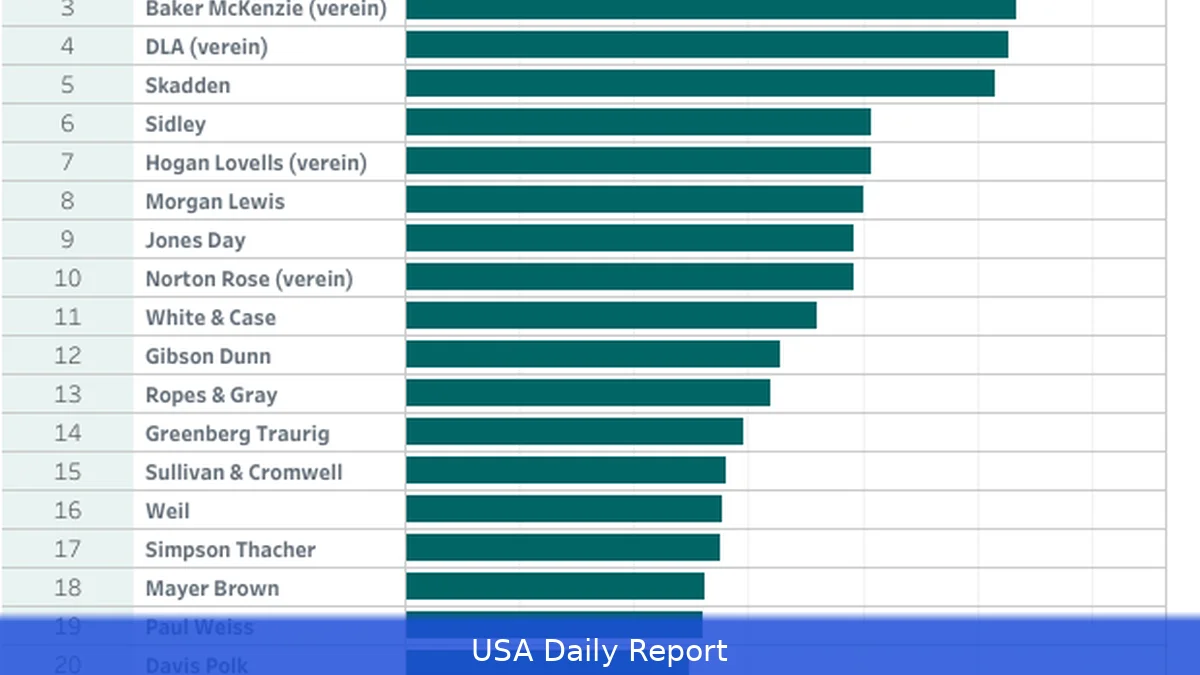
Big law revenues climbed in 2025.
Where the list comes from
Am Law publishes the annual Am Law 100, which people in the industry often use to judge firm size by gross revenue. ALM's reporters run the numbers each year — revenue, profit, revenue per lawyer and more — to show where big firms land. The Am Law franchise actually publishes several complementary lists — gross revenue, revenue per lawyer, profits per partner — so you can’t judge a firm on just one stat.
ALM's recent coverage also included a separate ranking focused on revenue per lawyer, where researchers combed through firm-level numbers to highlight where firms are getting the most revenue from each practicing lawyer. That analysis, published under the Am Law banner, is part of a broader ALM effort to compare firms across more than a dozen financial measures.
Revenue growth across big firms
Many firms posted revenue gains in 2025. Abigail Adcox wrote that nearly all of the 13 firms tied to an executive order, or that reached deals to head off such action, saw revenue growth last year — in some cases, quite large increases. That shows revenue momentum at the top end of the market kept building even as clients and firms adapted to new pressures.
But a jump in top-line revenue can mean different things: for some firms it shows higher rates, for others just bigger headcount. Firms with heavy corporate and financial practices tend to see different fluctuations than firms anchored in litigation or regulatory work. Am Law's gross-revenue list captures the total receipts, but the revenue-per-lawyer ranking and other slices help explain where that money comes from and how efficiently it's earned.
Prestige versus pounds of revenue
Another way the market is being measured this year comes from BCG Attorney Search, which produced a prestige ranking that focuses on how lawyers themselves view firms — not just what they earn. BCG’s list emphasizes reputation among peers, the complexity of work, selective hiring and career outcomes for alumni.
Firms such as Cravath, Swaine & Moore; Wachtell, Lipton, Rosen & Katz; Skadden, Arps, Slate, Meagher & Flom; and Sullivan & Cromwell often top that kind of prestige list.
Revenue rankings and prestige rankings don't always match. Some shops that earn huge fees across large teams don't always land at the very top of a prestige survey, and vice versa. Am Law's gross revenue list shows which firms brought in the most money; BCG's prestige list shows which firms lawyers most admire. Both matter for recruits and clients — but in different ways.

Why the numbers moved in 2025
ALM's reporting and industry analysis point to a few drivers behind the revenue moves: strong deal pipelines in certain practice areas, contingency and contingent-fee litigation wins for others, and firms capitalizing on changes in client demand. Artificial intelligence also showed up in the conversation. One column suggested firms can use new AI tools to speed workflows and win more work, though the article didn't cite specific ALM reporting to prove that point.
At the same time, regulatory and enforcement matters pushed fees for teams specializing in investigations and compliance. And some firms that confronted potential government orders or reached settlements around regulatory reviews appear to have steadied or grown their businesses rather than shrank, according to the reporting by Abigail Adcox.
What the Am Law totals tell us about the market
Gross revenue numbers show which firms are pulling in the most cash — usually the biggest, multi-practice firms with global reach. Large global firms still command scale — they can deploy hundreds or thousands of lawyers across geographies and practice areas, and that breadth turns into big toplines. But revenue-per-lawyer measures pull the curtain back on efficiency and pricing power: smaller teams doing high-margin work often post stronger per-lawyer numbers even if their overall revenue is lower.
For clients, a firm's gross revenue can signal capacity and resources. For recruits, prestige and per-lawyer pay may matter more. But for investors and corporate counsel watching the sector, the mix of metrics gives a clearer sense of which firms are growing, which are investing in technology and talent, and which are extracting more value from their existing headcount.
Hiring, pay and strategic bets
Big-grossing firms often ramp up recruiting to support their work, which helps them keep growing their revenue. Bigger revenues buy recruiting reach — and that cycle can widen the gap between top firms and the rest. ALM’s deep dives into firm finances show that some firms focus on adding partners and practice groups to chase revenue growth, while others invest in technology to lift revenue per lawyer.
Comp structures and lateral hiring flows are part of the story. Firms with expanding lucrative practices often raise partner draws and associate pay to hold talent, which in turn can affect profit margins. But the topline matters most in positioning: a firm that posts a major revenue jump gets attention from clients, recruits and rivals.
How to read the Am Law 100 in 2026
Use the Am Law 100 like a multi-tool: each ranking — gross revenue, revenue per lawyer, prestige — tells a different part of the story. The gross-revenue ranking shows where the market's dollars land. The revenue-per-lawyer list shows where firms are getting the most for each lawyer. Prestige surveys show where lawyers want to work. Together, the lists give a three-dimensional view of big law in the U.S.
Right now, firms and their clients are dealing with a market shaped by AI tools, deal cycles, regulatory work and shifting client budgets. The Am Law totals are a snapshot — a strong one — of how firms turned those forces into dollars in 2025.
What to watch next
Watch the interplay between technology investment and fee growth. If firms can use AI and workflow automation to expand capacity without cutting rates, that could lift gross revenue across the board. Also watch how regulatory scrutiny affects firms that operate in sensitive sectors; the firms that managed legal-friction last year often still posted growth, according to recent coverage.
Finally, compare lists. Firms that rank highly on both gross revenue and revenue per lawyer are showing scale and efficiency together — a powerful combination in a market where clients expect speed and depth.
Related Articles
Nearly all of the 13 law firms hit with an executive order, or who struck deals to resolve or head off an order, experienced revenue growth in 2025 — in several cases, very large growth.
This article was created with AI assistance.


