
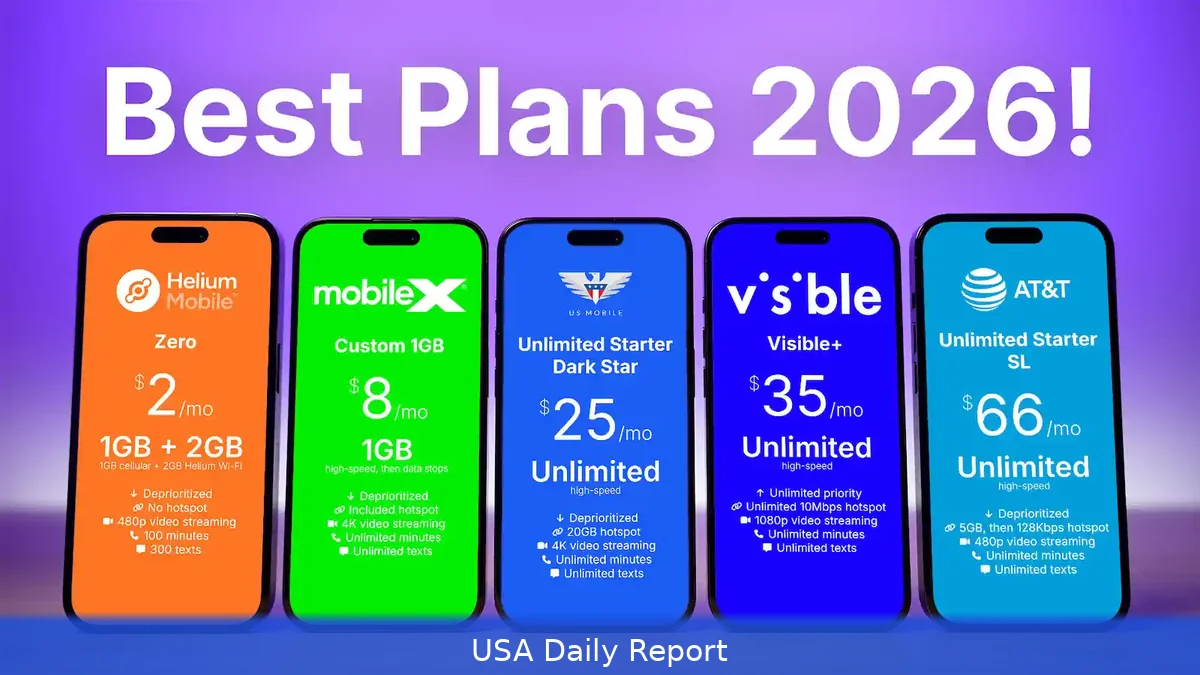
Looking to get approved for a phone plan quickly in 2026? Here's a guide on what carriers look for, the documents and credit info you'll need, how deposits and device financing work, plus a straightforward step-by-step approval process. Read the quick summary, then follow the numbered process to speed past surprises and get service today.
Quick reference
- Postpaid vs prepaid: postpaid may need a hard credit pull and device financing; prepaid usually doesn't.
- In 2026, starter prepaid plans usually cost between $10 and $25 a month, while unlimited plans run from $25 to $60. Activation fees range from $0 to $40, deposits can be anywhere from zero up to $400 for postpaid plans, and device financing typically lasts 24 to 36 months.
- Credit scores like FICO and VantageScore range from 300 to 850. If your score is below 670, you might have to pay a deposit or could be denied financing.
- Useful URLs: Verizon (https://www.verizon.com), AT&T (https://www.att.com), T‑Mobile (https://www.t-mobile.com), Mint (https://www.mintmobile.com), Visible (https://www.visible.com), Lifeline (https://www.fcc.gov/lifeline-consumers), Annual Credit Reports (https://www.annualcreditreport.com).
Prerequisites
Before you apply, have these ready. Carriers want photo ID, proof you can pay, and sometimes a credit check. Preparing ahead cuts approval time from days to minutes.
1) ID and contact info: government photo ID — driver’s license or passport — and a Social Security number if you have one. If you don't have an SSN, many carriers accept an Individual Taxpayer Identification Number (ITIN) or passport plus proof of address. Bring a second ID if you're activating in-store; some reps ask for two forms.
2) Proof of address: recent utility bill, bank statement, lease, or government mail dated within 30–60 days. Electronic bills printed from the provider's website usually work. If you're transient, bring a letter from a shelter or a campus housing statement; MVNOs often accept alternate proofs.
3) Payment method: a debit card, major credit card (Visa, MasterCard, AmEx, Discover), or bank routing/account number for autopay. Carriers often require an initial charge for the first month, activation fees, or device down payment. Typical activation fees in 2026 range $0 to $40 for major carriers; some promotions waive them.
4) Credit picture: know your FICO range. FICO and VantageScore run 300–850. Scores are grouped: 300–579 poor, 580–669 fair, 670–739 good, 740–799 very good, 800–850 exceptional. If your score is below 670, expect extra steps — refundable deposits, higher down payments, or limited device financing. You can pull your credit reports for free once per year at https://www.annualcreditreport.com or check scores at https://www.myfico.com and https://vantagescore.com.
5) Coverage and plan choice: run a coverage check before you apply. Use carrier maps — Verizon (https://www.verizon.com/coverage-map), AT&T Maps (https://www.att.com/maps/wireless-coverage.html), T‑Mobile (https://www.t-mobile.com/coverage/coverage-map) — and read local signal reports. If you live in a rural ZIP, expect different device financing options and possible higher deposits.
Step-by-step: How to get approved for a phone plan
Follow these numbered steps. They're ordered so most people get approved on the first try.
Step 1 — Decide postpaid vs prepaid
Postpaid plans are billed monthly and usually require a credit check for the account and any device financing. They often include perks like family lines, international roaming, and device trade-in credits. Prepaid plans charge up front, rarely require a credit check, and are the fastest route to service. If you're building credit or want a financed phone, pick postpaid. If you need immediate service with no check, pick prepaid.
Step 2 — Compare carriers and MVNOs

Big carriers — AT&T, Verizon, T‑Mobile — do hard credit checks for postpaid activations and device financing. They also offer 24- or 36-month installment plans and promotional trade-in deals. MVNOs (Mint Mobile, Visible, Consumer Cellular, Metro by T‑Mobile and others) often run lighter checks or no financing and use the big carriers' networks. In 2026, many prepaid plans start around $10–$25/month and unlimited options run roughly $25–$60/month. MVNOs may drop unlimited to $20–$40 with fewer perks. Check each carrier's deal page: Verizon Deals (https://www.verizon.com/deals), AT&T Offers (https://www.att.com/offers), T‑Mobile Offers (https://www.t-mobile.com/offers).
Right now, step 3 — Prequalify online where possible
Do a soft prequalification before applying. Many carriers and retailers let you do a soft credit check that won’t hurt your score but will give you an idea if you’ll get approved, what deposits you might owe, and what financing options are available. Look for pages labeled “pre-qualify,” “check eligibility,” or “soft credit check.” Soft-check tools typically reveal whether you'll get 0% financing, need a down payment, or face a required deposit.
Step 4 — Gather supporting documents
Bring the documents listed in Prerequisites and any supplementary proof if you're an international customer: passport, visa, I‑94, and proof of U.S. Address. For business accounts, bring an EIN and articles of incorporation. If you're adding a line under someone else's account, have written permission and the accountholder’s ID and account number.
Step 5 — Apply in the right place
Apply online for speed, but go in-store if you need help, have odd documents, or have a low credit score. Store reps can often verify identity faster, scan documents, and offer instant approvals. Online activations are fast — many finish within minutes — but financing contracts require e-signature, so have an email address and a phone number ready.
Step 6 — Understand deposit and financing terms
If required, deposits commonly range from $50 to $400 on major carriers in 2026, based on credit. Some customers with very low credit or no history may see higher deposits or be offered prepaid-only service. Device financing terms are most often 24 or 36 months. Many carriers advertise 0% APR if you meet the installment terms and keep the account in good standing. Read the fine print: late payments can trigger interest, repossession, or collection actions.
Step 7 — Activate and confirm
Once approved, activate your SIM or eSIM. Activation steps vary by carrier: use the carrier app (Verizon app, myAT&T, T‑Mobile app), call the activation line, or follow the included card. If porting a number, keep your old account active until the port completes to avoid losing your number. Porting usually completes within a few hours but can take up to a day for some MVNOs.
Tips
- Use autopay discounts. Many carriers cut $5–$10/month per line for enrolling in autopay. That adds up fast on multi-line accounts.
- Consider a co-signer or joint account. Adding a trusted co-signer with good credit can reduce or eliminate deposits and unlock better device financing.
- Trade in devices for instant credits. Carriers may give $100–$800 in trade-in value depending on model and condition; trade-in can lower your down payment or monthly installment amount.
- Check for employer, student, or military discounts. Many carriers list employee and association discounts online and at checkout.
- Balance financing and total cost. A $30/month device payment over 36 months is $1,080 total. Compare that to buying unlocked at full price to decide what's cheaper long term.
Common mistakes to avoid
- Applying without checking coverage. Cheap plans mean nothing if the carrier has poor signal at home or work. Run coverage checks first.
- Forgetting to cancel autopay or trade-in holds when switching plans. That can leave you paying for devices you no longer use.
- Assuming ‘prequalify’ is a guarantee. Soft checks estimate approval but final underwriting can still deny financing during a hard pull.
- Porting your number too early. Cancelling the old account before the port completes can lose the number and delay service.
- Overlooking fees. Read for activation fees ($0–$40), upgrade fees, restocking fees on returns, and early termination penalties on some legacy plans.
- Ignoring Lifeline and assistance programs. If you meet income or program-eligibility rules, Lifeline (https://www.fcc.gov/lifeline-consumers) can give a monthly discount, and some states offer additional subsidies.
Related Articles
- How to Apply for Money-Saving Aid in US 2026
- 401k 2026 contribution limit IRS
- How much is the best health insurance in USA in 2026
If credit or cash is tight, start with prepaid or an MVNO, apply for Lifeline if eligible, or save for a larger down payment. For most people, preparing ID, checking scores, and choosing the right carrier and plan cuts approval time to minutes rather than days.
This article was created with AI assistance.


