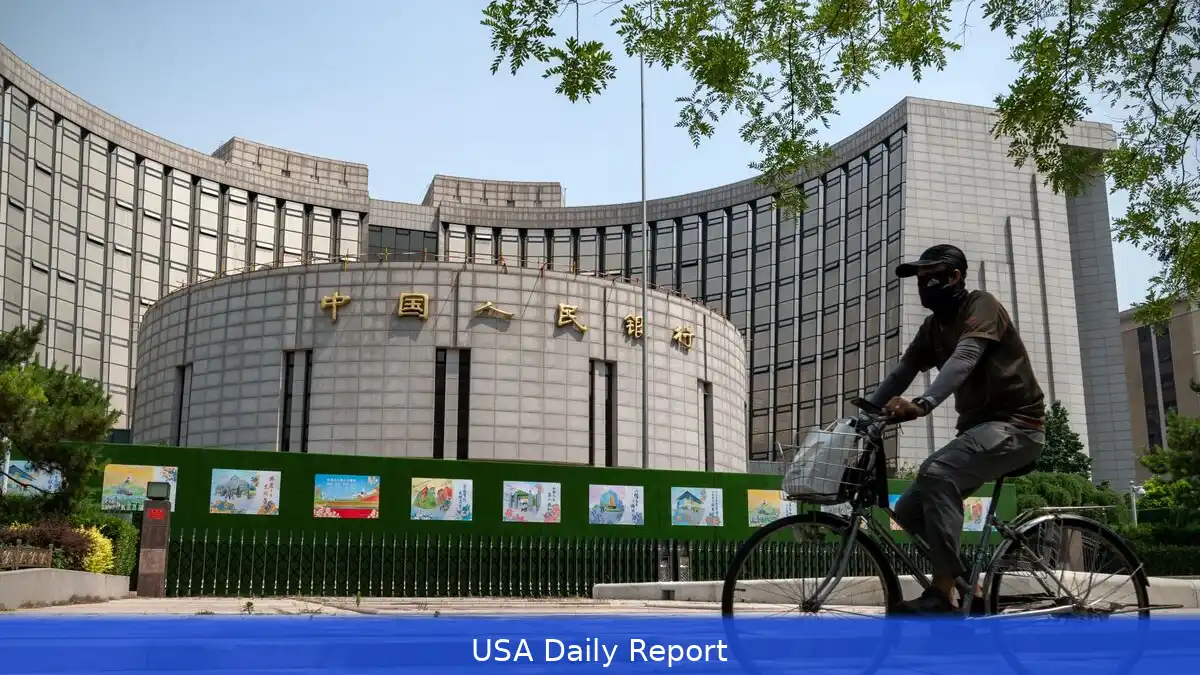
This week, China’s central bank pulled 70 billion yuan out of its banking system, showing caution as the economy struggles to recover. While many expected rate cuts, the People’s Bank of China kept key policy rates steady, underscoring pressure from a weak yuan and external headwinds.
Central Bank Holds Rates, Pulls Liquidity
On Monday, the People’s Bank of China (PBOC) rolled over 100 billion yuan ($13.8 billion) in medium-term loans at an unchanged 2.5% rate. But with 170 billion yuan of loans maturing this month, the net effect was a withdrawal of 70 billion yuan from the banking system. This move shows Beijing isn’t eager to ease monetary policy aggressively, even with warning signs in the economy.
Consumer prices barely rose in March, up just 0.1% year-over-year—the smallest gain in six months. Exports tumbled sharply, and credit growth hit a record low. New bank lending also disappointed, rising less than expected. These trends suggest China’s recovery remains shaky.
Still, the yuan’s 1.9% drop against the U.S. Dollar this year has complicated matters.
The weak yuan and lower yields versus other countries have caused capital to flow out, adding pressure on the PBOC. That’s partly why policymakers are hesitant to cut rates or flood the market with cash.
Liquidity Crunch Ahead of Lunar New Year
At the same time, the PBOC has been pumping cash into the system to prepare for the Lunar New Year holiday, when seasonal cash withdrawals spike. Ahead of the festival, the central bank injected 600 billion yuan ($86 billion) through short-term reverse repurchase agreements.
Officials could add another 500 billion yuan before the holiday starts.
That’s to cover massive cash withdrawals as millions travel and exchange "hongbao"—red envelopes stuffed with money for good luck. Last year, payment platforms processed over 8.5 trillion yuan in transactions during the first week of the festival. Electronic hongbao alone numbered 46 billion via apps like WeChat.
But the holiday cash drain makes liquidity pressures worse in an already fragile economy. Bloomberg estimates the banking system could face a shortfall of around 3.2 trillion yuan ($500 billion). To help, local governments plan to issue about $132 billion in bonds in February, while the central government will likely add another $57 billion.
Digital Yuan Evolves Amid Financial Stress
Meanwhile, China is pushing forward with its digital yuan, which entered a new phase in 2026. For the first time, wallet balances began earning interest at rates similar to demand deposits. That’s a sharp break from global norms—most central banks have kept digital currencies non-interest bearing to avoid disrupting traditional banking.
China’s decision shifts the digital yuan from being just digital cash (M0) to more like demand deposits (M1). It’s a shift toward a "digital deposit currency 2.0," blending payment convenience with potential new financial contract capabilities.
Experts say That could redefine how money flows in China, especially as the economy faces slowing growth and capital pressures. The digital yuan’s interest-bearing feature might encourage more use, but it could also reshape bank funding dynamics at a delicate time.
Monetary Tightrope
The PBOC faces a tough balance: supporting growth without causing the currency to fall or money to leave China. The decision to keep key rates steady, even as credit growth falters, shows a cautious approach. Injecting liquidity before the Lunar New Year helps ease short-term pressures but doesn’t signal a full easing cycle.
China’s economy is grappling with a mix of factors—weak export demand, slowing consumer prices, and external shocks like rising oil prices. The central bank’s moves reveal a strategy focused on stability over stimulus for now. But with first-quarter GDP data and activity indicators due soon, markets will be watching for signs of deeper intervention.
China’s monetary policy is trying to support growth while keeping the currency stable. The rare cash withdrawal from banks this week sends a message: Beijing is wary of loosening too fast. Yet, with liquidity tightening ahead of the Lunar New Year and digital yuan reforms underway, the coming months could reshape China’s financial landscape in unexpected ways.


