
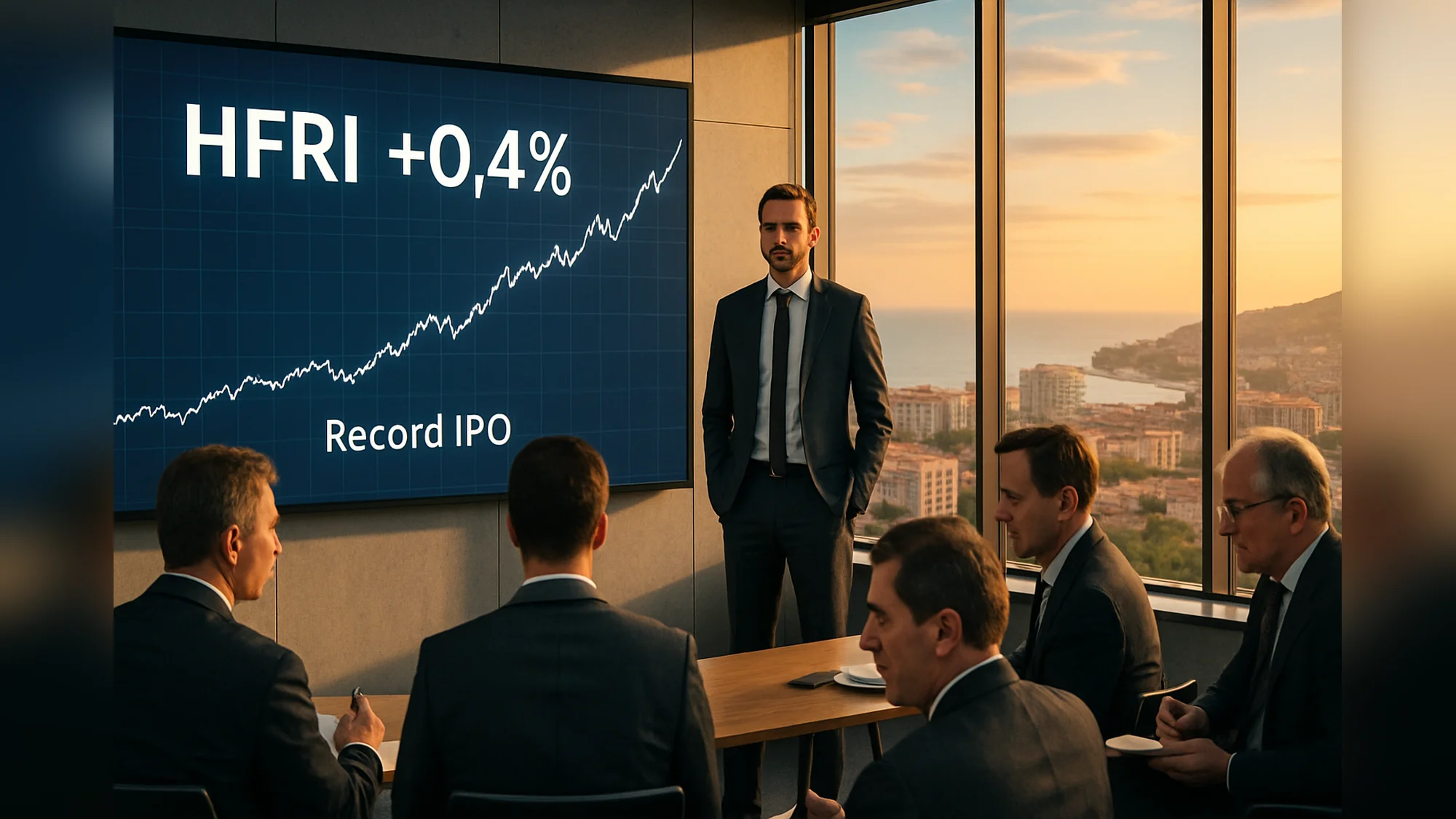
"We may be approaching the Minsky moment because the Mag-7’s capex growth is running well ahead of their revenue growth," said Amin Rajan, founder of the Create research consultancy, even as hedge funds posted a 0.4 percent gain in June, leaving the HFRI Fund Weighted Composite Index up 7.57 percent year-to-date and marking a 6.55 percent return for the second quarter, Hedge Fund Research reported. Kenneth J Heinz, president of Hedge Fund Research, linked June's advance to record equity levels, rising investor optimism, falling energy prices and portfolio exposure to a major IPO. The gain extended the industry to a third consecutive monthly advance and produced the strongest quarterly return for hedge funds since the final three months of 2020. Still, HFR and managers at the Fund Forum in Monte Carlo voiced caution about concentrated valuations and the sustainability of AI spending.
"Hedge funds advanced for the month as equity markets eclipsed new records driven by AI gains, and positive exposure to the record Space X IPO, although managers were forced to navigate increasing risk off sentiment throughout the month driven by concerns about valuation and the sustainability of AI spending," said Kenneth J Heinz, president of Hedge Fund Research.
HFR's numbers show a sector that delivered modest upside in June while depending heavily on a narrow set of market drivers. The industry posted a 0.4 percent gain for the month, 7.57 percent year-to-date and 6.55 percent for the second quarter. But HFR described the quarter as the strongest quarterly gain for hedge funds since Q4 2020 and tied the advance to three forces: record equity levels, falling energy costs and specific event exposure to a major IPO.
Numbers and nuance
The totals mask sharp differences across managers. HFR framed the first-half outperformance as conditional, not universal. Some strategies benefited from AI-related rallies and selective long positions tied to the landmark IPO, while others confronted rising risk-off sentiment as market participants questioned stretched valuations.

At the Fund Forum in Monte Carlo in late June, executives echoed that split. Onstage, several institutional figures and asset managers praised U.S. technological leadership and cited AI as a core market driver. Michael Hunstad, president of Northern Trust Asset Management, told the conference, "This is nothing like the dotcom era," arguing many large AI-related tech companies today have solid earnings and balance sheets.
Offstage caution and the Minsky warning
Offstage, allocators sounded a different note. Amin Rajan warned that heavy capital expenditure by a concentrated group of mega-cap tech firms could create long payback periods and push those companies toward bond-market funding if free cash flow comes under pressure. Rajan also questioned whether current valuations partly reflect retail-driven FOMO rather than long-term investor conviction.
HFR highlighted a mixed macro backdrop for the rest of 2026. The firm cited geopolitical tensions, supply-chain constraints, uncertainty over the near-term path of interest rates and shifting political sentiment ahead of elections as potential disruptors to hedge fund performance. That list frames the industry gains in the first half of 2026 as the result of strong equity markets and selective event exposure rather than a blanket risk-on stance across strategies.
Managers and allocators at Monte Carlo debated how long the AI-fueled advance can keep going if corporate spending patterns change. Some argued that durable earnings and clean balance sheets among leading tech firms justify current prices. Others warned that stretched valuations and financing risks in credit markets could expose the sector to sharper corrections.
For allocators, the immediate task is balancing exposure. Several attendees described reweighting to strategies that can profit from both strong equity markets and rising volatility. HFR's data suggest the industry has so far navigated the first half of 2026 with modest gains, but the drivers behind those gains are concentrated enough that outcomes could diverge materially across funds.
Related Articles
- Hedge Funds Back Oil, Profit From Shorting Renewables
- SK Hynix U.S. listing could raise $29.4 billion
Hedge Fund Research called the second-half outlook mixed, with AI-led gains balanced against evolving risks from corporate spending, geopolitics, supply chains and interest rates.
This article was created with AI assistance.


