
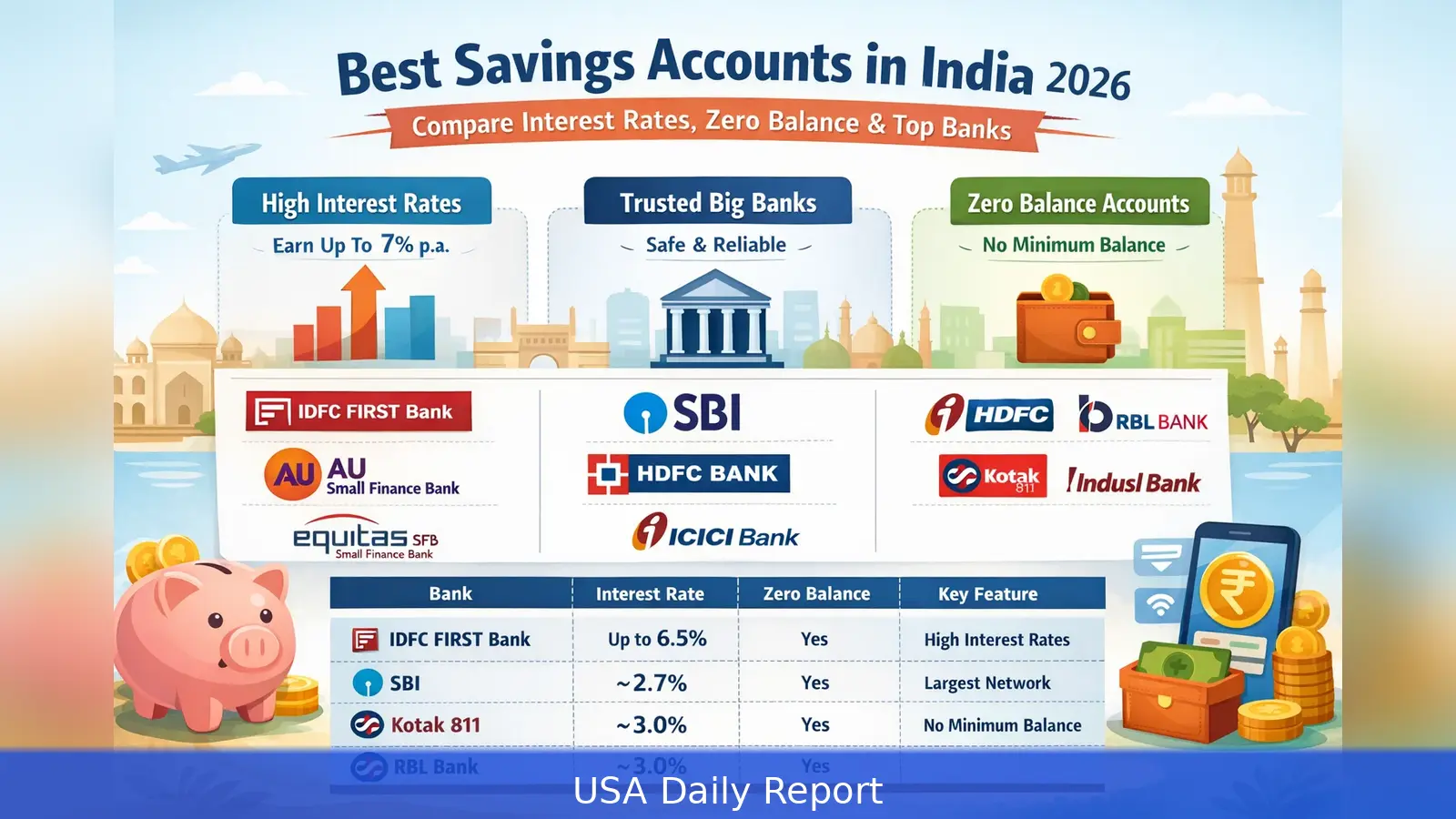
Looking for who's the best bank to have a savings account with in 2026? Rates, fees and features changed a lot over the last few years. This guide ranks the top banks and credit unions for savings accounts in 2026, explains fees and eligibility, and shows the exact steps to open an account that actually works for your goals.
Quick reference — at a glance
Short on time? Here are the top picks for who's the best bank to have a savings account with in 2026:
- 1. Ally Bank — Best overall online savings (APY 4.40%, $0 min, $0 monthly).
- 2. Marcus by Goldman Sachs — Best for easy goal-based saving (APY 4.25%, $0 min, $0 monthly).
- 3. Discover Online Savings — Best for customer service + rewards (APY 4.20%, $0 min, $0 monthly).
- 4. Capital One 360 Performance Savings — Best for mobile-first savers (APY 4.10%, $0 min, $0 monthly).
- 5. American Express High Yield Savings — Best for stable APY (APY 4.00%, $0 min, $0 monthly).
- 6. Sallie Mae High-Yield Savings — Best for high APY among niche online banks (APY 3.90%, $0 min, $0 monthly).
- 7. Synchrony Bank — Best for ATM-linked savings (APY 3.85%, $0 min, $0 monthly).
- 8. Barclays Online Savings — Best for simple online-only saving (APY 3.75%, $0.01 min, $0 monthly).
- 9. Bank of America Advantage Savings — Best if you need branches (APY 0.01%, $100 min, $8 monthly — waivable).
- 10. Wells Fargo Way2Save — Best branch + hybrid features (APY 0.01%, $25 min, fees vary by account activity).
Ranked list — who's the best bank to have a savings account with (1–10)
1. Ally Bank
Key features: Competitive APY (4.40% as of 2026), no minimum deposit, no monthly fees, 24/7 mobile app, automatic savings tools, FDIC insured.
Pros: High APY, no fees, easy transfers to external banks, round‑up and buckets for goals.
Cons: No physical branches, ATM access limited to partner networks for savings.
Who it's best for: Savers who want the best mix of yield and usability without branch access.
Pricing: APY 4.40% (2026); $0 minimum; $0 monthly fee; excessive transfer rules: up to 6 convenient withdrawals per statement cycle typical.
2. Marcus by Goldman Sachs
Key features: Strong APY (4.25% as of 2026), no fees, intuitive web and mobile interface, automated transfers and goal trackers, FDIC insured.
Pros: Predictable UX, no balance or deposit minimums, daily compounding interest.
Cons: No ATM or debit card tied to savings; no branches.
Who it's best for: People who want simple goal-driven saving and strong yields.
Pricing: APY 4.25% (2026); $0 min; $0 monthly fee.
3. Discover Online Savings
Key features: Competitive APY (4.20% as of 2026), $0 minimum, free transfers, strong customer service and mobile tools, FDIC insured.
Pros: Robust app, excellent support, no fees, integrated checking options if wanted.
Cons: No physical branches for in-person service.
Who it's best for: Savers who want top-tier service and tools along with high yield.
Pricing: APY 4.20% (2026); $0 min; $0 monthly fee.
4. Capital One 360 Performance Savings
Key features: APY 4.10% (2026), $0 min, mobile-first features, easy link to 360 checking, FDIC insured.
Pros: Great app, optional ATM access when paired with checking, nationwide Cafés and branches in some cities.
Cons: APYs can change with market; fewer branch locations than large national banks.
Who it's best for: Mobile-savvy savers and existing Capital One customers.
Pricing: APY 4.10% (2026); $0 min; $0 monthly fee.
5. American Express High Yield Savings
Key features: Stable APY around 4.00% (2026), no monthly fees, $0 to open, FDIC insured.

Pros: Strong customer trust, simple online management, reliable rate history.
Cons: No branch network, no ATM card for savings.
Who it's best for: People who value stability and brand reliability while chasing a good APY.
Pricing: APY 4.00% (2026); $0 min; $0 monthly fee.
6. Sallie Mae High-Yield Savings
Key features: One of the top APYs in 2026 at 3.90%, no minimum, no monthly fees, daily compounding, FDIC insured.
Pros: High APY, mobile check deposit, no monthly fees.
Cons: No branches or ATMs; product narrower than full-service banks.
Who it's best for: Rate-first savers who don't need a branch.
Here's the thing — pricing: APY 3.90% (2026); $0 min; $0 monthly fee.
7. Synchrony Bank
Key features: APY 3.85% (2026), optional ATM card for savings, high-yield focus, $0 monthly fees, FDIC insured.
Pros: ATM access for some accounts, solid APY, mobile and online tools.
Cons: Limited in-person support.
Who it's best for: Savers who like an ATM option on a high-yield account.
Pricing: APY 3.85% (2026); $0 min; $0 monthly fee.
8. Barclays Online Savings
Key features: Steady APY around 3.75% (2026), low opening requirement (often $0.01), no monthly fees, FDIC insured.
Pros: Simple, no-nonsense savings with competitive rates.
Cons: No branch network or ATM access for savings.
Who it's best for: Savers who want a hands-off, reliable online account.
Pricing: APY 3.75% (2026); $0.01 min; $0 monthly fee.
9. Bank of America Advantage Savings
Key features: Branch access, integrated rewards if you're a Preferred Rewards member; APY 0.01% (2026) base rate; $100 minimum to open; $8 monthly fee unless waived.
Pros: Huge branch and ATM network, easy in-person service, strong overdraft link with checking.
Cons: Very low APY unless you hit high balance tiers, monthly fee unless waived.
Who it's best for: People who need branches and full-service banking rather than top APY.
Pricing: APY 0.01% (2026); $100 min to open; $8 monthly fee (first six months waived for new customers; fees waivable under conditions).
10. Wells Fargo Way2Save Savings
Key features: Wide branch network, automatic savings options, hybrid bank model; APY around 0.01% (2026) for base accounts.
Pros: Branch access, tools that automate saving from checking, physical support.
Cons: Low APY compared with online banks; fees can apply based on account activity.
Who it's best for: People who prioritize branches and in-person help over APY.
Pricing: APY 0.01% (2026); $25 min to open typical; monthly fee varies and is often waivable with qualifying activity.
How to open a savings account — step by step
Follow these steps to open a savings account quickly and securely:
- Compare APY and fees. Look at annual percentage yield (APY), monthly fees, minimum opening deposit and transfer limits.
- Confirm FDIC insurance. Make sure the bank is FDIC insured — standard coverage is up to $250,000 per depositor, per bank, per ownership category.
- Gather documents: U.S. Government photo ID, Social Security number, and proof of address (utility bill or lease).
- Apply online or in-branch. Fill out the application, provide ID, and accept terms. If in-branch, bring the documents with you.
- Fund the account. Many banks allow electronic transfer, mobile check deposit or mailed checks. Some require a minimum opening deposit.
- Set up automatic transfers. Schedule weekly or monthly transfers to build savings without thinking about it.
- Link external accounts. Verify small test deposits to enable fast transfers to checking when needed.
Costs, fees and eligibility criteria
Most online high-yield savings accounts in 2026 charge no monthly fees and no minimum deposit to open. Brick-and-mortar accounts often have monthly maintenance fees — Bank of America charges $8 a month on its Advantage Savings unless you meet waiver conditions, and requires $100 to open. Expect transfer limits of up to 6 convenient withdrawals or transfers per statement cycle at many institutions; excess transactions can trigger fees (commonly $5–$15) or account conversion. All banks require U.S. Identity verification — typically a SSN and government ID.
Common mistakes to avoid
- Chasing teaser rates without checking how long they last — promotional APYs can drop after a few months.
- Ignoring compounding frequency — daily compounding gives better effective yield than monthly.
- Leaving emergency cash in accounts with low APY at brick-and-mortar banks when online alternatives pay much more.
- Not linking accounts — transfers can take days if you don’t set up external links in advance.
- Overlooking fees for excess withdrawals or for inactivity in some accounts.
Alternatives to a traditional savings account
If the highest APY is the top priority, Look at these alternatives:
- High-yield checking accounts — sometimes offer competitive APYs if you hit monthly requirements.
- Short-term CDs — locked rates often higher for fixed terms; penalties for early withdrawal.
- Money market accounts — often combine checking-like access with better yields.
- Series I Savings Bonds and Treasury bills — government-backed options that can beat bank APYs depending on inflation and auction rates.
- Credit unions — often pay higher rates but require membership and may have limited branch networks.
How we chose the banks on this list
We ranked banks by practical consumer factors that answer the question: who's the best bank to have a savings account with in 2026? The criteria included:
- APY and how often interest compounds.
- Fees and minimum balance requirements.
- Mobile and web experience — speed of transfers, mobile deposits, alerts and automation.
- Access needs — branch and ATM footprint versus online-only convenience.
- Customer service and account features (automatic transfers, goal tools, linked checking options).
- Safety — FDIC insurance and clarity of terms.
We balanced yield against usability. For many people, a slightly lower APY with easy branch access makes more sense than the highest possible rate with no human support.
Related Articles
- Top 10 Best Banks in United States 2026
- How to Apply for Punjab Government Home Loan 2026
- Top 5 AI Spreadsheet Tools 2026
Final verdict — who's the best bank to have a savings account with? If your priority is the highest practical return, an online bank like Ally, Marcus, Discover or Capital One 360 is the best choice in 2026 — they combine APYs in the 4% range with no fees and easy mobile tools. If you need branches, a large bank like Bank of America or Wells Fargo will give you service and convenience, but expect very low base APYs. Match the account to the role it plays for you: emergency fund (high APY, instant transfers), short-term goal (CD or HYSA), or everyday reserve (hybrid checking/savings). Check FDIC limits, set up automatic transfers, and re-shop rates annually — rates change, and the bank that’s best this month might not be best next year.
This article was created with AI assistance.


