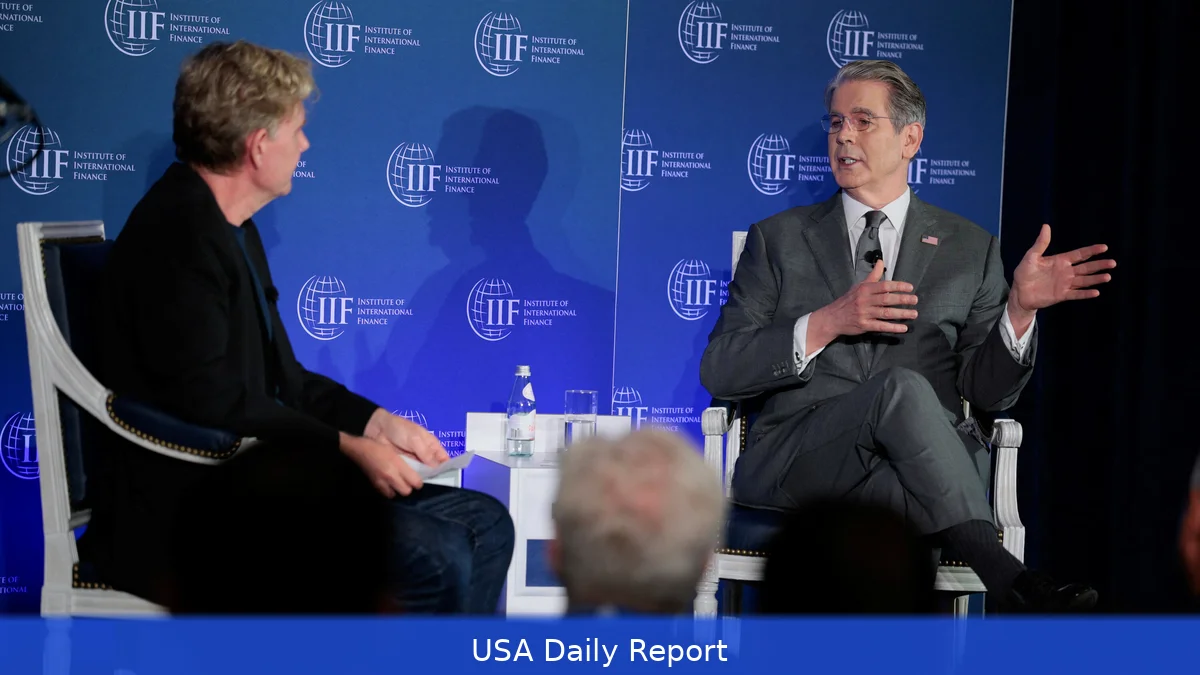
Scott Bessent challenged climate priorities at global finance talks.
Sharp rebuke at the spring meetings
Scott Bessent, U.S. Treasury secretary, used his appearance at the IMF and World Bank spring meetings in Washington this week to criticize how those institutions treat climate issues. He argued the IMF has drifted from its financial mandate and warned the World Bank against using climate goals to guide lending priorities.
Look, he didn't pull punches.
In a speech delivered to delegates gathered from nearly 189 countries, Bessent said, "The IMF was once unwavering in its mission of promoting global monetary cooperation and financial stability. Now it devotes disproportionate time and resources to work on climate change, gender and social issues. These issues aren't the IMF's mission."
He pressed the World Bank to focus on expanding energy access with technologies that keep economies growing, rather than chasing what he called "distortionary climate finance targets." That line of argument continues the White House push to limit explicit climate language at multilateral finance institutions.
Where the pushback is coming from
Not everyone at the meetings agreed with Bessent. Mohamed Adow, director of the Power Shift Africa think tank, said sidelining climate at a moment of global energy volatility is perilous. "It is beyond absurd that, in the middle of an escalating oil crisis, a World Bank meeting could sideline talk of climate change," Adow said.
Point is, poorer countries face much of the immediate damage from extreme weather and rising seas, and many are asking international lenders for cash to adapt infrastructure, shore up coasts and move electricity grids toward renewables.
Those needs sit uneasily alongside a U.S. Push that, according to participants, has encouraged less direct discussion of climate in plenary sessions and reports. Some officials told delegates they were avoiding the term "climate" in documents and presentations to prevent friction with the U.S. Delegation.
Energy security versus climate policy
The geopolitical backdrop sharpened the debate. A fragile ceasefire in the Middle East and a global oil supply crunch have fanned concerns over energy security, and some countries want emergency financing to keep power plants running. Bessent's call for an "all-of-the-above" approach — including financing for gas, oil and coal where affordable and reliable — is framed as a pragmatic response to that squeeze.
Critics say that short-term fixes risk locking low-income countries into fossil-fuel infrastructure for decades. Supporters respond that unreliable power kills growth, and that without immediate energy access poor countries can't lift living standards.
The tension is more than policy theater. The United States is the World Bank's largest shareholder, holding roughly 17% of its capital. That stake gives Washington sizeable influence over the bank's strategy and has made U.S. Priorities a focal point of internal negotiations.
How this ties to broader politics
Climate policy has long been politically fraught, and the current debate at the spring meetings mirrors domestic divisions. Academic and popular treatments of future risks — like David Wallace-Wells's book The Uninhabitable Earth — have tried to translate climate science into economic and social forecasts, warning of potential large-scale disruption to agriculture, migration and public health.
At the same time, cultural responses range from urgent activism to resigned indifference. Brookings noted how even dramatic warnings can leave people feeling overwhelmed. Comedian Colin Jost captured that mood on Saturday Night Live when he joked that huge-scale risks make people give up rather than act.
Those attitudes complicate policymaking. If populations resist major economic transitions, elected officials hesitate to push policies that could raise short-term costs. That reality feeds into Bessent's critique: he told the meetings that multilateral lenders should avoid what he called mission creep into social and political agendas.
What it means for climate finance
Negotiations over a new climate change action plan at the World Bank — meant to replace the current strategy expiring in June — are now in doubt. Some delegations reportedly prefer shelving a new plan rather than force a public split with Washington.
For developing countries, that could be a problem. They already spend billions repairing climate-related damage from storms, floods and droughts, and many argue international lending must steer more resources toward mitigation and adaptation. If a new bank-wide plan is delayed or softened, those flows could remain fragmented and small.
Advocates warn the window to finance a transition to cleaner, more stable energy is narrow. Renewable investments can, they argue, reduce exposure to volatile fossil-fuel prices and lower the long-term cost of energy systems — while also cutting greenhouse-gas emissions.
Where lenders might go from here
Look, institutional responses will matter. The IMF's core work on balance-of-payments support and macroeconomic stability doesn't disappear because climate shocks change risk profiles. Debt, fiscal buffers and balance sheets will all be affected when extreme weather hits economic output or supply chains.
So the debate isn't just ideological. It's technical. It asks whether climate-related risks are now central enough to the IMF's financial-stability mission that they demand staffing, models and lending tools tailored to those shocks.
Bessent's answer was no — at least for now. He urged the IMF to stick to core monetary and financial tasks and the World Bank to prioritize reliable energy for growth. Others say those institutions already face climate impacts in their regular work and must plan accordingly.
Who's watching and what's next
Delegates at the meetings are expected to take procedural votes and set work programs. Some countries are pushing quietly for more explicit climate commitments; others want a neutral stance to avoid alienating the U.S. Delegation. The result could be a compromise document that trims climate language while keeping some financing pathways open.
That outcome would leave big questions about how multilateral loans, guarantees and technical assistance will be used in coming years — and whether poorer countries can accelerate clean energy without runs on balance sheets or unacceptable rates.
What investors and markets will do in response depends on clarity. If the World Bank and IMF signal a clearer strategy that ties climate risk to lending, private capital might follow. If those signals are muddled, markets could demand higher returns for lending to vulnerable countries.
Related Articles
- Pakistan Wins $5B Gulf Support to Shore Up Reserves
- US Stocks Hold Up Despite Oil and Rising Yields
- Prosecutors Visit Fed Renovation Site Unannounced
The United States holds roughly 17% of the World Bank's capital.


