
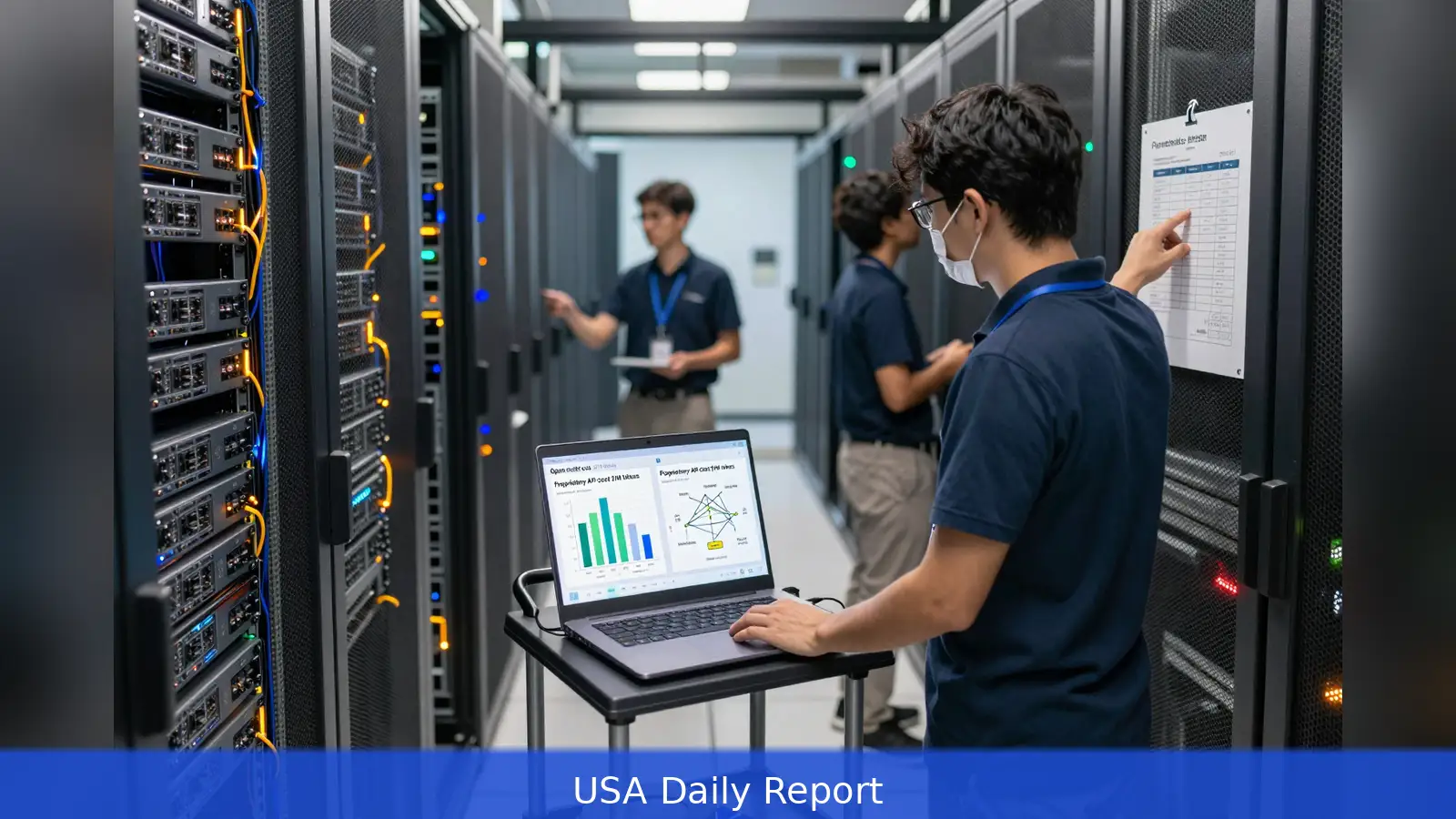
Companies can cut inference costs roughly sevenfold, because community models have closed much of the quality gap and token pricing for self-hosted options has fallen sharply. One analysis of 94 models found 63 percent of the dataset were open-source, put the top open model seven quality points behind the best proprietary model, and calculated average inference costs of about $0.83 per million tokens for open models versus $6.03 per million tokens for proprietary APIs. That roughly 7.3x cost gap, combined with faster throughput for optimized open deployments and a finding that nine open models are production-ready for many professional tasks, forces procurement choices to be practical rather than ideological. The most actionable move is clear: run a task-specific pilot that measures task accuracy, the all-in inference cost including infrastructure and staffing, and operational risk, then use those like-for-like results to decide whether to self-host open weights, consume proprietary APIs, or adopt a hybrid route.
That shift forces organizations to choose a strategy based on concrete trade-offs between Performance, Total cost of ownership, Data control and operational capacity rather than ideology, because open models now deliver parity for most enterprise tasks while per-token costs remain far lower.
1. Start with the use case and performance needs
Begin with the function the model must perform. Industry executives commonly advise to "innovate where it matters and rent where it does not," and that guidance captures the practical split every procurement team should make. For tasks that demand the very best reasoning, such as complex legal review, adjudication of regulated claims, or any safety-critical automation, proprietary platforms still often provide the shortest route to deployable, top-tier accuracy and packaged support. For high-volume, lower-complexity tasks where throughput and marginal cost dominate the equation, open-source models tend to offer better value.
Worked example: a customer support pipeline. First, route high-volume, routine tickets to a tuned open model to capture the lower per-token cost. Second, escalate legal, compliance or high-risk queries to a proprietary API that provides the strongest out-of-the-box reasoning and contractual assurances. That split answers the core business question, which is whether the task requires the absolute top-tier reasoning or a reliably good model combined with tight cost control.
2. Benchmark and cost reality
Procurement must be led by benchmarked performance on the exact task and by realistic cost math. One analysis of 94 models reported that 63 percent of the dataset were open-source models, and found the lead open model trailing the best proprietary model by seven quality points on that study's index, down from a larger gap in 2024. The same analysis calculated an average inference cost of about $0.83 per million tokens for open models versus $6.03 per million tokens for proprietary APIs, a gap the study described as roughly 7.3 times cheaper for open options at that time.
The study also reported faster throughput for optimized open deployments and concluded nine open models were production-ready for many professional use cases, while proprietary systems retained the lead in the elite performance tier. It emphasized API-accessible, production-ready models and noted it didn't cover every research-only open-weight release. Analysts drawn to those figures point to a near-term trajectory as well, with that analysis forecasting parity with top proprietary systems soon, while other commentary stresses momentum without a firm parity date.
3. Calculate total cost of ownership and deployment work
Lower per-token prices are real savings, but they're only part of the equation. Open weights favor organizations that can absorb infrastructure and engineering costs, because self-hosting shifts the bill from API fees to GPU provisioning, MLOps, monitoring, model maintenance and staff.
Analysts and enterprise advisors stress that the cost advantage becomes material only when teams plan for lifecycle expenses rather than comparing API list prices to a zero-upfront licensing figure.
Worked example: use the per-million-token figures from the benchmarking study as a back-of-envelope. At $0.83 per million tokens, an open deployment would incur about $83 for 100 million tokens. At $6.03 per million, a proprietary API would cost about $603 for the same volume. That simple math shows where savings concentrate, but it omits the capital and operating expense to run and staff the open deployment. Include GPU-hour costs, redundancy for reliability, storage for logs and checkpoint retention, and the salaries or contractor fees for MLOps and model engineering when you compute true TCO.
Also account for geographic variation. The same analysis highlighted disruptive pricing from several labs that pushed per-token costs down further in certain regions, creating windows where self-hosting becomes especially attractive for locally hosted or latency-sensitive workloads.
4. Assess data control, licensing and security trade-offs
Licensing is a permission map. Open-source distributions grant access to model weights and code, enabling customization, fine-tuning and on-premises deployment. That access delivers stronger control over training data, inference logs and data residency, which is essential for regulated industries and public-sector actors that require auditable data handling. Proprietary platforms, by contrast, offer closed weights and API access with contractual usage constraints, but they commonly package compliance features, SLAs and vendor support that reduce operational risk for regulated workloads.

Worked example: a health-care provider facing patient data residency rules. Self-hosting an open model lets the provider keep inference logs and patient inputs within its own network and apply bespoke audit trails. A proprietary vendor may offer certifications and contract terms that satisfy regulators without the provider having to run its own GPU fleet, but the trade is less direct control over raw model weights and telemetry.
Policymakers and commentators have also flagged risks. The transparency that makes open models attractive for customization also raises concerns about misuse and national security. That's one reason some organizations limit which workloads run on fully open stacks and keep highly sensitive flows on vendor-managed platforms with contractual protections.
5. Evaluate operational maturity and talent
Open strategies return the biggest dividend to organizations with established MLOps practices, GPU capacity and the ability to recruit or contract engineering talent. Those teams can squeeze latency out of inference, maintain model versions, implement safety layers and instrument monitoring that tracks drift and incidents. Firms without that operational depth often prefer proprietary offerings for their managed infrastructure and lower upfront staffing demands.
Worked example: a mid-size software company lacking in-house MLOps expertise will likely reach production faster by consuming a proprietary API that includes model updates, monitoring dashboards and enterprise support. A larger firm with a capable platform engineering team can assume the work of optimizing an open-weight model, tuning it to domain data and realizing the per-token savings at scale.
Industry executives therefore recommend a mixed strategy in practice: use proprietary services where speed-to-market and vendor-managed assurance matter, and use open models where differentiation, cost control or data governance require ownership.
6. Account for sector-specific adoption patterns and vendor lock-in risk
Market coverage shows a bifurcated adoption pattern. Open models have surged in availability and are widely used across development teams and startups, while proprietary platforms maintain dominance in many large enterprises and regulated sectors thanks to bundled compliance, support and integrations. Some research indicates more than half of enterprises already use open-source AI tools and plan to increase their use, a fact that helps explain the rapid growth of hybrid architectures.
Worked example: financial services firms often run reconciliation and bulk analytics on open weights for cost control, while retaining proprietary APIs for front-line decisioning where auditability and vendor SLAs reduce operational risk. That dual approach mitigates vendor lock-in while preserving access to elite capabilities when they matter most.
But vendor lock-in remains a real consideration. Proprietary platforms can be stickier because customers build integrations around APIs, compliance features and vendor-specific tools. Open weights reduce that stickiness by allowing export and migration of models, though supply-chain and dependency risks persist and require governance.
7. Design a pilot and measurement plan
Pilots convert strategy into procurement. Analysts recommend pilots that measure three variables in production-like settings: task-specific accuracy against an agreed metric, inference cost per unit of output including infrastructure and staffing, and operational risk measured by incident throughput, monitoring coverage and compliance readiness. The recommended approach is to pilot both open and proprietary options in parallel where doable, because hybrid deployments are often the best path: run bulk inference on open models for cost efficiency and route escalation or high-sensitivity queries to proprietary systems.
Worked example: instrument two parallel endpoints for the same production traffic. First endpoint, an optimized open model, handles 90 percent of calls. Second endpoint, a proprietary API, handles routed escalations. Measure three things over a representative window: 1) accuracy on labeled test cases and on live edge cases, 2) all-in inference cost per resolved transaction, and 3) incidents per thousand sessions including monitoring gaps and compliance exceptions. Analysts advise collecting at least one quarter of representative data so seasonal load and edge-case frequency are visible before scaling.
Finally, set governance rules tied to pilots. Formalize update cadences, third-party dependency audits and rollback triggers so a delivered model can be traced, remediated and, if necessary, reverted quickly. Those policies manage supply-chain and safety risk no matter which technical foundation you pick.
Decision checklist as procedural steps
First, define the user story and success metric so the purchase decision addresses a measurable outcome. Second, benchmark model candidates on the exact task, because public leaderboards and internal evaluation will often reorder vendors compared with general-purpose ranks. Third, compute total cost of ownership including GPUs, storage, model maintenance and staffing rather than comparing list API prices alone. Fourth, map regulatory and data-governance constraints including residency, auditability and retention rules so licensing and deployment choices align with compliance needs. Fifth, assess in-house operational capability and hiring timelines because open strategies require sustained engineering and MLOps investment. Sixth, pilot both open and proprietary approaches with real traffic, instrument for accuracy, latency and cost, and collect at least one quarter of representative data before scaling. Seventh, set a governance policy for model updates, third-party dependency audits and rollback triggers to manage supply-chain and safety risk.
In short
1) Decide by use case, not ideology: elite reasoning often favors proprietary APIs, bulk inference favors open models. 2) Benchmark task-specific performance and include the full infrastructure and staffing costs in TCO. 3) Pilot open and proprietary paths in parallel where possible and collect at least one quarter of representative data. 4) Use hybrid routing to combine low-cost bulk inference with vendor-managed escalation for sensitive calls. 5) Lock governance rules to the pilot so updates, audits and rollbacks are codified before scaling.
Related Articles
- Apply for Dallas Housing Authority: 8 Steps
- Send Tuition from Nigeria to US: 10-Step 2026 Guide
- Apply for Los Angeles County Jobs in 9 Clear Steps
The next concrete step is operational: run a task-specific pilot that measures task accuracy and the all-in inference cost, instrument the pilot to capture incident rates and at least one quarter of representative traffic, and use those like-for-like results to choose whether to self-host open weights, consume proprietary APIs, or adopt a hybrid route.
This article was created with AI assistance.


