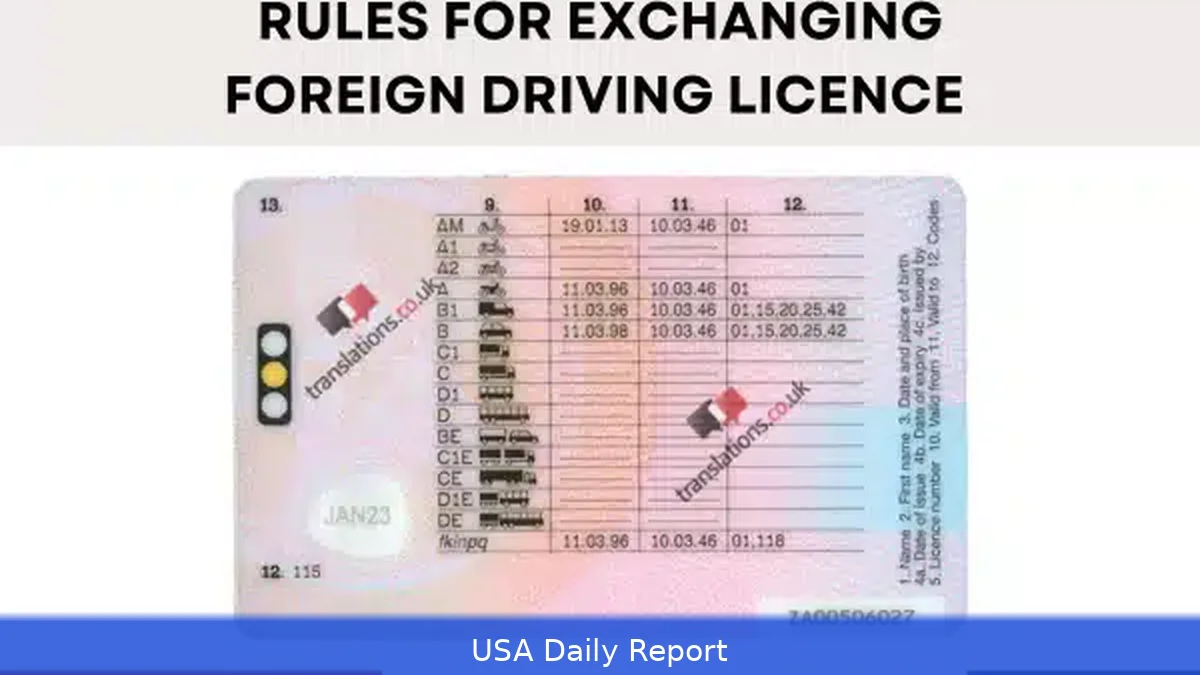
Planning to drive in the US in 2026? If you're a foreign national, you might be wondering whether you can swap your current licence or if you'll have to take a driving test. Since rules differ from state to state, knowing them ahead can save you a lot of time and trouble.
Eligibility for a US Driving Licence as a Foreign National in 2026
Foreign nationals living in the US on valid visas are generally eligible to apply for a US driving licence. But eligibility depends heavily on your visa status, the state where you reside, and whether your home country has reciprocal agreements with that state. That means what works in California might not work in Texas or New York.
In most states, you need a valid, current foreign driving licence to swap it for a US one without taking tests. For example, California allows licence exchange if your country is on its list of reciprocal agreements, which includes countries like Canada, Germany, South Korea, and Taiwan. If your country isn’t on the list, you’ll usually have to pass both the written knowledge test and the behind-the-wheel driving skills test.
If you hold a work visa like H-1B, a student visa like F-1, or are a green card holder, you usually can apply for a driving licence as long as you prove you live legally in the state. This proof often includes documents like a lease agreement, utility bill, or bank statement showing your local address.
Visitors on temporary tourist visas (B-1/B-2), however, are usually limited to using an International Driving Permit (IDP) alongside their home country licence, valid for up to one year in most states.
Some states set additional requirements. For instance, New York requires foreign nationals to provide proof of lawful presence as well as their Social Security Number or a letter of ineligibility from the Social Security Administration. Florida requires proof of residency and may ask for a letter from the consulate if your country doesn’t issue driver’s licences that meet US standards.
Keep in mind that age restrictions apply. Most states require applicants to be at least 16 or 18 years old, and some have graduated licensing programs for drivers under 21. Always check your local DMV for details.
Step-by-Step Application Process
Every state has its own DMV or similar agency that handles driving licences. So procedures and fees vary, but here’s a general process to follow:
- Check State Requirements: Visit your state’s official DMV website to confirm if your country’s licence can be exchanged or if you must take tests. For example, California’s DMV (Https://www.dmv.ca.gov) lists countries eligible for licence exchange. New York’s DMV (Https://dmv.ny.gov) provides detailed instructions and forms.
- Gather Documentation: You’ll need your valid foreign driving licence, passport, visa documentation (like your I-94 or I-797 approval notice), proof of residence (utility bills, lease agreements, bank statements), and your Social Security Number (if applicable). Some states also require a letter of authorization or verification from the consulate or embassy.
- Apply for a Learner’s Permit (if required): If your licence can’t be exchanged, you may have to take a written knowledge test to get a learner's permit. This permit allows you to practice driving under supervision before taking the road skills test. The written test often includes questions about traffic laws, road signs, and safe driving practices. Most DMVs offer study guides online and sometimes in person.
- Schedule and Pass the Driving Test: After passing the written exam and holding the permit for the required time — which varies by state (for example, 6 months in some places, none in others) — you schedule a behind-the-wheel driving test. This practical exam tests your ability to drive safely in different traffic situations, obey speed limits, use signals, and handle parking. It’s usually conducted at a DMV testing center.
- Pay Fees and Submit Application: Fees also vary. For example, New York charges $64.25 for a standard licence application, while California fees range from $35 to $38.50 depending on the type of licence. Some states allow online payment; others require payment at the DMV office.
- Receive Your Licence: Once you finish all the steps and pay the fees, you usually get a temporary paper licence that day. The permanent plastic card is mailed to your residence within 2 to 4 weeks.
Tips for a Smooth Application
- Start early. Some states require appointments for tests that can be booked weeks in advance.
- Keep copies of all documents handy and organized.
- Use official DMV study materials to prepare for tests.
- Check if your state offers online practice tests for the written exam.
- Bring a licensed driver with you when practicing with a learner’s permit.
- Review your state's driving laws as they can differ significantly from your home country.
- Be patient during DMV visits — wait times can be long, especially in big cities.
- Check if there are language assistance services at your DMV if English isn’t your first language.
Common Mistakes to Avoid
- Assuming all states accept licence exchanges — many do not.
- Not bringing all required documents, which can delay your application.
- Ignoring residency proof requirements — some states want very specific documents.
- Failing to schedule your driving test early enough.
- Underestimating the difficulty of the written and driving tests.
- Using an expired or invalid foreign licence during the application process.
- Not updating your address with the DMV after moving within the state.
Getting a US driving licence as a foreign national in 2026 means understanding state-specific rules about exchanging your existing licence or taking tests. Start early, check your local DMV’s website for the latest requirements, gather your documents carefully, and prepare well for any exams.


