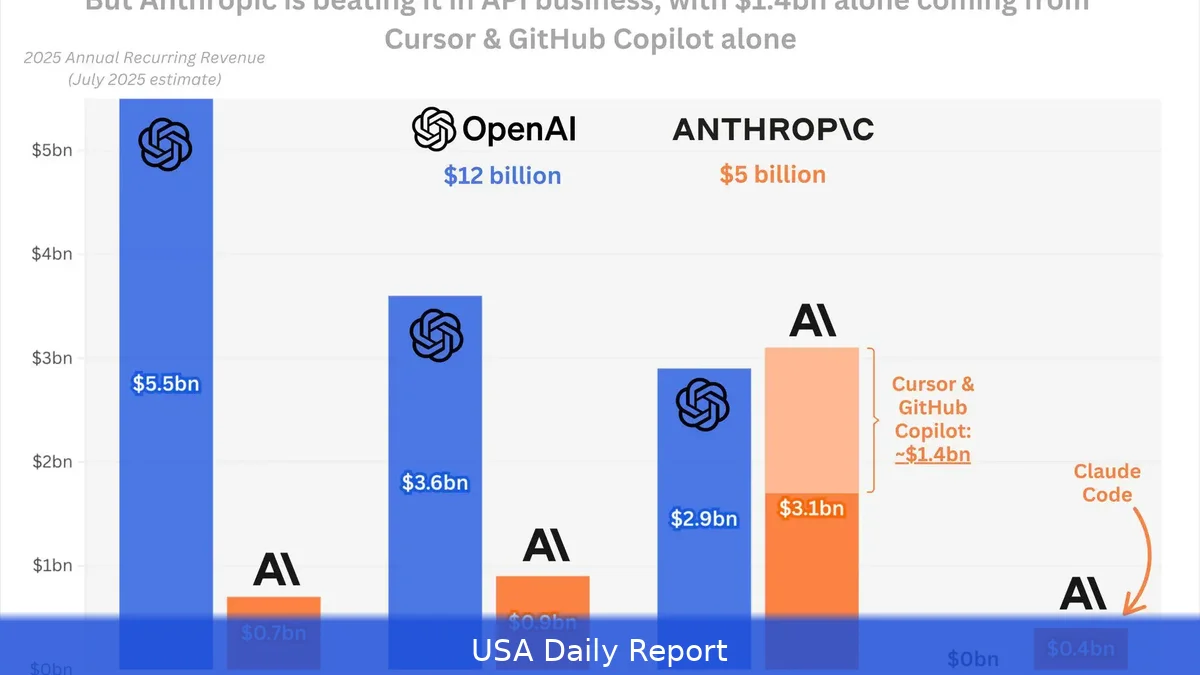
Anthropic's AI is closing the gap with OpenAI. Ramp's customer payment data shows Anthropic used by 30.6% of businesses that pay for AI products. That's up 6.3 percentage points since March and within striking distance of OpenAI's 35.2%.
Rapid rise in corporate spending
Ramp, a finance automation firm and corporate card issuer, reported that half of its customers now pay for AI products. The company’s snapshot of customer spending shows Anthropic grabbing 30.6% of that group, while OpenAI sits at 35.2%. Ramp's figures represent only its client base — a slice of the market — but they mark a fast shift in which vendors businesses are buying from.
Ramp's customers tend to be companies that use technology day-to-day, which helps explain why the headline matters to their purchasing decisions. Many of them are startups, small firms and scaling companies — places where a small productivity edge can matter a lot.
Why Claude is resonating with engineers
Anthropic's Claude Code has become particularly popular with software engineers and developers, Ramp's data and market chatter show. Claude Code's traction with developers probably helped drive purchases — developers try tools, teammates pick them up, and usage can ripple into product and ops teams.
Arena.ai's benchmarks put Anthropic's models near the top; buyers do look at independent rankings when choosing models. So companies looking for strong coding and developer features may favor Claude — and then commit budget.
There's a practical network effect: as companies in software, finance and professional services adopt a model, partners often add integrations and workflows tied to that model. Those integrations raise the cost of switching, since teams adapt to a model's outputs and built-in workflows.
Sector winners and who’s adopting
Ramp found Anthropic leading OpenAI in specific industries: information, finance and insurance, and personal services.
That sector breakdown suggests the race isn't uniform — Anthropic is winning in areas where developer tooling and certain enterprise workflows matter most.
Funding profile also correlates with AI adoption. Ramp's data shows VC-backed companies adopt AI at an 80% rate. Private-equity-backed firms adopt at 64%, while companies without VC or PE backing are at 45% adoption. Those gaps show money still helps drive early use — whether that's through hiring, product investment or tolerance for trialing new tech.
The Pentagon clash and a rebound effect
Thing is — Anthropic got an unexpected spotlight in February when it challenged a deal with the Pentagon. Defense Secretary Pete Hegseth urged the company to accept the military's terms for using Claude, or risk being blacklisted by federal agencies. Anthropic pushed back, and the Department of Defense later flagged the company as a supply chain risk.
President Donald Trump then told federal agencies to stop using Anthropic’s tech, and OpenAI stepped in to offer services to the Department of Defense. That public back-and-forth could have hurt Anthropic's commercial prospects. Instead, the opposite happened for a stretch: some users rallied behind the company. Claude briefly overtook ChatGPT on the App Store, and big tech players such as Microsoft signaled support.
The post-controversy uptick shows reputational shocks don't always cost a company business, at least in the private sector. Sometimes they galvanize a user base — especially among private-sector customers who don't have the same procurement constraints as federal agencies.
What the numbers actually show
Ramp's dataset is a narrow but telling yardstick. It covers spending by Ramp customers, not the whole market. Still, the movement matters: Anthropic rose 6.3 percentage points in a single month among those buyers. That's a big swing in corporate procurement cycles.
Most firms on Ramp that pay for AI are companies that already invest in tech. Those early adopters often shape vendor momentum: when startups and VC-backed firms pick a model, it influences toolchains, hiring and product builds elsewhere.
Competition, partnerships and product focus
OpenAI and Anthropic are fighting over the same buyers, but they're doing it in different ways.
Anthropic's playbook leans on model performance in developer use cases and targeted enterprise features like Claude Code. OpenAI has broad mindshare and an ecosystem around ChatGPT and its APIs.
Microsoft, Meta and Visa have all encouraged employees to try AI in daily work, according to Ramp's reporting. That corporate nudge fuels overall demand, and it creates more budget for AI vendors to capture. Vendors that provide the best developer experience, compliance features or integration paths stand a good chance of getting that spend.
Point is, vendor choice isn't just about raw model accuracy. It's also about product fit, compliance posture, partnerships and how easy the tool is to fold into existing processes. That helps explain why Anthropic can surge in certain verticals even while OpenAI keeps broad market share.
Limits and what Ramp’s snapshot leaves out
Ramp's numbers are helpful but limited. They don't track every company or public-sector buying, and they don't reveal contract sizes or multi-year commitments. A small developer team buying seats looks different from a large enterprise signing a multi-million-dollar contract.
Still, rapid month-to-month shifts — like a 6.3 point jump — indicate momentum. If that pace holds, Ramp says Anthropic could top OpenAI among its customers within weeks. Ramp framed the trend as a current trajectory, not a finalized market takeover.
Frankly, the broader market will be shaped by how these companies handle enterprise needs: compliance, reliability, cost and specialized tooling. Vendors that move fastest on those fronts will probably keep winning pockets of business.
Related Articles
- OpenAI, Anthropic, and Google Join Forces to Fight AI Model Theft in China
- Anthropic Joins Forces with Tech Giants to Combat AI-Driven Cyber Threats
- CoreWeave Inks Multi-Year Deal to Power Anthropic's Claude, Stock Pops
Ramp's data shows Anthropic at 30.6% of Ramp customers paying for AI products, up 6.3 points from March, versus OpenAI's 35.2%.


