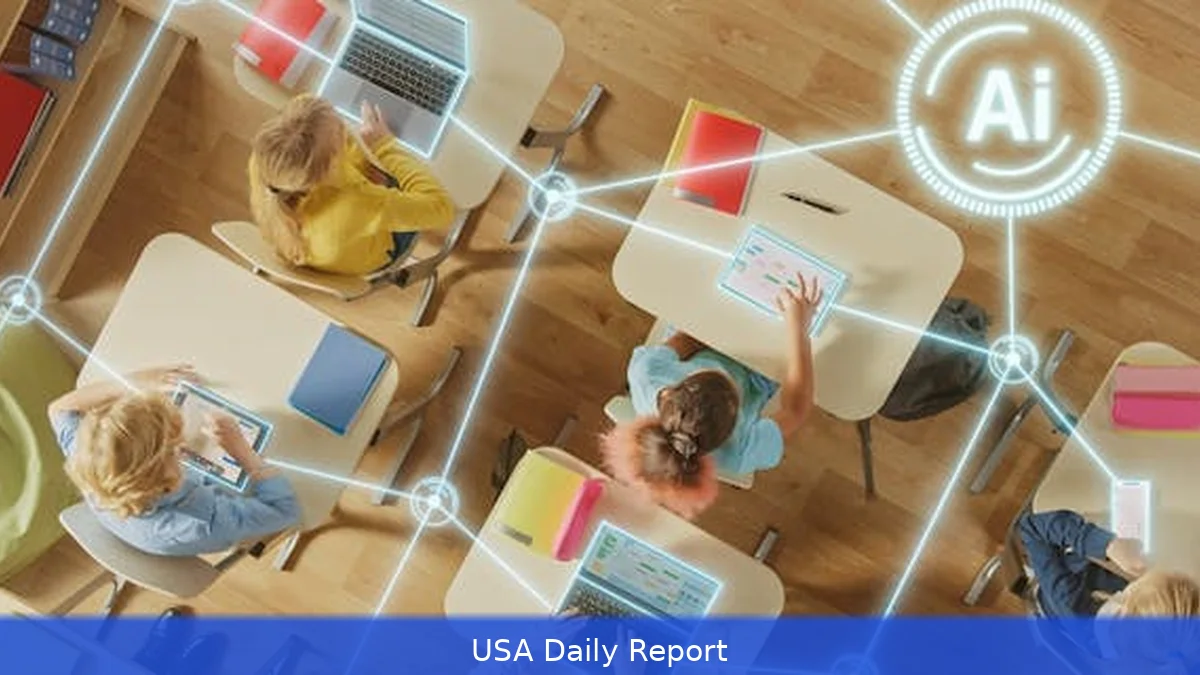
Many K–12 and college classrooms across the U.S. now experiment with AI tools, though how and how often they use them varies widely. Some districts embrace it for grading and lesson planning. Others lock devices down to protect student data. Here’s where schools stood in 2026: which tools they were testing, which rules shaped those choices, and the actual problems teachers and families were reporting.
Quick reference
- About 50 million K–12 students are in U.S. Public schools — many exposed to AI tools in some form.
- Popular classroom tools: ChatGPT (OpenAI), Google Gemini/Bard, Microsoft 365 Copilot, Khan Academy’s Khanmigo, Turnitin’s AI reports, and Gradescope-style autograders.
- Typical consumer prices (2026): ChatGPT Plus $20/month; Microsoft 365 Copilot for Business $30/user/month (education licensing varies); many K–12 contracts are negotiated district-by-district.
- Key laws: FERPA (1974), COPPA (1998), CIPA (2000); federal AI executive actions in late 2023 pushed agencies to draft guidance affecting school use.
Current state — where schools actually are
Adoption of AI in 2026 was uneven across districts and campuses. Some classrooms use AI every day. Others ban it on district-managed devices. Why? Funding, staff training and privacy rules vary widely.
Some college faculty used AI to draft course materials, speed research tasks, and create alternative text for images to improve accessibility. Professors use large language models for drafting syllabi, producing scaffolded assignment prompts, and creating alternative-text for images. At the K–12 level, teachers lean on AI for lesson ideas, grading rubrics, and individualized practice. Districts use automated item scoring for statewide assessments and chatbot-based help desks for parents.
Major vendors have baked education features into mainstream products. OpenAI’s ChatGPT and Google’s Gemini are common choices for classroom-level experimentation. Microsoft bundles Copilot features into Office apps, aimed at district IT and highered institutions that already pay for Microsoft 365.
Key developments that shaped 2024–2026
So much changed after 2023. The White House’s October 2023 executive actions on AI pushed federal agencies to create guidance.
Schools felt the aftershocks — procurement rules tightened, and privacy reviews became mandatory for third-party AI vendors working with student data.
Many districts tapped federal stimulus and leftover ESSER dollars to buy edtech, which sped up some deployments. That meant: smart purchasing at scale, but also rapid rollouts without full training. The result: some gains — faster grading, more tailored practice for students — and some headaches — overreliance on model outputs and inconsistent safeguards.
Vendors moved beyond pilots: for example, Turnitin added AI-detection and source-attribution features to its product set. Khan Academy’s Khanmigo moved from pilot to subscription options for districts wanting an AI tutoring layer. Gradescope-style autograders grew more accurate on objective items and simpler short answers; complex writing still needs human judgment.
Top picks and how districts use them
| Tool | Common school use (2026) | Price point (public info) |
|---|---|---|
| ChatGPT (OpenAI) | Lesson planning, formative feedback, student Q&A (supervised) | Free tier; ChatGPT Plus $20/month for consumers; institutional pricing varies |
| Google Gemini/Bard | Search-centric help, lesson materials, Google Workspace integration | Included with Google Workspace for Education editions; advanced features priced per contract |
| Microsoft 365 Copilot | AI writing help inside Word, assignment analytics, teacher productivity | Copilot pricing announced at $30/user/month for business plans; education contracts negotiated separately |
| Khanmigo (Khan Academy) | AI tutoring and guided practice aligned to standards | Pilot and paid tiers; district contracts commonly negotiated |
| Turnitin & Gradescope | Plagiarism and AI-origin reports; automated grading workflows | Institutional licensing; per-student or per-course pricing |
Industry impacts — classrooms, districts and suppliers
AI altered teachers’ daily routines, cutting time on some tasks while creating new oversight needs. Teachers save hours on routine tasks: grading multiple-choice and short responses, generating rubrics, and creating differentiated worksheets. Some districts report cutting planning time by a measurable margin — which freed teachers for targeted interventions. But not every school or teacher saw those benefits. Where training lagged, teachers got overwhelmed by prompts, model errors and bias.
Assessment companies now offer AI-assisted scoring that speeds large-scale tests. That reduces turnaround time for results — a boon for timely interventions. Yet concerns about model fairness and opaque scoring algorithms persist. Parents and advocacy groups press for transparency in how algorithms affect grades and placements.
That said, on procurement, districts lean toward bundled deals with big tech. That centralization gives discounts, but it also concentrates student data. Smaller edtechs still find demand for niche tutoring tools and content alignment services, but they must meet tougher privacy and security checklists.
Policies and legal guardrails
Federal privacy laws still matter: FERPA controls who can access students’ education records. COPPA controls collection of data from children under 13. CIPA influences filtering and acceptable-use policies for devices on federally funded networks. District legal teams now add AI-specific clauses: requirements for model explainability, differential privacy assurances, and clear data-retention rules.
So, schools ask vendors: who trains the model, where does student data go, can parents opt out? Contracts increasingly require vendors to delete identifiable student data after a set period, and to provide audits. Still, contract language varies, and enforcement is resource-intensive.
Privacy and safety — real concerns teachers and families raise
Privacy is the headline issue. AI systems can memorize and regurgitate student inputs. That raises obvious risks: exposure of personally identifiable information, sensitive health details, or disciplinary records. Schools worry about inadvertent data transfers to third-party cloud services and cross-context leakage when a model trained on educational inputs encounters public queries.
Bias and hallucinations are another worry. Models can invent citations, misinterpret student answers, or produce culturally blind feedback. For special education, adaptive tech powered by AI helps access — but wrong recommendations can harm placement decisions.
Safety practices that districts are using: limited data-sharing (tokenized or anonymized inputs), teacher-in-the-loop systems for any grade-impacting decisions, and routine audits of model outputs for bias and factual accuracy.
Expert views — what researchers and practitioners say
Researchers urge caution. They say AI can be a force-multiplier — if districts invest in professional development and infrastructure. Teachers want better, shorter training that focuses on classroom workflows. IT directors ask for clear federal standards so they can compare vendor claims.
Privacy advocates push for stronger state rules and more transparency in procurement. Some school boards want public dashboards showing how many students use which AI tools and what data is being stored. Others argue for moratoria on certain uses — like automated disciplinary recommendations — until models meet higher scrutiny.
Practical tips for districts and schools
- Create an AI use matrix: list permitted tools, allowed pupil inputs, and teacher review steps.
- Start small: pilot one use-case — like feedback on problem sets — and measure teacher time saved and student outcomes over a semester.
- Require vendors to sign data-protection addenda: state the retention period, deletion process, subprocessors and audit rights.
- Train teachers on prompt design and on spotting hallucinations. A 90-minute hands-on session beats a 200-page policy doc every time.
- Keep humans in charge of high-stakes decisions: grading, placement, discipline.
What’s next — where this heads in 2027 and beyond
Expect more regulation and clearer standards. The federal push that began in 2023 will ripple into tighter procurement rules and technical checklists for vendors. States will keep diverging — some will offer permissive guidance to accelerate innovation; others will curb school use until stronger protections exist.
On the tech side, models will get better at citing sources and tagging uncertainty — which helps classroom adoption. Pricing will stay mixed: consumer tiers will be cheap, but district-wide, privacy-focused deployments will cost more because they require contract guarantees and hosting options.
Most important: AI won't replace teachers. It will change their workflows. Schools that invest in training, clear policies and robust vendor checks will get real benefits. Those that rush into tools without guardrails will face data breaches, inequity and wasted money. The choice districts make now — careful, evidence-driven adoption versus bolt-on experiments — will shape how students experience learning for years to come.
Related Articles
- Best Smart Home Devices US 2026 — Alexa, Google Home and Apple Compared
- US Online Safety Bill 2026: What It Means for Social Media Users
- Best Laptops Under $500 US 2026 — For Work, Students and Home Use
AI in U.S. Schools in 2026 is practical and messy. It helps some students and teachers right now, and it creates new risks at the same time. The next year will be about rules, clearer contracts, and smarter classroom practice — not hype. Schools that pair small pilots with strong privacy and human oversight will come out ahead.


