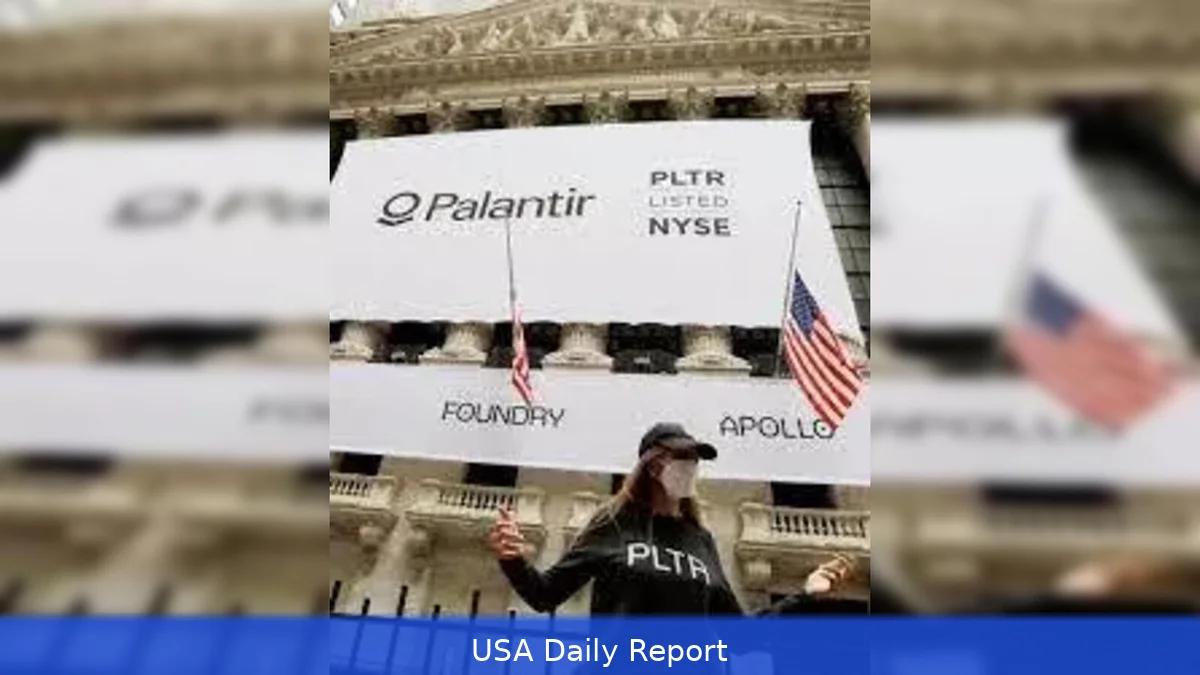
Shares of Palantir have surged nearly 1,900% since late 2022. That rally has pushed the company's market value above $300 billion.
How Palantir went from fringe to core
Palantir started as a niche data firm and, in just a few years, climbed into the headlines as a major market player — its market cap passed $300 billion. The shift centers on two products, Gotham and Foundry: Gotham serves government clients and Foundry sells subscriptions to businesses. Gotham is built to help government clients collect and analyze data and support mission planning, while Foundry is a subscription service that helps companies wrangle and act on their own data.
Look, the government business matters. Multiyear contracts with federal agencies have turned what used to be lumpy revenue into something far more predictable. That predictability is a key part of why investors have piled into the stock.
And Wall Street noticed the results. The stock's dramatic ascent since 2022 made Palantir a much bigger name in technology and pushed its market capitalization past the $300 billion mark, a scale few companies reach.
Products that create a moat
Palantir's pitch to clients is straightforward: link disparate data, analyze it with machine learning, and deliver actionable outputs.
Gotham focuses on government workflows; Foundry targets enterprise customers. Neither segment faces many direct rivals at scale.
That relative scarcity of competition helps explain why investors describe the company as having a sustainable moat. It also explains why some analysts and investors treat Palantir as an AI play as much as a government contractor.
Palantir wraps analytics and machine learning into tools agencies and companies use to standardize workflows, and customers can tweak outputs to meet specific missions or business requirements.
Still, a hard-to-replace product doesn't erase valuation math; investors pay a premium for that stickiness, and the numbers have to justify it. It just gives the business a better chance to keep selling over the long term. But investors still need to pay up for that privilege.
The valuation that turns heads
The debate centers on one metric: Palantir's trailing 12-month price-to-sales ratio, which sits at 102. The trailing-12-month price-to-sales ratio sits at an eye-popping 102. That's not a rounding error; it's the figure most market-watchers cite when they say the stock is priced for perfection.
Historically, market leaders in hot sectors have seen P/S ratios climb — and then fall when the hype fades. Prior episodes for other high-flying tech names saw peaks closer to the 30-to-40 range, not triple digits. If a broad re-rating hits AI or big-data names, Palantir would feel the heat sooner than most because investors already pay such a premium.
That risk doesn't mean Palantir would immediately lose sales. Multiyear government contracts and subscription revenue from Foundry could shelter top-line performance. But it would squeeze returns for anyone buying at today's prices.
How investors are thinking
Some investors point to multiyear government deals as the backbone of predictable cash flow, while others call the current valuation dangerously optimistic. Some see multiyear government deals as the bedrock for sustained cash flow. Others see the company's valuation as leaving almost no margin for error. The debate shows up in trading — and in the volatility of the share price.
Right now, those who favor Palantir point to the uniqueness of its offerings and the stickiness of government clients. Those who worry point to historical patterns: when a tech theme overheats, the market can reprice even the firms with real products.
Sure, Palantir could keep growing revenue quickly. Hypothetical growth of 30% a year for several years would help but probably wouldn't justify a P/S of 102 unless profit margins steeply improved. That's the math investors are running through.
Where Palantir sits in the market
Only a handful of public companies have ever cleared a $1 trillion valuation. Most of those businesses were massive, widely held, and deeply profitable. Palantir, despite its big gains, remains in a different category: fast-growing but still working to convert a user base and government contracts into consistent margins that match the highest-valued tech giants.
The company's rapid move from a smaller, fringe tech name to a major market cap demonstrates how much investor sentiment around AI and data analytics has shifted. And it shows how government business — often viewed as conservative and boring — can be a springboard for a firm's stock when investors chase growth stories.
That split view — solid government revenue versus a very high valuation — is why investors remain sharply divided on Palantir. You can argue both sides without sounding unreasonable. The company has real tech, real clients, and recurring revenue. It also trades at a multiple that leaves little room for missteps.
Risks that matter
Regulatory and contract risks are never far from the surface in firms that work with the government. Changes in procurement rules, shifts in agency budgets, or high-profile project setbacks can all alter how Wall Street values a company that relies on public-sector deals.
Operationally, Palantir still needs to broaden and deepen commercial sales through Foundry. That business is supposed to diversify the revenue mix and reduce reliance on federal contracts. But enterprise sales cycles can be long and outcomes uncertain. If commercial uptake slows, the company's overall growth story dims.
Bottom line: investors balance steady federal revenue against the awkward fact that a P/S of 102 assumes continued strong government and commercial growth.
What this means for markets
High-growth tech names often set the tone for sector moves. Palantir's surge and current valuation level add to the larger conversation about how much investors should pay for fast-growing, AI-enabled software companies.
If Palantir keeps delivering revenue growth and gradually improving margins, the valuation could look less extreme over time. If it slips, the stock could correct sharply.
So, the company's position is a test case. It shows how government contracting, AI hype, and subscription software economics can combine to create both oversized gains and oversized risks.
Investors who want exposure to AI through names like Palantir are effectively betting that the company will expand Foundry, keep federal clients happy, and translate that into stronger profitability. That's a tall order. But then again, the market reward has already been tall.
Related Articles
- CoreWeave Soars as Markets Flip: Ceasefire Rally Meets a Choppy Finish
- Two Billion Gmail Users Face a Major Choice as Google Turns on Gemini in Mail
- Software Stocks Are Getting Pulverized — Bitcoin’s Bounce Hints a Bottom Might Be Near
Palantir's trailing-12-month price-to-sales ratio stood at 102.


