
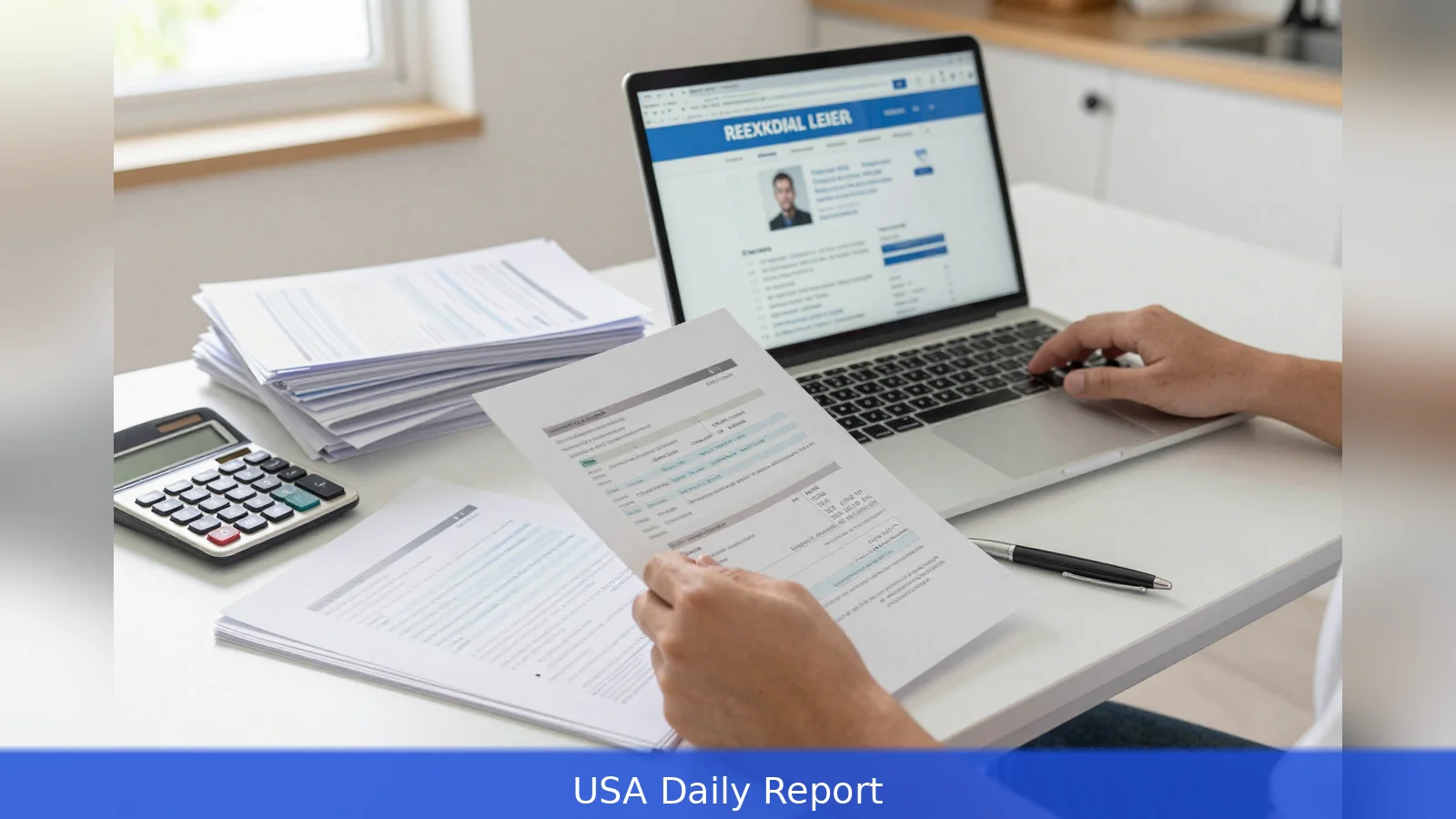
The kitchen table is strewn with bills and a credit report printout as a first-time buyer with a low score scrolls lender guides on a laptop, deciding whether to apply now or rebuild credit first. Order free credit reports at AnnualCreditReport.com and dispute any errors before you talk to lenders, because corrected files can change which loan programs you qualify for. Government-backed options matter: FHA loans can accept a FICO as low as 500 with a 10 percent down payment or 580 with a 3.5 percent down payment, while USDA and VA programs and some lenders apply different thresholds. Start by getting the corrected reports, then use the seven steps below to pick a program, shore up compensating factors, and shop lenders so you don't pay more than necessary.
At that kitchen table, the decision breaks into seven practical steps a buyer can follow without guesswork.
1. Check and correct your credit
First, get the facts. Order free copies of your credit reports from AnnualCreditReport.com and review the files from Equifax, Experian and TransUnion. Lenders pull those same reports, so an inaccuracy on one bureau can change which programs and rates you see. Consumer guides repeatedly recommend prioritizing the removal of reporting errors and paid collections because improved documentation can reduce lender concern about past delinquencies.
Second, dispute mistakes immediately. If a collection is shown as unpaid but you have proof of payment, submit that documentation during the dispute. If a delinquency is listed for the wrong account or the wrong dates, push for correction. The corrected file is the version underwritten by lenders, and a cleaned report can move you across program thresholds without other changes.
Worked example: a buyer finds a misreported late payment from three years ago. They gather bank statements proving payment and a creditor letter, file disputes with the bureau reporting the error, and include the corrected documentation with future preapproval packets so underwriters see the fixed file up front.
2. Know which programs accept lower scores
Not every mortgage product treats a low score the same.
Government-backed loans are the clearest pathways for buyers with challenged credit.
Consumer guidance and mortgage guides note FHA can allow a FICO score as low as 500 if the borrower makes a 10 percent down payment, and a 580 score with a 3.5 percent down payment. That 580/3.5 percent rule is the commonly cited floor for FHA in consumer guides, while the 500/10 percent path exists as an alternative for buyers who can produce the larger down payment.
USDA rural loans and VA loans are also frequently cited as more flexible. USDA loans typically request scores near 640, though requirements vary by lender. VA loans do not have a single official minimum; lender preferences vary.
Conventional mortgages from private lenders are usually less forgiving. The Mortgage Reports and other consumer mortgage guides commonly note lenders historically favored applicants with scores near 620, though exact thresholds vary by lender and product.
The practical takeaway: don't rely on a single published cutoff. If your score sits near any of these thresholds, talk to several lenders to confirm their overlays and actual minimums.
3. Build compensating factors lenders value
Lenders look at the full file, not just the score. Expect underwriters to weigh debt-to-income ratio, documented income stability, cash reserves, the size of your down payment and the overall credit history.

A larger down payment consistently reduces lender risk and can offset a lower score. Guides emphasize that co-signers, documented gift funds for the down payment, or significant cash reserves all improve approval odds. Be aware that approvals at lower scores typically come with higher interest rates and required mortgage insurance or additional fees. In some cases the lender will require manual underwriting if an automated system flags the file.
Practical moves that matter and cost nothing except discipline: pay down high-interest revolving balances to improve your debt-to-income ratio, bring recent delinquencies current, and try to negotiate removal of paid collections where possible. Each item that trims monthly obligations or raises your documented reserves reduces the lending risk the underwriter sees.
Worked example: a buyer with a 560 FICO reduces credit-card balances to improve their DTI, documents three months of reserves in a bank statement, and secures a lender-friendly letter from their employer to show income stability. Those compensating factors can move a lender from decline to approved, albeit at a higher rate and with mortgage insurance.
4. Gather the paperwork specific programs require
Paperwork speeds approval and limits surprises in underwriting. Before you apply, assemble two years of tax returns if self-employed, recent pay stubs and W-2s, bank statements showing reserves and the down payment source, and documentation for any disputed or cured derogatory items. If you plan to use FHA, VA, or USDA financing, confirm program-specific paperwork requirements early.
FHA checklists and seller or agent guidance are commonly referenced in consumer guides. VA loan approvals require a certificate-of-eligibility for veterans and service members. State and local first-time buyer down payment assistance programs are worth exploring because multiple guides report these programs often accept applicants with weaker credit or provide education that lenders value. Gift funds for down payments are common under these programs, but you will need documentation showing the gift source and lack of repayment obligation.
Worked example: a buyer using FHA financing presents two years of tax returns, a signed gift letter for part of the down payment, and bank statements showing three months of reserves. The lender can use this packet to satisfy both automated and manual underwriting checks more quickly than a partial application.
5. Get preapproved and shop multiple lenders
Preapproval is the testing ground for your file. It gives a snapshot of borrowing capacity and signals to sellers you are serious. Consumer guides recommend applying for preapproval with several lenders, including mortgage brokers and direct lenders that advertise programs for lower-credit borrowers.
Important: lenders apply overlays. One lender may accept a 580 score for an FHA product while another demands 620 for the same product. Compare not only headline interest rates but also upfront fees, mortgage insurance terms, underwriting turn times, and whether the lender allows manual underwriting. Mortgage brokers can expose you to multiple retail and wholesale options, but make sure you understand who will hold the loan and what fees each path carries.
Run scenarios when you shop. Ask each lender to provide rate quotes under three conditions: your current score and assets, your file after correcting any errors, and your file if you raise the down payment by a specified amount. That way you see how much each compensating factor lowers cost.
6. Consider short-term credit repair and co-signer tradeoffs
If time is on your side, targeted moves can produce meaningful differences in the interest rate you qualify for. The standard plays are the same: bring current any recent delinquencies, pay down high-interest revolving balances, and negotiate removal of paid collections. These moves improve both score and debt-to-income ratio, and lenders care about both.
If you must buy immediately, some borrowers use a creditworthy co-signer to qualify for better terms. That option improves odds but shifts liability to the co-signer; lenders handle co-signer obligations differently and the co-signer should understand the risk. Another immediate alternative is increasing the down payment amount, because a larger down payment reduces lender risk and can offset a lower FICO.
7. Prepare for underwriting and closing realities
Lower-score approvals frequently carry conditions. Expect documented source-of-funds demands for the down payment, longer seasoning requirements after bankruptcy or foreclosure, and proof of reserves. Mortgage insurance is common: FHA loans carry mortgage insurance, and many conventional loans with low down payments require private mortgage insurance until the loan-to-value meets the threshold for cancellation.
Closing costs and mortgage insurance raise monthly payments and total borrowing costs. Several guides recommend running best-case and conservative rate scenarios before making an offer so you understand the full monthly payment under higher insurance and rate assumptions. If you have recent negative events, research program-specific seasoning rules for bankruptcy, short sales and foreclosures because those timelines vary by loan type and lender.
Worked example: a buyer approved with compensating factors discovers underwriting requires additional bank statements to verify reserves and a 24-month seasoning on a discharged Chapter 7. The buyer delays closing until the paperwork is assembled rather than risk a last-minute denial at underwriting.
Across these steps the common instruction repeats: verify the lender-specific minimums. Where sources disagree on eligibility thresholds the difference isn't a mystery but a practical reality. The Mortgage Reports lists typical cutoffs as FHA 500 with 10 percent down or 580 with 3.5 percent, USDA 640, and conventional 620. Other consumer guides generally align on the FHA pathways.
First, order your reports at AnnualCreditReport.com. Second, dispute inaccuracies and collect corrected files. Third, pick the program types that match your score and your down payment capacity. Fourth, assemble full documentation for underwriting. Fifth, secure preapproval from multiple lenders and compare full costs. Sixth, decide whether to pause for targeted repair or move forward with compensating factors. Seventh, be ready for mortgage insurance and underwriting conditions at closing.
In short: First, get and correct the credit reports. Second, confirm program thresholds with multiple lenders. Third, gather paperwork and show reserves. Fourth, expect higher costs but shop to limit them.
Related Articles
- Open Source vs Proprietary AI: A 7x Cost Case and the Trade-Offs
- Apply for Dallas Housing Authority: 8 Steps
- Send Tuition from Nigeria to US: 10-Step 2026 Guide
The single concrete step to start with is simple and specific: request your free credit reports at AnnualCreditReport.com, correct any errors, and gather the corrected files before applying for preapproval. That action alone often changes which loan programs you can access and cuts the guesswork out of choosing between immediate home search and tactical credit repair.
This article was created with AI assistance.


