Twelve thousand years ago, during the last Ice Age, Native Americans were tossing dice. Not the six-sided cubes we're used to, but simple two-sided pieces designed to produce random outcomes. This find shakes up what we thought about where probability and games of chance first came from.
Native Americans and the Birth of Dice
Dice have long been linked to Old World civilizations, often seen as one of their original inventions. But new research led by Robert Madden, a graduate student at Colorado State University, flips that narrative. His study, published in the journal American Antiquity, points to North America as the true birthplace of dice—dating back over 12,000 years.
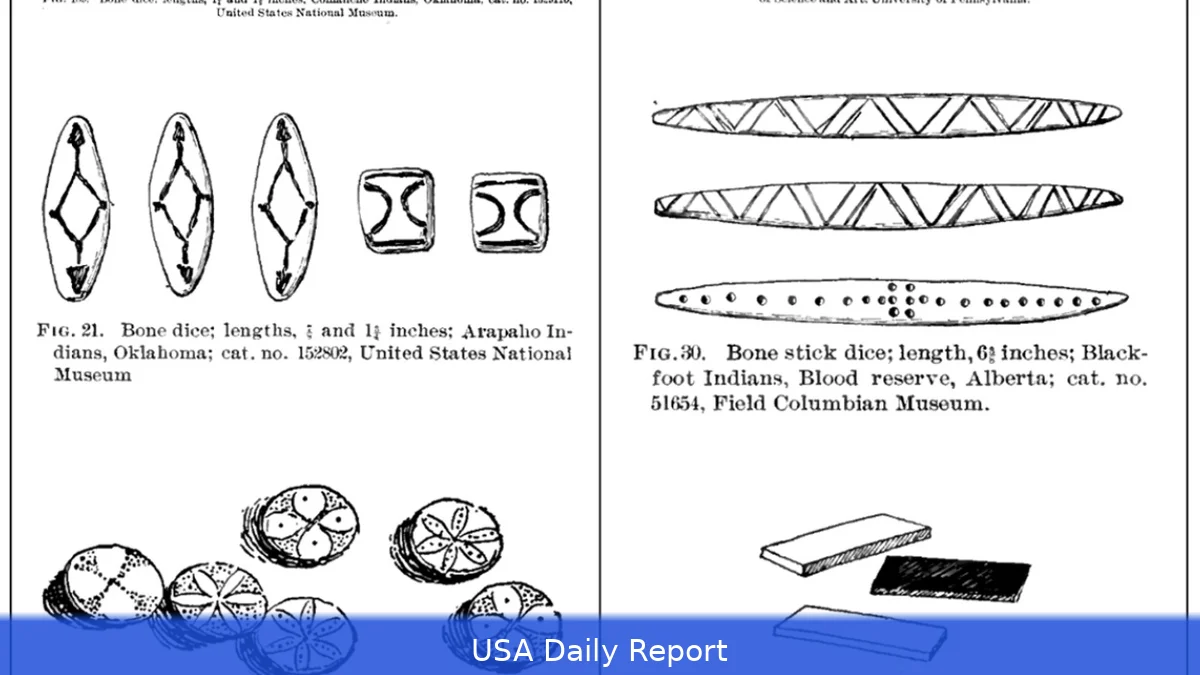
Madden examined more than 600 sets of game pieces unearthed from archaeological sites across the Western United States, spanning from Wyoming to New Mexico. These artifacts, carved from bone or wood, are far simpler than modern dice, often shaped as flat or slightly curved discs with distinct markings on two sides. These "binary lots," as anthropologists call them, functioned much like a coin toss, offering a 50/50 chance of landing on one side or the other.
What These Early Dice Tell Us
Not only do these findings push back when dice were first used by thousands of years, but they also tell us more about how early humans thought. Making objects meant to create random results shows they understood chance and probability. Madden argues that these early Native American groups weren’t just surviving harsh Ice Age conditions; they were experimenting with systems of randomness and structured play.
"These aren't casual byproducts of bone working," Madden said. "They were made to generate random outcomes." That kind of purposeful creation implies a sophisticated mental leap. Early humans were not only observers but also active participants in exploring randomness and uncertainty.
Games of Chance in Prehistory
The use of these dice wasn’t limited to a single moment in time. Archaeological evidence shows a continuous tradition of gambling and games of chance lasting at least 12,000 years.
The Folsom period hunter-gatherers, known for their finely crafted stone tools, have left behind these game pieces, suggesting that gambling was a cultural fixture even then.
Later periods show similar dice-like objects, indicating that these games were passed down through generations. Madden cross-referenced his findings with anthropologist Stewart Culin’s century-old compendium, "Games of the North American Indians," which documents the use of binary lots across nearly every Native American tribe.
That ethnographic analogy helped confirm these ancient objects' function as dice.
Rethinking Probability’s Origins
Historians and mathematicians have often credited Old World societies with initiating the concepts of probability and randomness. The earliest known dice from Europe and Asia date back roughly 6,000 years. But these North American artifacts outdate those by about 6,000 years, rewriting the timeline.
Understanding probability is a major step in human intellectual history. It lays the groundwork for developments in mathematics, science, and decision-making. The fact that early Native Americans were already engaging with these ideas challenges the conventional view that such cognitive advances were isolated to ancient Eurasian cultures.
What’s more, the simplicity of these dice—often just two sides—reflects an elegant approach to chance. Instead of complex polyhedral dice, these binary lots offered a straightforward way to generate randomness in games or decisions.
"They’re simple, elegant tools," Madden said. "But they’re also unmistakably purposeful."
This discovery gives us fresh ways to look at early human culture and thinking. It proves early Native Americans weren’t just surviving—they were shaping ideas that still matter today. How these early experiments with randomness influenced later societies remains an intriguing question.


