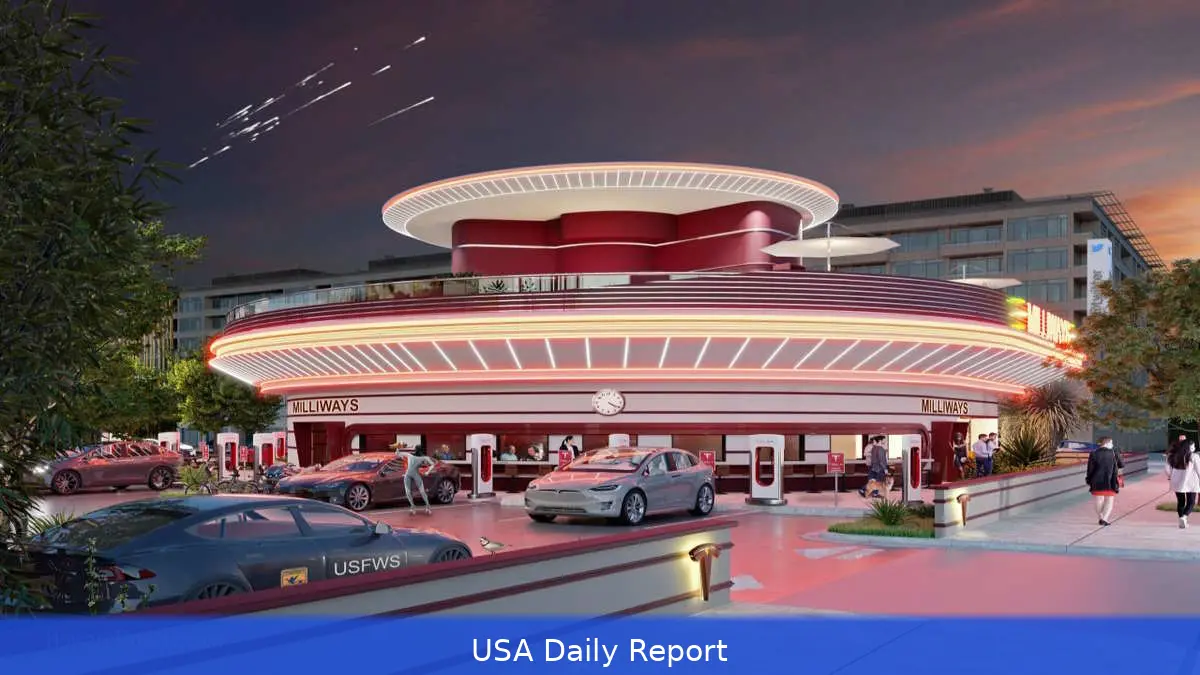
When Tesla launched its Hollywood diner in July 2025, it promised more than just a spot to grab a meal. The idea was to turn EV charging into a destination experience. But six months in, the diner’s fate looks mixed—busy chargers but a largely empty dining room.
Charging Station Triumph, Restaurant Trial
The Tesla Diner opened alongside 80 Superchargers, designed to offer a quick charge and a bite. On recent visits, more than 90% of those chargers were occupied, showing strong demand from Tesla drivers. The diner itself, however, rarely draws a crowd comparable to its charging bays. Most visitors stay in their cars, charging quickly and leaving, sometimes grabbing a snack or coffee delivered right to their vehicle.
So, the diner isn’t really a traditional eatery. It’s more like a pit stop with food options. And this plays into its identity as a charging hub rather than a culinary hotspot. Hollywood’s food scene is fierce, with classics like In-N-Out Burger and Pink’s Hot Dogs just blocks away. Competing against eateries with decades of local loyalty makes it tough for the Tesla Diner to stand out on food alone.
From Viral Launch to Quiet Reality
At launch, the diner had the buzz of a blockbuster event. Long lines of Tesla owners circled the block, and social media was flooded with photos and hype. It was touted as a retro-futuristic blend of Americana and EV culture, with Elon Musk’s flair adding spectacle. But that excitement faded fast. By early 2026, visitors reported mostly empty parking lots and staff outnumbering customers.
The diner’s menu has also been trimmed. Celebrity chef Eric Greenspan, who helped design the food offerings, left in late 2025. Without his influence, the diner lost some of its culinary edge. What remains is a clean but pricey eatery, more like a Tesla showroom than a dining destination. Critics have pointed out slow service and high prices, with some describing the robotic service as gimmicky rather than futuristic.
Branding Over Basics
The Tesla Diner was always more of a branding exercise than a restaurant venture. That’s not unusual for a company like Tesla, which thrives on spectacle and image. But the diner’s challenge is basic: it needs to appeal beyond Tesla drivers and Musk fans. Right now, it doesn’t. The food doesn’t match the price, and the experience doesn’t justify the hype.
Plus, limited parking for non-Tesla owners restricts potential customers.
Adding to the diner’s troubles is the growing negativity around Elon Musk. Once celebrated as a visionary, he has become a polarizing figure. Public skepticism and criticism of Tesla’s safety record also bleed into perceptions of the diner. The combination of fading novelty, affordability issues, and Musk’s controversial image has left the Tesla Diner struggling to find its place.
What It Means for Tesla’s Future
Tesla is facing headwinds beyond this diner. The company recently lost its spot as the world’s leading EV seller to BYD, and U.S. Sales hit a four-year low in November 2025. This diner’s decline might be a small sign of bigger challenges. If Tesla wants to build lifestyle brands around its cars, it will need to nail both the product and the experience.
For now, the diner works as a Supercharger station with some food options, but it’s far from the vibrant, must-visit destination it was meant to be. The question is whether Tesla can innovate its way back or whether this experiment will become just a footnote in the company’s story.
The Tesla Diner’s story is far from over, but its current state makes people wonder about blending tech branding with real-world experiences. Will Tesla learn from this and improve? Only time will tell.


