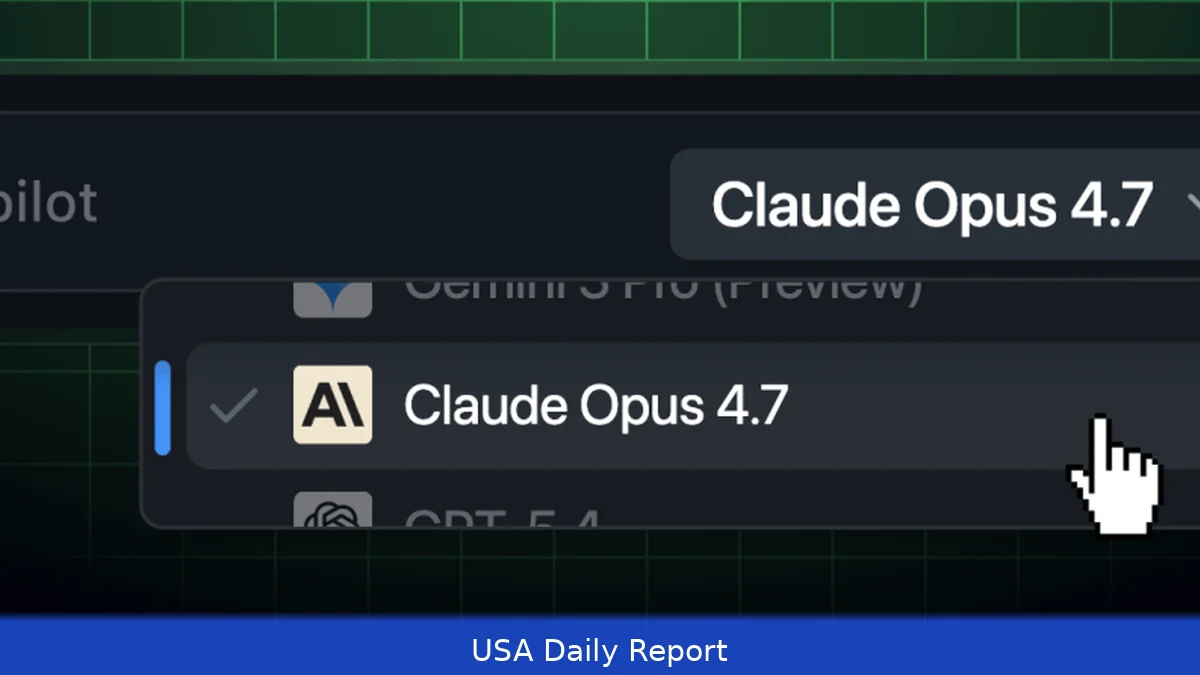
Claude Opus 4.7 is available now. Anthropic calls Opus 4.7 their most capable model available to the public.
Where to find Opus 4.7
Anthropic has rolled out Claude Opus 4.7 across its consumer and developer channels. The model is live on Claude AI and via the Claude API. Partners such as Microsoft Foundry, Amazon Bedrock and Google Cloud Vertex AI are offering access as well, expanding where teams can plug Opus 4.7 into apps and services.
Access options include the same pricing tier that Anthropic used for Opus 4.6, though developers should be ready for a change in token usage patterns. Anthropic published a migration guide for teams moving from Opus 4.6 to 4.7 that explains differences in tokenizer behavior and output length.
Measurable gains on coding and reasoning
Benchmarks show Opus 4.7 outperforms Opus 4.6 in coding and document reasoning. On SWE-bench Multilingual, a test of coding skills, Opus 4.7 scored 80.5% compared with 4.6’s 77.8%. On document-focused OfficeQA Pro, Opus 4.7 posted an 80.6% score versus 4.6’s 57.1%.
Decrypt’s analysis of third-party evaluations also reported strong performance against large-model rivals. On GDPVal-AA, which measures economically valuable knowledge work across finance and legal tasks, Opus 4.7 reached 1,753 Elo.
That score outpaced the 1,674 Elo recorded for GPT-5.4 on the same test.
Long-context and sustained-task benchmarks saw notable improvement. A long-running agentic task on Vending-Bench 2, which simulates managing a small autonomous business over time, returned a simulated balance of $10,937 for Opus 4.7 against $8,018 for Opus 4.6. That gap suggests Opus 4.7 keeps coherent plans and accounting across extended runs better than its predecessor.
How Anthropic positions Opus 4.7 versus Mythos
Anthropic is clear that Opus 4.7 isn't the company’s most powerful model overall. Claude Mythos, which Anthropic previewed earlier in April, remains more capable but is restricted to a limited set of partners and internal research. Opus 4.7, by contrast, is the firm’s most advanced model that it's comfortable offering widely.
The company says the Mythos line tested higher on many benchmarks but was deemed too risky for broad public release. Teams that need the highest ceiling on raw capability will still be using Mythos where they have access. For everyone else, Anthropic frames Opus 4.7 as a step up in reliability and problem-solving without opening full access to Mythos-level power.
Developer reaction and the Opus 4.6 ‘shrinkflation’ debate
Community reaction played a role in setting expectations for 4.7. In the weeks before the release, some developers on GitHub, Reddit and X documented what they described as a decline in Opus 4.6 behavior — a perceived softening of capability they dubbed “shrinkflation.”
Users who had complained about 4.6’s drift reacted quickly when Anthropic announced 4.7. Some called the new release an apparent restoration of earlier 4.6 behavior. A prominent developer posting under the handle Dev Ed (@developedbyed) captured that sentiment on X when they contrasted recent versions with the earlier Opus behaviour that many had preferred.
Anthropic denies quietly downgrading model weights to save compute. Instead, the company says Opus 4.7 reflects targeted development to improve multi-step reasoning, coding quality and visual analysis while tightening safety controls.
Token counts, tokenizer changes and cost implications
Teams planning to migrate from Opus 4.6 to 4.7 should expect two practical changes. First, Opus 4.7 uses an updated tokenizer that processes text differently. Depending on content, the tokenizer can consume roughly 1.0x to 1.35x more tokens. Second, Opus 4.7 tends to "think" more at higher effort levels, producing longer internal chain-of-thought and often more output tokens as it works through complex tasks.
Those changes matter because Anthropic charges by input and output tokens. Even where headline model pricing matches 4.6, higher token usage can raise costs on long jobs and agentic workflows. Anthropic’s migration guide and the company’s documentation both include strategies for optimizing token usage and tailoring prompts to limit unnecessary verbosity.
Safety controls and cybersecurity limits
Anthropic added automated safeguards in Opus 4.7 to block risky cybersecurity prompts. The company says it did deliberate work during training to reduce the model’s ability to assist with illicit hacking and other harmful tasks. Those limits are enforced by runtime checks that detect prohibited prompts and refuse or redirect them.
Security researchers and legitimate cybersecurity teams that need reduced restrictions can apply to Anthropic’s Cyber Verification Program. The program is described as a controlled route for vetted professionals to access higher-risk capabilities for testing and defensive work under supervised conditions.
New tooling for code review and developer workflows
Anthropic also rolled out new tools for software teams with the model. Claude Code, the company’s code-oriented interface, gained a new /ultrareview command that creates a dedicated review session. The ultrareview scans changes, flags bugs and highlights design issues. During the preview phase, Claude Pro and Claude Max Code users receive three free ultrareviews.
Anthropic says Opus 4.7 handles complex, long-running coding jobs with more rigor and consistency than prior Opus models. Developers testing the model reported that it pays closer attention to multi-step instructions and proposes verification steps before returning results — helpful behaviors when handing off large engineering tasks to an LLM agent.
Where Opus 4.7 fits for teams
Opus 4.7 aims at organizations that need strong coding, document analysis and visual reasoning without the risk profile of a full Mythos deployment. It’s positioned for teams that want agentic capabilities — the ability to run multi-step autonomous tasks — but need built-in safety fences and predictable cost behavior.
For researchers and partners who can manage higher risk, Mythos remains the more capable option. For most commercial customers and public developers, Opus 4.7 is the new baseline: smarter, more consistent and broadly available.
Related Articles
- Claude Opus 4.7 Launches for Developers
- VCs Pitch Anthropic at $800B Valuation
- An AI opened a real shop in San Francisco with $100,000 — and bungled day-one staffing
Anthropic set Opus 4.7’s price at $15 per million input tokens and $75 per million output tokens.


